A Ukrainian MSLR BM-21 “Grad” fires towards Russian positions, near Bakhmut at the frontline in Donetsk region, Ukraine, Wednesday, June 21, 2023. (Photo by Iryna Rybakova via AP Photo)
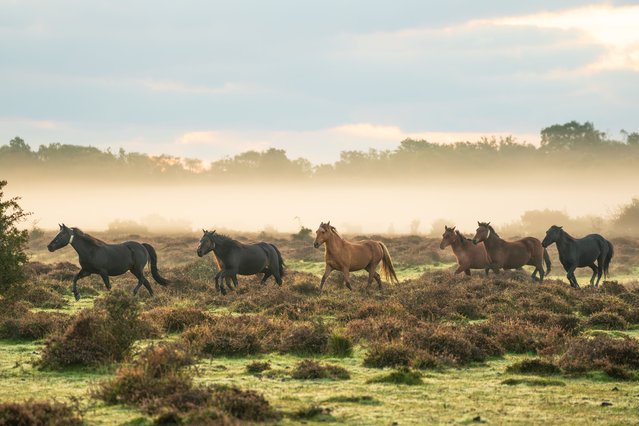
A misty start to the day in the New Forest with ponies running near Ringwood in Hampshire, UK on Saturday, October 6, 2024. (Photo by Steve Hogan/Picture Exclusive)
An aerial image shows hot air balloons, mostly made from recycled paper and tied with ropes, floating in the air during the annual hot air balloon festival, held since 1950 to celebrate Eid al-Fitr, the Islamic holiday marking the end of Ramadan, in Wonosobo, Central Java, on April 2, 2025. (Photo by Devi Rahman/AFP Photo)
Young Christian Lebanese women, who are members of Kataeb Phalangist party, show their skill in handling arms while they train in a village between Christian-controlled eastern port of Jounieh and the Christian village of Zahle in the west Lebanon on September 9, 1976. The Lebanese civil war erupted in April 1975. (Photo by Erich Stering/AFP Photo)
“I have seen batches of banknotes worth more than $2.6 million, but beyond all doubt, gold bars look much more attractive!”. – Shamil Zhumatov. Photo: Cooling-down gold ingot. March 14, 2013; Tien Shan mountains, Kyrgyzstan. (Photo by Shamil Zhumatov/Reuters)
“I was born in 1977 in Warsaw, Poland. I had graduated from the High School of Art in Warsaw. My journey into the world of photography began in the early 90's, but at that time my biggest passion was painting. Painting helped me develop vision that was hard to create. Unfortunately I had to leave the paintbrush and canvas. A few years ago, I opened “the door” to my own world with help of a different key”... – Michal Karcz. Photo: “Last Outpost”. (Photo by Michal Karcz)
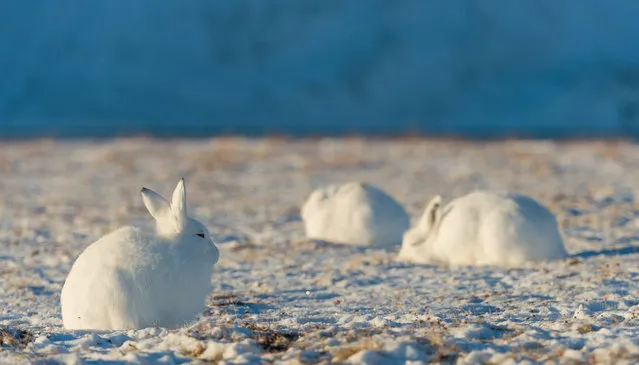
The arctic hare, or polar rabbit, is a species of hare which is adapted largely to polar and mountainous habitats. The arctic hare survives with a thick coat of fur and usually digs holes in the ground or under snow to keep warm and sleep. Arctic hares look like rabbits but have shorter ears, are taller when standing, and, unlike rabbits, can thrive in cold climates. They can travel together with many other hares, sometimes huddling with dozens or more, but are usually found alone, taking, in some cases, more than one partner. The arctic hare can run up to 60 kilometres per hour (40 mph). Its predators include the arctic wolf, arctic fox, and ermine.