Loading...
Done
Tibetan Mastiff

“The Tibetan Mastiff also known as Do-khyi (variously translated as “home guard”, “door guard”, “dog which may be tied”, “dog which may be kept”), reflects its use as a guardian of herds, flocks, tents, villages, monasteries, and palaces, much as the old English ban-dog (also meaning tied dog) was a dog tied outside the home as a guardian. However, in nomad camps and in villages, the Do-khyi is traditionally allowed to run loose at night and woe be unto the stranger who walks abroad after dark”. – Wikipedia

Photo: A man displays a Tibetan Mastiff he raised during the Tibetan Mastiff exposition on April 7, 2007 in Langfang of Hebei Province, China. (Photo by China Photos/Getty Images)
Details
05 Oct 2011 14:27:00
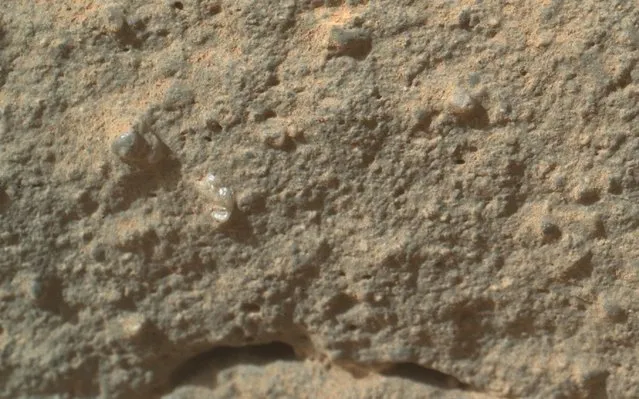
Scientists say that a “Martian flower”, seen here in an image from the Curiosity rover's Mars Hand Lens Imager, is a 2-millimeter-wide grain or pebble that's embedded in the surrounding rock. Another, darker-colored mineral grain can be seen above and to the left. (Photo by NASA)

“The scientists behind NASA's $2.5 billion Curiosity rover mission on Mars on Tuesday explained the nature of a tiny, gleaming "flower" embedded in Red Planet rock, and revealed where they'll be using the SUV-sized robot's drill for the first time”. – Alan Boyle via NBCNews.com

Photo: Scientists say that a “Martian flower”, seen here in an image from the Curiosity rover's Mars Hand Lens Imager, is a 2-millimeter-wide grain or pebble that's embedded in the surrounding rock. Another, darker-colored mineral grain can be seen above and to the left. (Photo by NASA)
Details
16 Jan 2013 11:12:00
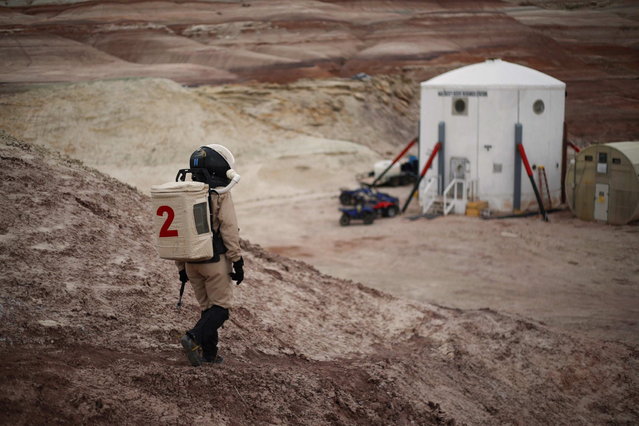
Csilla Orgel, a geologist of Crew 125 EuroMoonMars B mission, makes her way back to the Mars Desert Research Station (MDRS) in the Utah desert March 3, 2013. (Photo by Jim Urquhart/Reuters)

NASA says it could be another 20 years before humans touch down on Mars, but in a sense, the Mars Society has been exploring the red planet for more than a decade – in Utah. Photo: Csilla Orgel, a geologist of Crew 125 EuroMoonMars B mission, makes her way back to the Mars Desert Research Station (MDRS) in the Utah desert March 3, 2013. The MDRS aims to investigate the feasibility of a human exploration of Mars and uses the Utah desert's Mars-like terrain to simulate working conditions on the red planet. Scientists, students and enthusiasts work together developing field tactics and studying the terrain. All outdoor exploration is done wearing simulated spacesuits and carrying air supply packs and crews live together in a small communication base with limited amounts of electricity, food, oxygen and water. Everything needed to survive must be produced, fixed and replaced on site. (Photo by Jim Urquhart/Reuters)
Details
14 Mar 2013 12:11:00
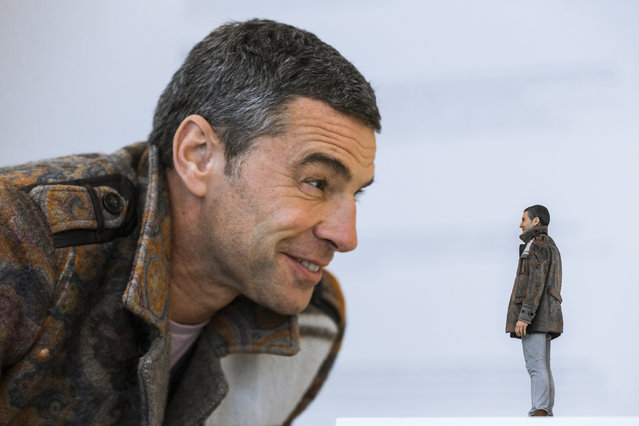
Customer Andreas Kroker looks at a 3D-printed figure of himself at the Twinkind 3D printing studio in Berlin, December 13, 2013. (Photo by Thomas Peter/Reuters)

Customer Andreas Kroker looks at a 3D-printed figure of himself at the Twinkind 3D printing studio in Berlin, December 13, 2013. A 3D-printed likeness is produced by taking a 360 degree photographic scan of a person, which is then rendered into a 3D digital model and retouched to meet the requirements for printing. The printing machine uses this digital model to produce a high-resolution solid figure. Twinkind co-founder Timo Schaedel said, people often come to the session well-groomed, with fresh hair-cuts and their best clothes, “just as they used to do in the past, when they had their portrait taken in a photo studio”. (Photo by Thomas Peter/Reuters)
Details
17 Jul 2014 11:22:00
Black women in Brazil sit at the intersection of racism and misogyny, and have in recent years been at the forefront of a movement that challenges issues ranging from sexual and domestic violence to police brutality and stereotyping. Kolor Collective considers itself to be a part of this movement and questions expectations imposed on black women with satirical and subversive images, as seen here. (Photo by Kolor Art Collective/The Guardian)

Photographer Pol Kurucz’s vivid collection of photos explores issues faced by black Brazilian women, from political misrepresentation to unrealistic beauty standards. Kolor Collective is a Rio de Janeiro-based creative group that challenges the struggle faced by black women in Brazil through theatrical and provocative art. It was founded in 2015 by Franco-Hungarian photographer Pol Kurucz, who often touches on his own experiences of discrimination to call out sensitive social problems. (Photo by Kolor Art Collective/The Guardian)
Details
28 Dec 2016 07:24:00
A humanoid robot named “Yangyang” shows a facial expression during its demonstration at the Global Mobile Internet Conference (GMIC) 2015 in Beijing, China, April 29, 2015. (Photo by Kim Kyung-Hoon/Reuters)

A humanoid robot named “Yangyang” shows a facial expression during its demonstration at the Global Mobile Internet Conference (GMIC) 2015 in Beijing, China, April 29, 20155. The android was produced jointly by China's Shanghai Yangyang Intellegent Robot Science Service center and Japanese professor Hiroshi Ishiguro, with the aim of popularising robotics among the young. (Photo by Kim Kyung-Hoon/Reuters)
Details
30 Apr 2015 10:50:00
A protester sprays paint on the window of a bank during a rally against Expo 2015 in Milan, Italy, April 30, 2015. The Milan Expo will open in the city on May 1. Officials are counting on some 20 million visitors to the six month-long exhibition of products and technologies from around the world. (Photo by Stefano Rellandini/Reuters)

A protester sprays paint on the window of a bank during a rally against Expo 2015 in Milan, Italy, April 30, 2015. The Milan Expo will open in the city on May 1. Officials are counting on some 20 million visitors to the six month-long exhibition of products and technologies from around the world. (Photo by Stefano Rellandini/Reuters)
Details
01 May 2015 13:05:00
An altar is pictured after it was decorated by the Antar family with some 3,000 traditional cheese and corn buns called “chipas”, in celebration of Kurusu Ara in Asuncion May 3, 2015. (Photo by Jorge Adorno/Reuters)

An altar is pictured after it was decorated by the Antar family with some 3,000 traditional cheese and corn buns called “chipas”, in celebration of Kurusu Ara in Asuncion May 3, 2015. Kurusu Ara, the Day of the Cross, is a Catholic festival that is combined with local Gurani culture and falls annually on May 3. Paraguayans typically celebrate the festival with chipas, used to decorate religious shrines and altars. The chipas are later distributed to attendees. The buns at the top are arranged to read, “March 3 live”. (Photo by Jorge Adorno/Reuters)
Details
04 May 2015 09:18:00