Loading...
Done
“Early morning in Mandawa, rural Rajasthan: it was the morning of Diwali and the streets were swept by smiling women in brightly coloured sarees as I took an early morning cup of chai. Celebrations started later, when darkness fell”. (Photo by Hamish Scott-Brown/Guardian Witness)

“Early morning in Mandawa, rural Rajasthan: it was the morning of Diwali and the streets were swept by smiling women in brightly coloured sarees as I took an early morning cup of chai. Celebrations started later, when darkness fell”. (Photo by Hamish Scott-Brown/Guardian Witness)
Details
20 Dec 2016 12:57:00
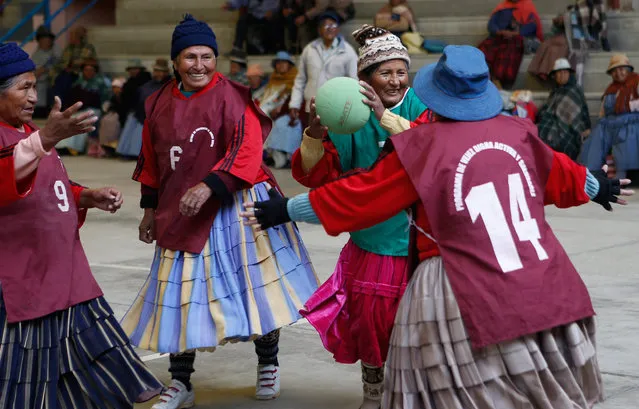
In this February 11, 2105 photo, 72-year-old Aurea Murillo prepares to make a pass during a handball match among elderly Aymara indigenous women in El Alto, Bolivia. Dozens of traditional Aymara grandmothers ease many of the aches and pains of aging by practicing a sport that is decidedly untraditional in Bolivia: team handball. (Photo by Juan Karita/AP Photo)

In this February 11, 2105 photo, 72-year-old Aurea Murillo prepares to make a pass during a handball match among elderly Aymara indigenous women in El Alto, Bolivia. Dozens of traditional Aymara grandmothers ease many of the aches and pains of aging by practicing a sport that is decidedly untraditional in Bolivia: team handball. (Photo by Juan Karita/AP Photo)
Details
27 Feb 2015 19:34:00
The rising sun illuminates the sky above the spires of a church in Vienna, Austria, November 17, 2015. (Photo by Heinz-Peter Bader/Reuters)

The rising sun illuminates the sky above the spires of a church in Vienna, Austria, November 17, 2015. (Photo by Heinz-Peter Bader/Reuters)
Details
19 Nov 2015 08:05:00
The Lun-class Ekranoplane was used by the Soviet Navy starting in 1987, and wasn't retired until the late 1990s, after the Soviet Union's fall. (Igor113)

“The Lun-class ekranoplan (NATO reporting name Duck) was a ground effect vehicle (GEV) designed by Rostislav Evgenievich Alexeev and used by the Soviet and Russian navies from 1987 until sometime in the late 1990s. It “flew” using the lift generated by the ground effect of its large wings when close to the surface of the water – about four metres or less. Although they might look similar and/or have related technical characteristics, ekranoplans like the Lun are not aircraft, seaplanes, hovercraft, or hydrofoils – ground effect is a separate technology altogether. The International Maritime Organization classifies these vehicles as maritime ships. The name Lun comes from the Russian for harrier”. – Wikipedia (Photo by Igor113)
Details
08 Aug 2014 10:51:00
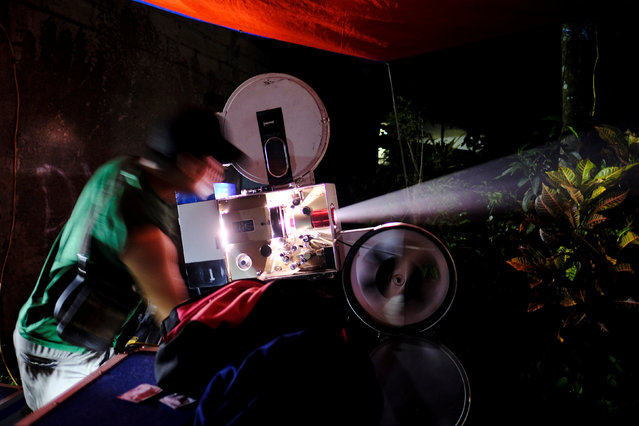
An operator adjusts a film projector during a wedding party in Bogor, Indonesia, February 18, 2017. (Photo by Reuters/Beawiharta)

An operator adjusts a film projector during a wedding party in Bogor, Indonesia, February 18, 2017. Indonesian entrepreneur Kamaluddin loves the gritty look of old 35-millimeter film so much that he spends most of his nights screening vintage movies at weddings and parties around Jakarta, the capital. (Photo by Reuters/Beawiharta)
Details
30 May 2017 08:20:00
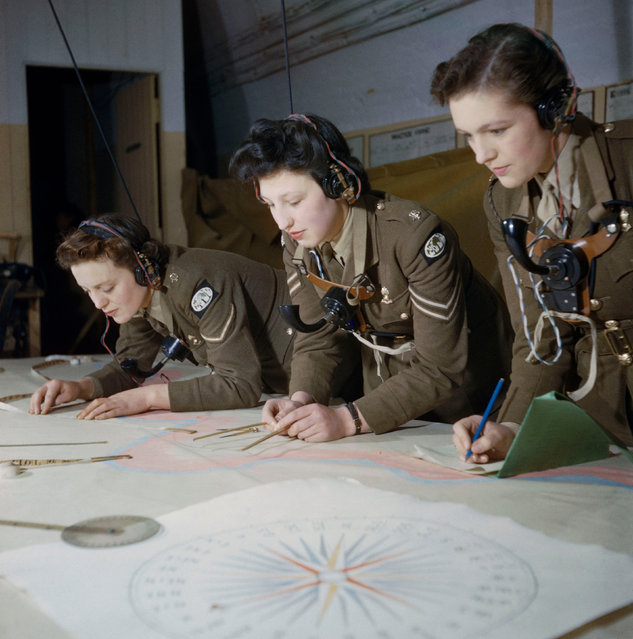
Auxiliary Territorial Service (ATS) plotters at work at Coastal Artillery Headquarters in Dover, December 1942. (Photo by Ted Dearberg/IWM/PA Wire)

Auxiliary Territorial Service (ATS) plotters at work at Coastal Artillery Headquarters in Dover, December 1942. The Auxiliary Territorial Service was the women's branch of the British Army during the Second World War. It was formed on 9 September 1938, initially as a women's voluntary service, and existed until 1 February 1949, when it was merged into the Women's Royal Army Corps. The ATS had its roots in the Women's Auxiliary Army Corps (WAAC), which was formed in 1917 as a voluntary service. During the First World War its members served in a number of jobs including clerks, cooks, telephonists and waitresses. The WAAC was disbanded after four years in 1921. (Photo by Ted Dearberg/IWM/PA Wire)

Details
13 Jul 2017 07:52:00
“Mr Big Dipper”, Nicholas Roemmelt (Denmark). A stargazer observes the constellation of the Big Dipper perfectly aligned with the window of the entrance to a large glacier cave in Engadin, Switzerland. This is a panorama of two pictures, and each is a stack of another two pictures: one for the stars and another one for the foreground, but with no composing or time blending. (Photo by Nicholas Roemmelt/National Maritime Museum/The Guardian)

“Mr Big Dipper”, Nicholas Roemmelt (Denmark). A stargazer observes the constellation of the Big Dipper perfectly aligned with the window of the entrance to a large glacier cave in Engadin, Switzerland. This is a panorama of two pictures, and each is a stack of another two pictures: one for the stars and another one for the foreground, but with no composing or time blending. (Photo by Nicholas Roemmelt/National Maritime Museum/The Guardian)
Details
27 Jul 2017 06:50:00
In this April 2, 2016 photo, dusty sculptures made of cast-off baby dolls sit in an open-air museum and art workshop off a trash-strewn street cutting through some of the poorest neighborhoods in Port-au-Prince, Haiti. They were created by Haitian artists called Atis Rezistans who have become celebrated in the international art world by creating sculptures out of scrapped car parts, old wood, discarded toys and even human skulls found scattered outside crumbling mausoleums. (Photo by David McFadden/AP Photo)

In this April 2, 2016 photo, dusty sculptures made of cast-off baby dolls sit in an open-air museum and art workshop off a trash-strewn street cutting through some of the poorest neighborhoods in Port-au-Prince, Haiti. They were created by Haitian artists called Atis Rezistans who have become celebrated in the international art world by creating sculptures out of scrapped car parts, old wood, discarded toys and even human skulls found scattered outside crumbling mausoleums. (Photo by David McFadden/AP Photo)
Details
12 Apr 2016 11:10:00