Loading...
Done
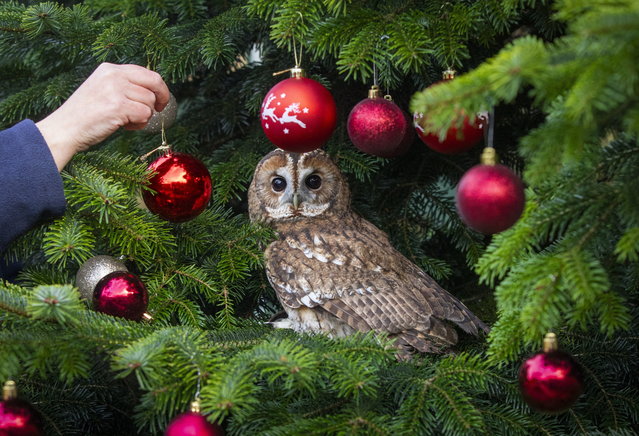
Tony the ten-year-old tawny owl tucks himself on December 8, 2025 into a Christmas tree at the Scottish Owl Centre, West Lothian, where he was hatched and raised. (Photo by Katielee Arrowsmith/South West News Service)

Tony the ten-year-old tawny owl tucks himself on December 8, 2025 into a Christmas tree at the Scottish Owl Centre, West Lothian, where he was hatched and raised. (Photo by Katielee Arrowsmith/South West News Service)
Details
21 Dec 2025 09:39:00
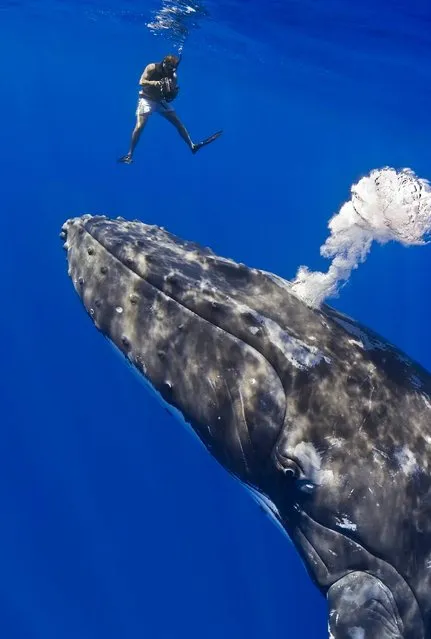
This is the moment a diver appears to shake hands with a giant 52ft whale. The divers were just metres away when one humpback whale – which weighs 36,000kg – extends its giant flipper in a peaceful manner. (Photo by Masa Ushioda/SeaPics/Solent News & Photo Agency)

This is the moment a diver appears to shake hands with a giant 52ft whale. The divers were just metres away when one humpback whale – which weighs 36,000kg – extends its giant flipper in a peaceful manner. (Photo by Masa Ushioda/SeaPics/Solent News & Photo Agency)
Details
11 May 2014 12:59:00
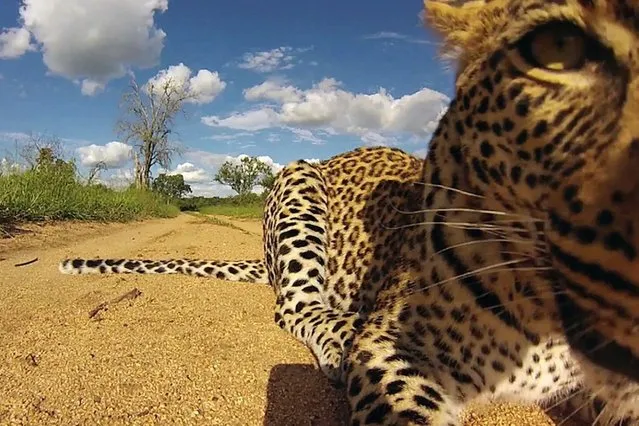
A curious leopard cub toys with a camera at MalaMala Game Reserve in Mpumalanga Province, South Africa. (Photo by Barcroft Media)

A curious leopard cub toys with a camera at MalaMala Game Reserve in Mpumalanga Province, South Africa. (Photo by Barcroft Media)
Details
23 May 2014 09:54:00
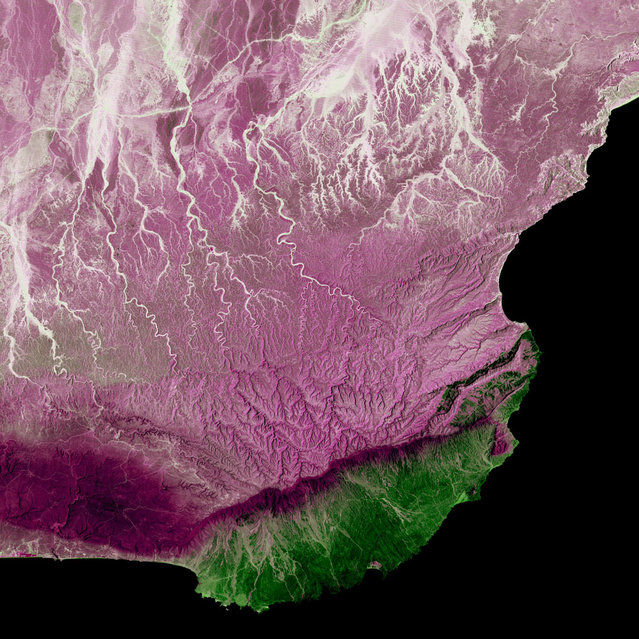
Dhofar Region, Oman. Much of Oman is desert, but the Arabian Sea coast in the Dhofar region represents a startling difference in climate. This coastal region catches the monsoon rains, or khareef, during the summer months. Drenching rains fall primarily on the mountainous ridge that separates the lush, fertile areas along the coast from the arid interior, recharging streams, waterfalls and springs that provide plentiful water supplies in the fertile lowlands for the remainder of the year. Image taken by Landsat 5 on April 2, 2005. (Photo by USGS/NASA)

Dhofar Region, Oman. Much of Oman is desert, but the Arabian Sea coast in the Dhofar region represents a startling difference in climate. This coastal region catches the monsoon rains, or khareef, during the summer months. Drenching rains fall primarily on the mountainous ridge that separates the lush, fertile areas along the coast from the arid interior, recharging streams, waterfalls and springs that provide plentiful water supplies in the fertile lowlands for the remainder of the year. Image taken by Landsat 5 on April 2, 2005. (Photo by USGS/NASA)
Details
25 Dec 2012 11:13:00
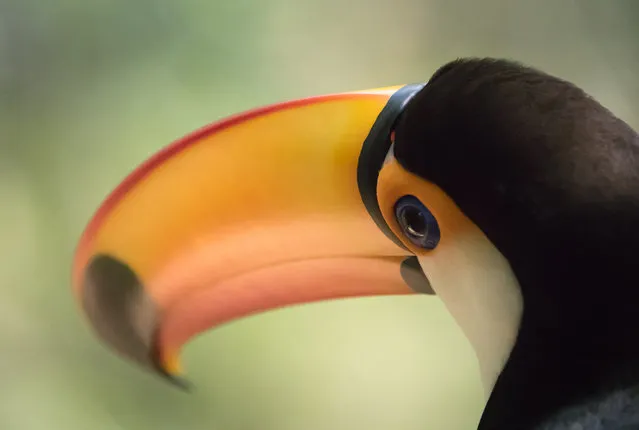
Overall runner-up: Toucan, Mark Tatchell. (Photo by Mark Tatchell/British Ecological Society)

The British Ecological Society has announced the winners of its annual photography competition, Capturing Ecology. Taken by international ecologists and students, the winning images will be exhibited at the society’s joint annual meeting in Ghent in December. Here: Overall runner-up; Toucan, Mark Tatchell. (Photo by Mark Tatchell/British Ecological Society)
Details
05 Dec 2017 08:05:00
Qian Hao's imported Pekingese dog, Mixiu, runs in a park in Beijing, China, February 8, 2018. (Photo by Thomas Peter/Reuters)

Qian Hao's imported Pekingese dog, Mixiu, runs in a park in Beijing, China, February 8, 2018. (Photo by Thomas Peter/Reuters)
Details
25 Feb 2018 00:02:00
Of all the species affected by river regulation in Australia, the ibis is one of the few that has changed its behaviour and moved to coastal cities. (Photo by Rick Stevens/The Guardian)

Tip turkey, dumpster chook, rubbish raptor – the Australian white ibis goes by many unflattering names. But it is a true urban success story, scavenging to survive in cities across Australia as wetlands have been lost. Wildlife photographer Rick Stevens captured them in Sydney. Here: Of all the species affected by river regulation in Australia, the ibis is one of the few that has changed its behaviour and moved to coastal cities. (Photo by Rick Stevens/The Guardian)
Details
11 Apr 2018 00:03:00
Some of the best entries so far in the 2016 Insight Astronomy Photographer of the Year competition. There are two weeks left to enter, and the winners will be announced in September. Here: Aurora over Laksvatn Fjord, Laksvatn, Norway. The aurora borealis dances in the skies over the town of Laksvatn, with the Milky Way to the left. The image is a single shot with no compositing, only post-processing to bring out the aurora, and some colour corrections. (Photo by Matt Walford/National Maritime Museum)

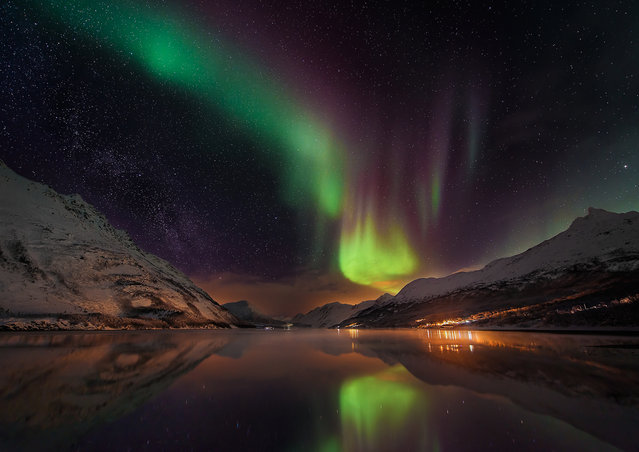
Some of the best entries so far in the 2016 Insight Astronomy Photographer of the Year competition. There are two weeks left to enter, and the winners will be announced in September. Here: Aurora over Laksvatn Fjord, Laksvatn, Norway. The aurora borealis dances in the skies over the town of Laksvatn, with the Milky Way to the left. The image is a single shot with no compositing, only post-processing to bring out the aurora, and some colour corrections. The photographer Matt Walford said: “I love the way the northern lights look like they are just wistfully dancing over the fjord, framed by the mountains on either side”. (Photo by Matt Walford/National Maritime Museum)
Details
01 Jul 2016 12:13:00