Loading...
Done
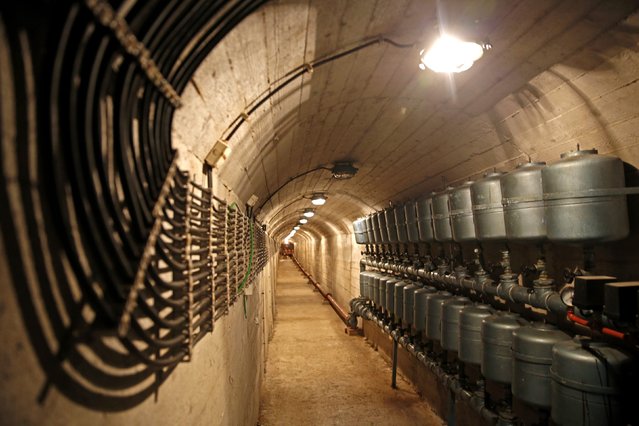
A tunnel with electric switches are seen in Josip Broz Tito's underground secret bunker (ARK) in Konjic, October 16, 2014. (Photo by Dado Ruvic/Reuters)

A tunnel with electric switches are seen in Josip Broz Tito's underground secret bunker (ARK) in Konjic, October 16, 2014. In the early 1950s, Josip Broz Tito, the late leader of the former Yugoslavia, ordered the building of the secret bunker, located 900 feet (270 m) underground and near the Bosnian town of Konjic, to safeguard the country's ruling class in case of a nuclear attack. Construction at the complex, which had a cost equivalent price tag of $4.6 billion, continued until 1979, the year before Tito died. (Photo by Dado Ruvic/Reuters)
Details
28 Nov 2014 12:14:00
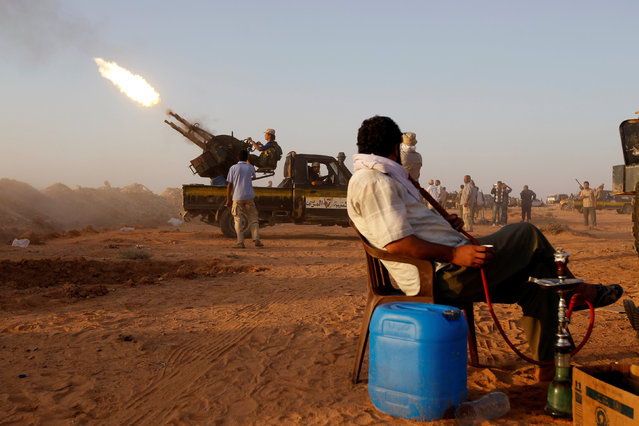
An anti-Gaddafi fighter tests an anti-aircraft gun southwest of Sirte, Libya one of Muammar Gaddafi's last remaining strongholds, September 16, 2011. (Photo by Goran Tomasevic/Reuters)

An anti-Gaddafi fighter tests an anti-aircraft gun southwest of Sirte, Libya one of Muammar Gaddafi's last remaining strongholds, September 16, 2011. A timeline of images dating from 2010 from Sirte, Libya, the home town of deposed Libyan leader Muammar Gaddafi. Libyan forces battling Islamic State in the city of Sirte say they have defeated the militant group after months of street to street fighting backed by U.S. air strikes. Islamic State took control of the city more than a year ago and set up its main base outside Syria and Iraq. (Photo by Goran Tomasevic/Reuters)
Details
06 Dec 2016 10:43:00
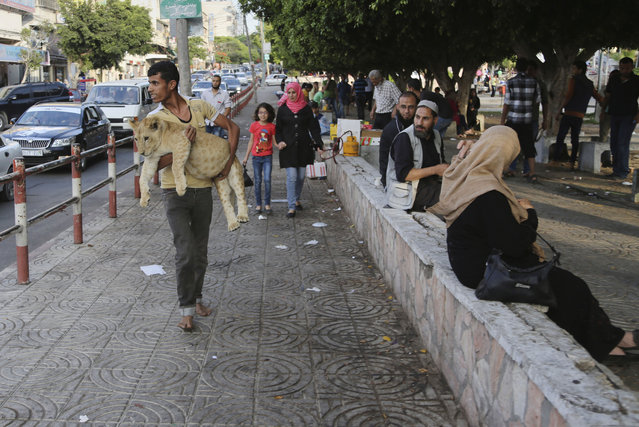
In this Monday, June 15, 2015 photo, Ahmad Abu Jereda, 16, carries Max, the male lion cub, as he passes by Palestinians at the main garden in Gaza City, in the northern Gaza Strip. (Photo by Adel Hana/AP Photo)

In this Monday, June 15, 2015 photo, Ahmad Abu Jereda, 16, carries Max, the male lion cub, as he passes by Palestinians at the main garden in Gaza City, in the northern Gaza Strip. A pair of lion cubs are stuck at a Gaza-Israel border crossing en route to a Jordan animal sanctuary, after being kept for a year by a family in crowded Gaza. Saduldin al-Jamal had bought the cubs from the Gaza zoo, hit during last summer's Israel-Hamas war. His family would take them to parks or the beach and children – those brave enough – would come up to pet them. (Photo by Adel Hana/AP Photo)
Details
04 Jul 2015 11:07:00
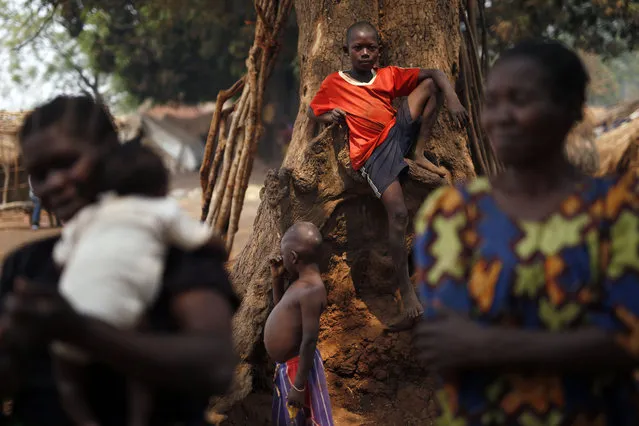
Christian families living in a refugee camp stand under a tree in Kaga-Bandoro, Central African Republic, Tuesday February 16,  2016. (Photo by Jerome Delay/AP Photo)

Christian families living in a refugee camp stand under a tree in Kaga-Bandoro, Central African Republic, Tuesday February 16, 2016. Refugees in the north of Central African Republic say they hope the new president will bring peace but no one is heading home just yet. Thousands are still living in displacement camps in Kaga-Bandoro, a stronghold of the former Muslim rebel group known as Seleka that was in power for nearly a year. The one-time rebels say they are waiting to see how the election turns out before taking any action. (Photo by Jerome Delay/AP Photo)
Details
20 Feb 2016 10:13:00
Florin Bors, aged 8 from Bacau, northern Romania, wearing a bear fur takes a break from performing a holiday season ritual in Bucharest, Romania, Tuesday, December 16, 2014. In pre-Christian rural traditions, dancers wearing colored costumes or animal furs, touring house to house in villages singing and dancing to ward off evil. (Photo by Octav Ganea/AP Photo/Mediafax)

Florin Bors, aged 8 from Bacau, northern Romania, wearing a bear fur takes a break from performing a holiday season ritual in Bucharest, Romania, Tuesday, December 16, 2014. In pre-Christian rural traditions, dancers wearing colored costumes or animal furs, touring house to house in villages singing and dancing to ward off evil. In recent years following the economic downturn in Romania, a European Union member since 2007, the tradition has moved to Romania's cities where dancers travel to perform the ritual for money. (Photo by Octav Ganea/AP Photo/Mediafax)
Details
20 Dec 2014 12:07:00
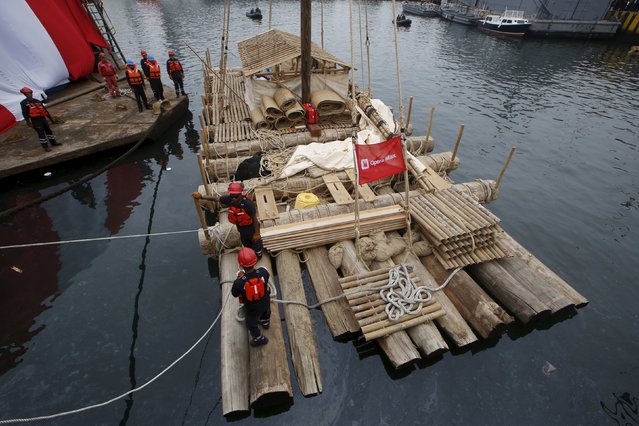
One of the two wooden rafts of the Kon-Tiki II expedition is prepared  at the port of Callao prior to the departure to Pascua island in Chile, in Callao, Peru, October 30, 2015. Fourteen men from various parts of the world set out on rafts to commemorate the  Norwegian navigator Thor Heyerdahl expedition 68 years ago. (Photo by Mariana Bazo/Reuters)

One of the two wooden rafts of the Kon-Tiki II expedition is prepared at the port of Callao prior to the departure to Pascua island in Chile, in Callao, Peru, October 30, 2015. Fourteen men from various parts of the world set out on rafts to commemorate the Norwegian navigator Thor Heyerdahl expedition 68 years ago. The original raft crossed the Pacific Ocean from South America to the Polynesian Islands. This rafts are a replica of ships used 6,000 years ago, but will be equipped with solar panel. (Photo by Mariana Bazo/Reuters)
Details
02 Nov 2015 08:00:00
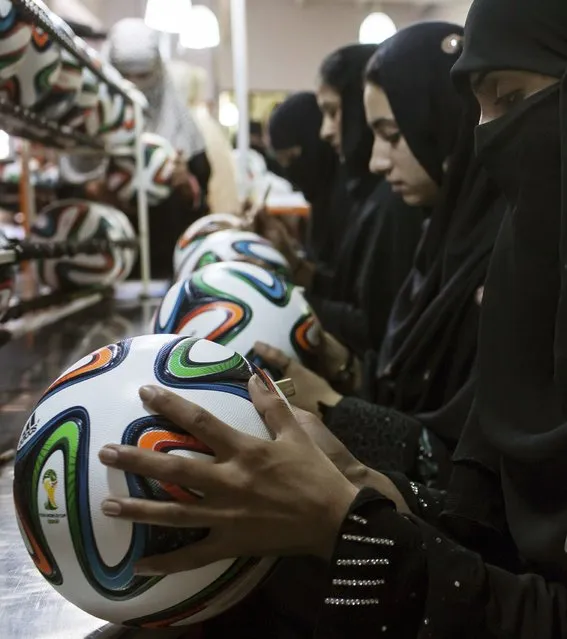
Employees conduct a final check to fix any cavities in the seams of balls inside the soccer ball factory that produces official match balls for the 2014 World Cup in Brazil, in Sialkot, Punjab province May 16, 2014. (Photo by Sara Farid/Reuters)

Employees conduct a final check to fix any cavities in the seams of balls inside the soccer ball factory that produces official match balls for the 2014 World Cup in Brazil, in Sialkot, Punjab province May 16, 2014. It was when he felt the roar of the crowd at the 2006 World Cup in Germany that Pakistani factory owner Khawaja Akhtar first dreamt up a goal of his own: to manufacture the ball for the biggest soccer tournament on the planet. Last year he finally got his chance – but only 33 days to make it happen. (Photo by Sara Farid/Reuters)
Details
26 May 2014 13:59:00
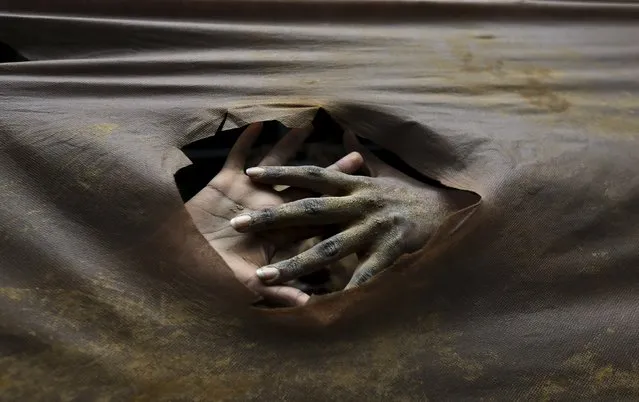
An environmental activist performs during a protest in front of the headquarters of Brazilian mining company Vale SA in downtown Rio de Janeiro, Brazil, November 16, 2015. (Photo by Sergio Moraes/Reuters)

An environmental activist performs during a protest in front of the headquarters of Brazilian mining company Vale SA in downtown Rio de Janeiro, Brazil, November 16, 2015. The collapse of two dams at a Brazilian mine, owned by Vale SA and BHP Billiton Ltd, has cut off drinking water for quarter of a million people and saturated waterways downstream with dense orange sediment that could wreck the ecosystem for years to come. Nine people were killed, 19 are still listed as missing and 500 people were displaced from their homes when the dams burst at an iron ore mine in southeastern Brazil on November 5. (Photo by Sergio Moraes/Reuters)
Details
18 Nov 2015 08:00:00