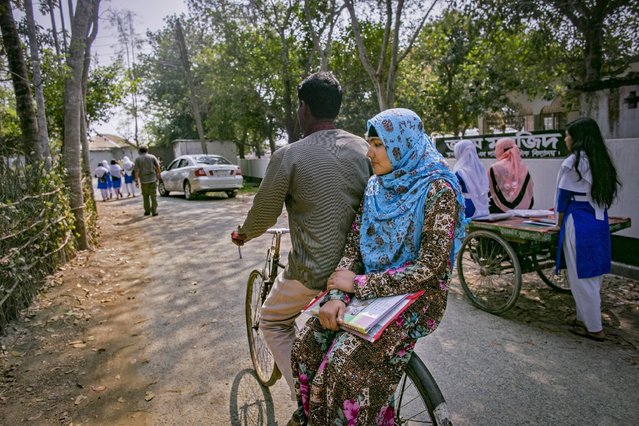
Rani rides home with her father on the back of his bicycle on March 6, 2017 in Khulna division, Bangladesh. Rani, who is now 16, was under pressure to marry a boy when she was 14-years-old despite the reluctance of Rani and her father, Abdul. (Photo by Allison Joyce/Getty Images)
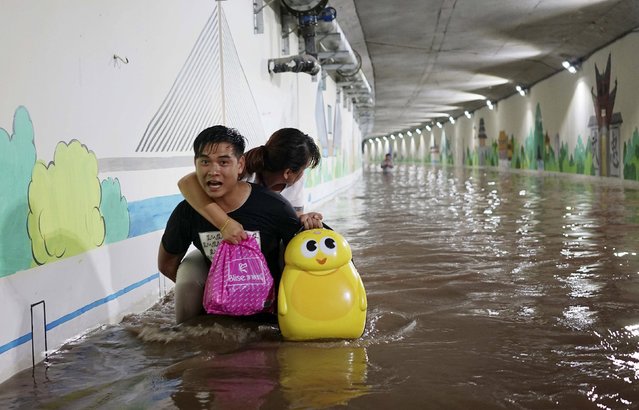
A man carries his wife on his back as they make their way with their luggage along a flooded tunnel to catch their train, after heavy rainfall hit Jinhua, Zhejiang province, China, July 21, 2015. (Photo by Reuters/China Daily)
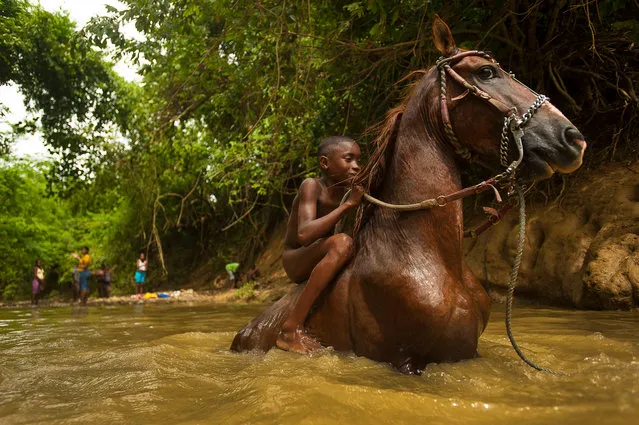
This image of a young bareback rider was taken in the village of Palenque de San Basilio, in Colombia’s Bolívar department. Founded by freed slaves in the 17th century, it became the first free town in the Americas, following a decree by the Spanish crown. Most of today’s inhabitants are direct descendants of those slaves and have preserved many of their customs, including their own language, Palenquero. (Photo by Sebastián Suki Beláustegui/The Guardian)
A plane belonging to U.S. missionary group Agape Flights burns after it was set on fire during protests demanding that the government of Prime Minister Ariel Henry do more to address gang violence including constant kidnappings, in Les Cayes, Haiti on March 29, 2022. (Photo by Duples Plymouth/Reuters)
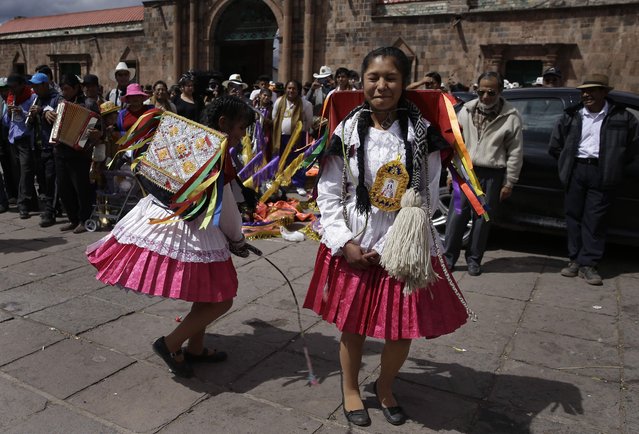
In this Sunday, August 5, 2018 photo, a dancer winces in pain as she is whipped by a fellow dancer in an adaptation of the Inca warrior dance known as “Kachampa”, during celebrations honoring Our Lady of Copacabana, in Cuzco, Peru. (Photo by Martin Mejia/AP Photo)
A Deer holding a leaf looks on as they roam Bridwell Park Estate on December 15, 2022 in Cullompton, England. The Devon estate is home to Lord Ivar Mountbatten, whose great uncle was Louis Mountbatten, 1st Earl Mountbatten of Burma. (Photo by Harry Trump/Getty Images)
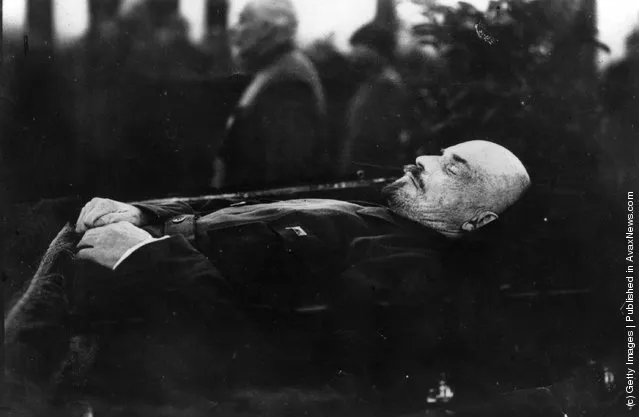
Photo: Vladimir Ilyich Lenin (1870 – 1924) lying in state in the Kremlin. (Photo by Hulton Archive/Getty Images). 1924
Important! For the same article in Russian language click here.
Something quite intriguing is happening within Russian-speaking internet during the last few – should you type a fully academic inquiry (at least, according to Russian academic requirements) in national search engines for "Lenin's mausoleum" – the first thing you get (even in top 10 searches) is website pages talking about black magic and occult. Website authors view this construction differently, but unconditionally agree on one thing: the mausoleum of the "leader of the world proletariat” – the essence of a magical artifact, a sort of “energy vampire”. It was built with a certain purpose: to drain the energy out of miserable Soviet citizens on one hand; and to poison the anthroposphere of one-sixth part of the earth with its vibes (the exact territory that was occupied by the former Soviet Union), depriving the Russian people of will to resist on the other hand. Complete nonsense? No doubt. Nevertheless, an intriguing one. Well, probably because some oddities do exist in mausoleum's history. These oddities are the thing we are going to discuss this time. First, let me refresh you memory on the subject.