Loading...
Done
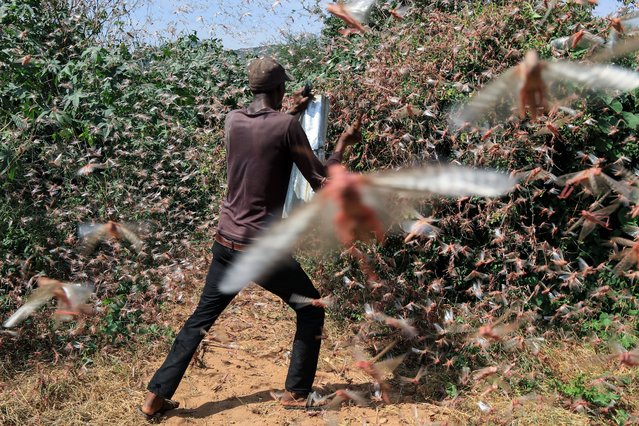
A man uses iron sheet to make noises, as a way of trying to disperse desert locusts that had invaded their farms during the second wave invasion in Kakongo village, in Nuu-Mwingi East, in Kitui, Kenya, 06 February 2021. The second wave invasion of the desert locusts in the country comes at a time where most famers are expecting to harvest their farm produce in the country. According to the United Nations Food and Agriculture Organization (FAO), on 04 February, warned numerous immature desert locust swarms persist in southern Ethiopia and Kenya. Some of the swarms are in community areas and therefore cannot be treated. In Kenya, immature swarms continue to spread westwards across northern and central counties where there are currently about 20 small swarms present, mostly about 50 hectares in size, it said. (Photo by Daniel Irungu/EPA/EFE)

A man uses iron sheet to make noises, as a way of trying to disperse desert locusts that had invaded their farms during the second wave invasion in Kakongo village, in Nuu-Mwingi East, in Kitui, Kenya, 06 February 2021. The second wave invasion of the desert locusts in the country comes at a time where most famers are expecting to harvest their farm produce in the country. (Photo by Daniel Irungu/EPA/EFE)
Details
25 Feb 2021 08:17:00
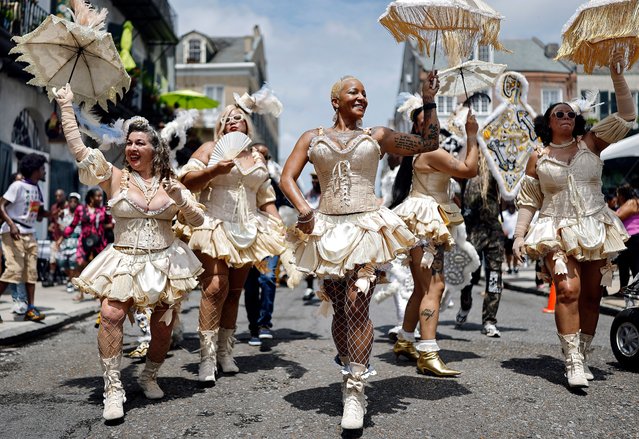
Members of the Mahogany Blue Baby Dolls including Victoria “Lady Lotus” Spotts (C) march in the 25th Anniversary Satchmo Salute second line parade, honoring New Orleans jazz legend Louis Armstrong, on August 3, 2025 in New Orleans, Louisiana. Revelers marched from historic St. Augustine Catholic Church in the Tremé neighborhood to the New Orleans Jazz Museum where Satchmo Summerfest is being held. New Orleans and the Gulf Coast region are preparing to mark the 20 year anniversary of Hurricane Katrina, which occurred on August 29, 2005. The failure of levees during the catastrophic storm in New Orleans flooded about 80 percent of the city including historic communities such as the Lower Ninth Ward. Katrina resulted in nearly 1,400 deaths, according to revised statistics from the National Hurricane Center, and remains the costliest storm in U.S. history at around $200 billion in today’s dollars. (Photo by Mario Tama/Getty Images)

Members of the Mahogany Blue Baby Dolls including Victoria “Lady Lotus” Spotts (C) march in the 25th Anniversary Satchmo Salute second line parade, honoring New Orleans jazz legend Louis Armstrong, on August 3, 2025 in New Orleans, Louisiana. Revelers marched from historic St. Augustine Catholic Church in the Tremé neighborhood to the New Orleans Jazz Museum where Satchmo Summerfest is being held. (Photo by Mario Tama/Getty Images)
Details
12 Aug 2025 03:19:00
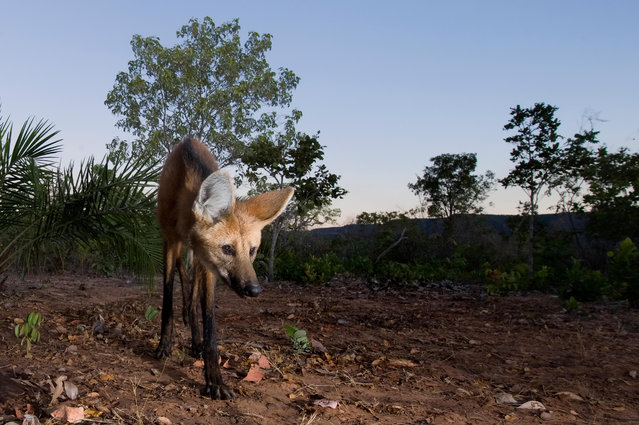
The maned wolf is among the large mammals in the Brazilian Cerrado that are threatened by the increasing conversion of grasslands into farmland for grazing and growing crops. (Photo by Ben Cranke/Nature Picture Library/Alamy Stock Photo)

Global wildlife populations will decline by 67% by 2020 unless urgent action is taken to reduce human impact on species and ecosystems, warns the biennial Living Planet Index report from WWF (World Wide Fund for Nature) and ZSL (Zoological Society of London). From elephants to eels, here are some of the wildlife populations most affected by human activity. Here: The maned wolf is among the large mammals in the Brazilian Cerrado that are threatened by the increasing conversion of grasslands into farmland for grazing and growing crops. (Photo by Ben Cranke/Nature Picture Library/Alamy Stock Photo)
Details
28 Oct 2016 10:47:00
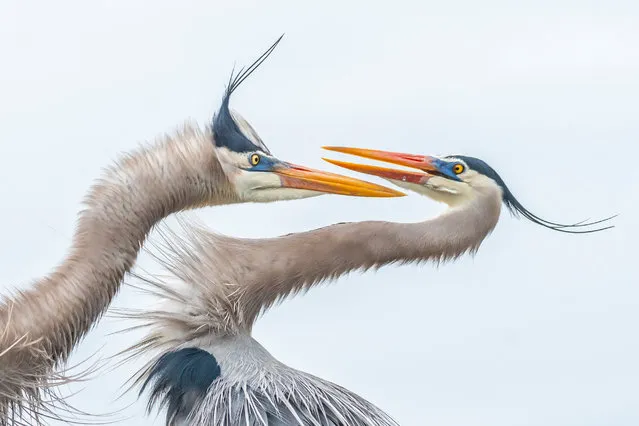
Melissa Rowell, amateur honourable mention. Wakodahatchee wetlands, Delray Beach, Florida, US. Equipped with sinewy necks and spear-like bills, great blue herons can lunge with fearsome speed to strike their aquatic prey. Adults will also employ rapid stabbing motions as one aspect of their complex courtship displays; they’re seemingly dangerous moves, but fitting to the intensity of mating season. (Photo by Melissa Rowell/Audubon photography awards)

Wakodahatchee wetlands, Delray Beach, Florida, US. Equipped with sinewy necks and spear-like bills, great blue herons can lunge with fearsome speed to strike their aquatic prey. Adults will also employ rapid stabbing motions as one aspect of their complex courtship displays; they’re seemingly dangerous moves, but fitting to the intensity of mating season. (Photo by Melissa Rowell/Audubon Photography Awards)
Details
17 Jul 2019 00:03:00
Burlesque dancer and Lucha VaVoom co-founder Rita D'Albert gets dressed before the Lucha VaVoom “Night of the Vampire” performance in Los Angeles, California October 29, 2014. (Photo by Patrick T. Fallon/Reuters)

Burlesque dancer and Lucha VaVoom co-founder Rita D'Albert gets dressed before the Lucha VaVoom “Night of the Vampire” performance in Los Angeles, California October 29, 2014. (Photo by Patrick T. Fallon/Reuters)
Details
01 Nov 2014 14:36:00
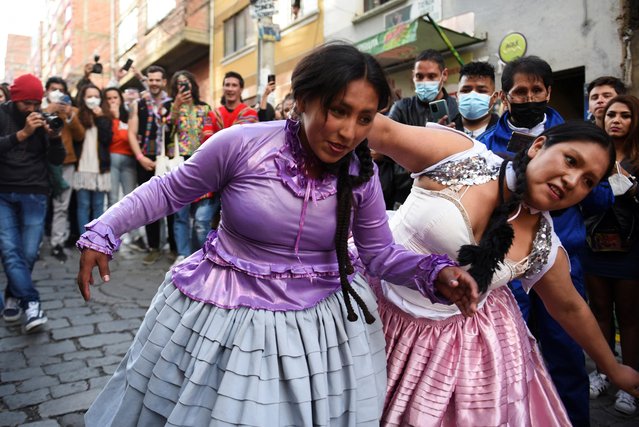
Cholita wrestlers stage a performance on the street during the Electropreste celebration, which combines traditional and modern customs, in La Paz, Bolivia on March 12, 2022. (Photo by Claudia Morales/Reuters)

Cholita wrestlers stage a performance on the street during the Electropreste celebration, which combines traditional and modern customs, in La Paz, Bolivia on March 12, 2022. (Photo by Claudia Morales/Reuters)
Details
10 Apr 2022 04:52:00
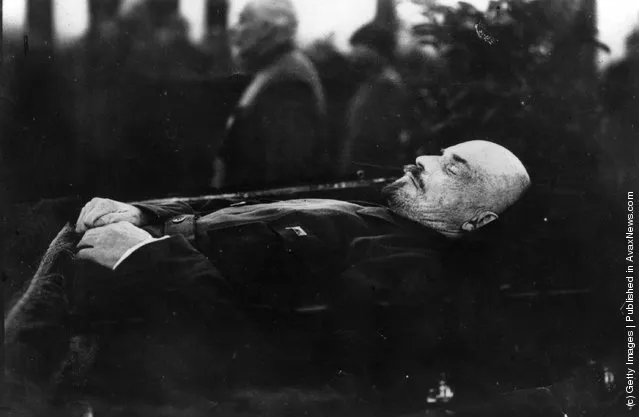
1924:  Vladimir Ilyich Lenin lying in state in the Kremlin

Photo: Vladimir Ilyich Lenin (1870 – 1924) lying in state in the Kremlin. (Photo by Hulton Archive/Getty Images). 1924

Important! For the same article in Russian language click here.

Something quite intriguing is happening within Russian-speaking internet during the last few – should you type a fully academic inquiry (at least, according to Russian academic requirements) in national search engines for "Lenin's mausoleum" – the first thing you get (even in top 10 searches) is website pages talking about black magic and occult. Website authors view this construction differently, but unconditionally agree on one thing: the mausoleum of the "leader of the world proletariat” – the essence of a magical artifact, a sort of “energy vampire”. It was built with a certain purpose: to drain the energy out of miserable Soviet citizens on one hand; and to poison the anthroposphere of one-sixth part of the earth with its vibes (the exact territory that was occupied by the former Soviet Union), depriving the Russian people of will to resist on the other hand. Complete nonsense? No doubt. Nevertheless, an intriguing one. Well, probably because some oddities do exist in mausoleum's history. These oddities are the thing we are going to discuss this time. First, let me refresh you memory on the subject.
Details
16 Oct 2011 11:27:00
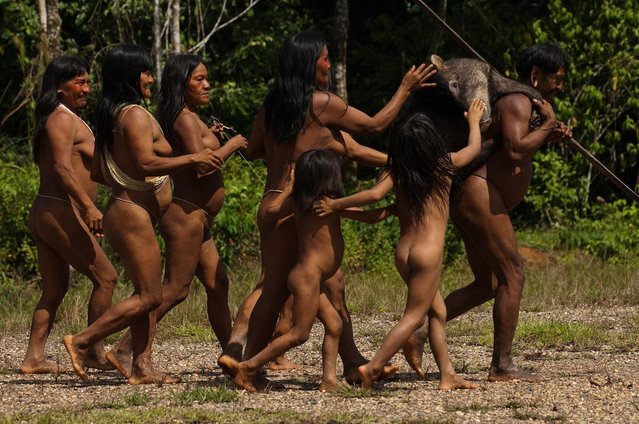
Spectacular images offering insight into the lives of the Huaorani people in the Ecuadorian Amazon have been revealed showing how they use traditional methods to hunt monkeys for food. The stunning pictures were taken by conservation photographer Pete Oxford from Torquay, Devon in the Ecuadorian Amazon. “The Huaorani Indians are a forest people highly in tune with their environment. Many are now totally acculturated since the 1950s by missionaries”, said Pete. “Today they face radical change to their culture to the proximity of oil exploration within their territory and the Yasuni National Park and Biosphere Reserve, they are vastly changed. Some still live very traditionally and for this shoot, through my Huaorani friend, a direct relative of those photographed he wanted to depict them as close to their original culture as possible. They still largely hunt with blow pipes and spears eating a lot of monkeys and peccaries”. The Huaorani are also known as the Waorani, Waodani or the Waos and are native Amerindians. Their lands are located between the Curaray and Napo rivers and speak the Huaorani language. Pete says that during his visit he was welcomed into the group and hopes that ancient cultures can be saved. Here: The tribe were seen celebrating after a hunter returned to camp with a wild pig. (Photo by Pete Oxford/Mediadrumworld.com)

Spectacular images offering insight into the lives of the Huaorani people in the Ecuadorian Amazon have been revealed showing how they use traditional methods to hunt monkeys for food. The stunning pictures were taken by conservation photographer Pete Oxford from Torquay, Devon in the Ecuadorian Amazon. Here: The tribe were seen celebrating after a hunter returned to camp with a wild pig. (Photo by Pete Oxford/Mediadrumworld.com)
Details
20 Jan 2017 07:58:00