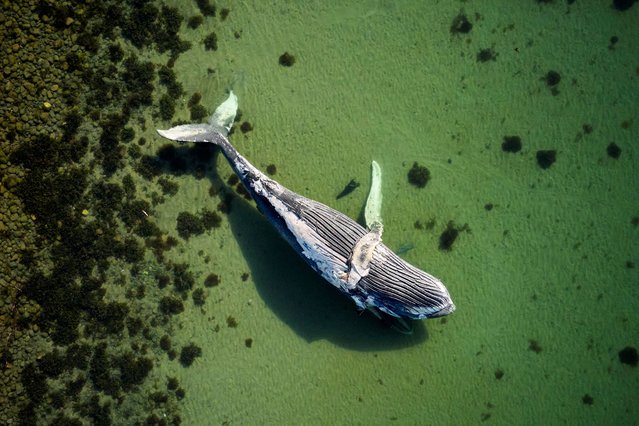
Drone photo of a dead humpback whale at Foelle Strand in Loegten Bay, Djursland, Denmark, on April 2, 2025. (Photo by Mikkel Berg Pedersen/Ritzau Scanpix via Reuters)
An aerial view of Syrian people flocked to the streets in the capital Damascus to celebrate US President Donald Trump's decision to lift sanctions in Damascus, Syria on May 13, 2025. (Photo by Amadeusz Mikolaj Swierk/Anadolu via Getty Images)
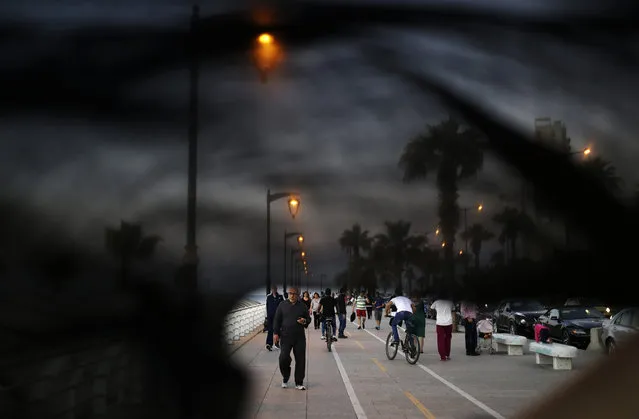
This Thursday, April 30, 2015 photo shows Lebanese citizens walking on the Corniche, or waterfront promenade in Beirut, Lebanon. This photo was shot through the lowered veil of a niqab, which is worn by some conservative Muslim women. The cloth allows women to follow a strict interpretation of their religious beliefs by preventing others from seeing their faces. (Photo by Hassan Ammar/AP Photo)
Ukrainian artist Dariya Marchenko works on a portrait of Russian President Vladimir Putin named “The Face of War” which is made out of 5,000 cartridges brought from the frontline in eastern Ukraine, in Kiev, July 23, 2015. The portrait will be presented along with a novel which will tell personal stories of six people involved in this project including Daria's own story and stories of people who helped her to collect shells from the frontline. Daria Marchenko calls her art approach philosophic symbolism where every element has its hidden meaning. In her works cartridges mean human's life that was brutally ended. (Photo by Gleb Garanich/Reuters)
Bella Hadid attends “The Unknown Girl (La Fille Inconnue)” Premiere during the 69th annual Cannes Film Festival at the Palais des Festivals on May 18, 2016 in Cannes, France. (Photo by Alberto Pizzoli/AFP Photo)
People take a selfie as the sun sets over Manhattan aligned exactly with the streets in a phenomenon known as “Manhattanhenge”, in New York City, U.S., July 11, 2016. (Photo by Mark Kauzlarich/Reuters)
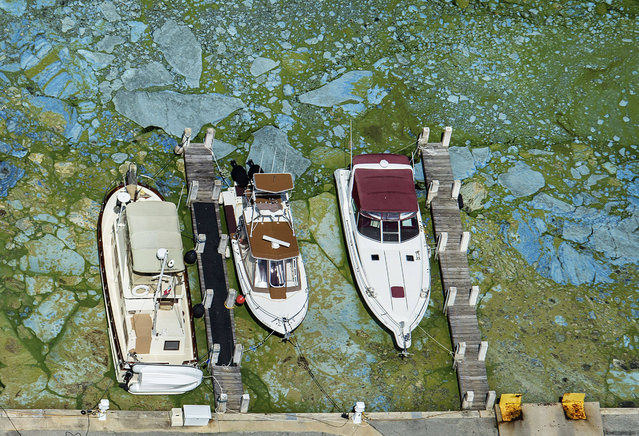
In this June 29, 2016 file photo, boats docked at Central Marine in Stuart, Fla., are surrounded by blue green algae. The 153-mile-long Indian River Lagoon has been plagued by harmful algae blooms. Water quality testing data analyzed by the AP showed the average phosphorous level – a byproduct of fertilizers and human waste that algae thrive on, rose nearly 75 percent between 2000 and 2016. (Photo by Greg Lovett/The Palm Beach Post via AP Photo)