Loading...
Done
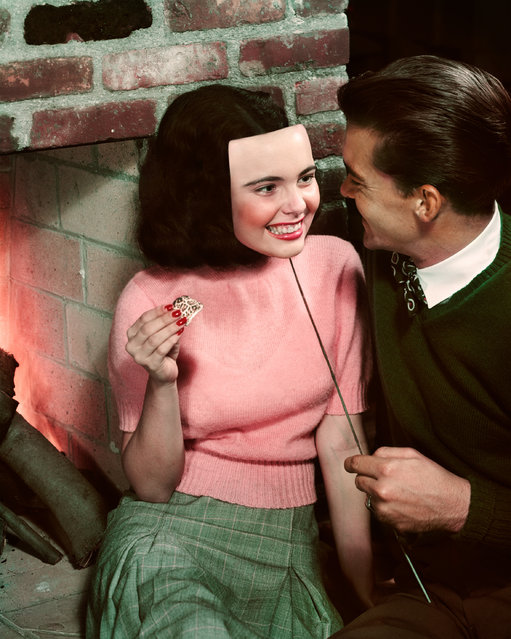
“Untitled #5”. “Family scenes, vacation souvenirs, everyday life, suspended anywhere between truth and fiction. It is hard to figure out whether they are spontaneous or entirely staged”. (Photo by Weronika Gęsicka/The Guardian)

In Weronika Gęsicka’s unsettling images, American archive photography gets distorted into scenes that are both nightmarish yet somehow entirely plausible. Gęsicka is a guest artist at the Circulations festival for young European photographers, Paris, until 5 March. Here: “Untitled #5”. (Photo by Weronika Gęsicka/The Guardian)
Details
23 Jan 2017 10:15:00
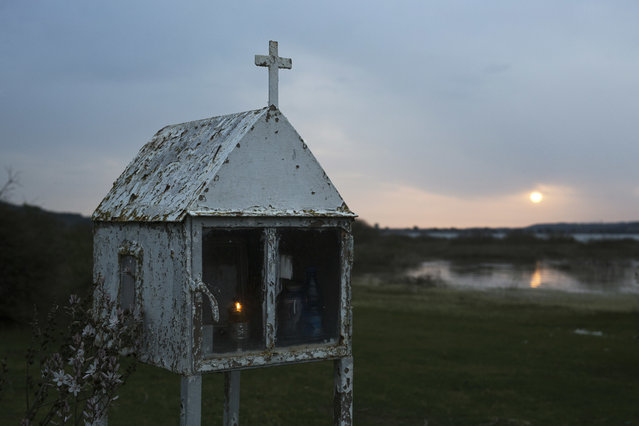
In this photo taken on Saturday, April 29, 2017, a candle is lit in a roadside shrine as the sun sets across a nearby lake of Pineia in the village of Souli, in the Peloponnese region of southern Greece. (Photo by Petros Giannakouris/AP Photo)

In this photo taken on Saturday, April 29, 2017, a candle is lit in a roadside shrine as the sun sets across a nearby lake of Pineia in the village of Souli, in the Peloponnese region of southern Greece. Made of iron sheeting, stone, wood, concrete or marble, tens of thousands of such shrines punctuate Greece’s roadside scenery, a common sight in a country that has one of the European Union’s worst road fatality rates. (Photo by Petros Giannakouris/AP Photo)
Details
13 May 2017 09:19:00
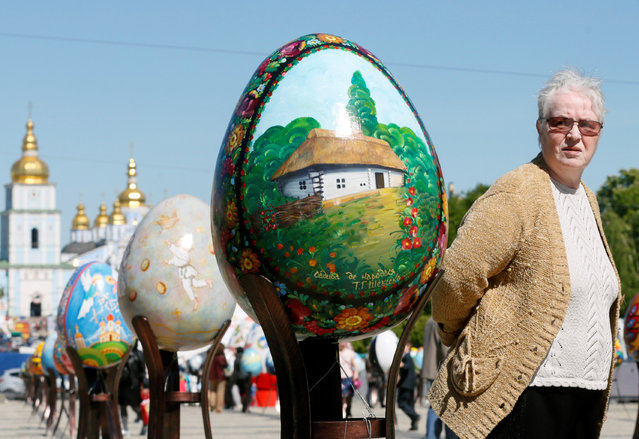
A woman looks at traditional Ukrainian Easter eggs “Pysanka”, installed as part of the upcoming celebrations of Easter, in central Kiev, Ukraine, April 29, 2016. A pysanka is a Ukrainian Easter egg, decorated with traditional Ukrainian folk designs using a wax-resist (batik) method. The word pysanka comes from the verb pysaty, “to write”, as the designs are not painted on, but written with beeswax. Many other eastern European ethnic groups decorate eggs using wax resist for Easter. These include the Belarusians, Bulgarians, Croats, Czechs, Hungarians, Lithuanians, Poles, Romanians, Serbs, Slovaks, Slovenes and Sorbs. (Photo by Valentyn Ogirenko/Reuters)

A woman looks at traditional Ukrainian Easter eggs “Pysanka”, installed as part of the upcoming celebrations of Easter, in central Kiev, Ukraine, April 29, 2016. A pysanka is a Ukrainian Easter egg, decorated with traditional Ukrainian folk designs using a wax-resist (batik) method. The word pysanka comes from the verb pysaty, “to write”, as the designs are not painted on, but written with beeswax. Many other eastern European ethnic groups decorate eggs using wax resist for Easter. These include the Belarusians, Bulgarians, Croats, Czechs, Hungarians, Lithuanians, Poles, Romanians, Serbs, Slovaks, Slovenes and Sorbs. (Photo by Valentyn Ogirenko/Reuters)
Details
30 Apr 2016 09:00:00
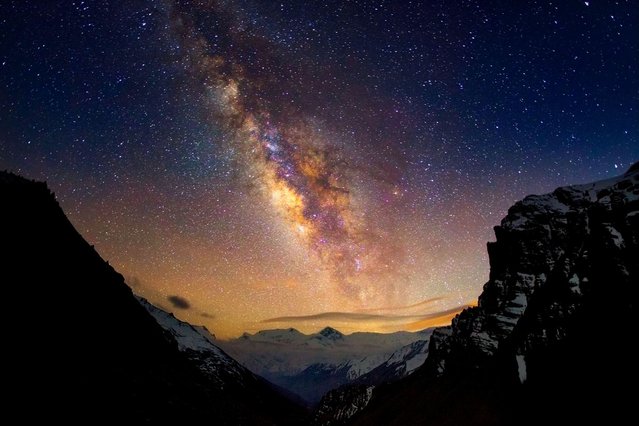
Amazing Milky Way Photos by Photographer Anton Jankovoy

Anton Jankovoy is professional travel-photographer, shooting in such genres as travel, landscape and portrait photography. Anton has obtained a bronze award at the “FEP (Federation of European Photographers) Professional Photographer of the Year 2011” and bronze award in the russian speaking countries at “Best Photographer 2011”. Anton Jankovoy: «My only aspiration in a photography is to wake up in everybody the realization of life. That is the only one way to feel this world the way it is and how it was created for us, the way the children see it». (Photo by Anton Jankovoy)
Details
01 Apr 2013 12:00:00


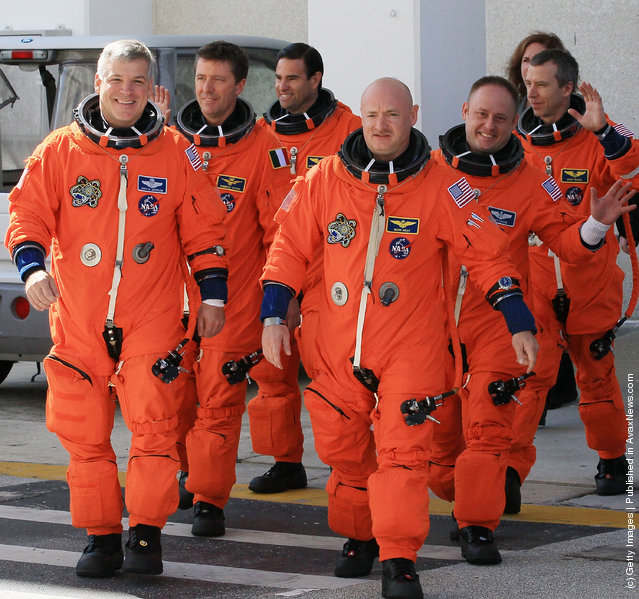
(L-R), Pilot Gregory H. Johnson, European Space Agency astronaut Roberto Vittori, Mission Specialist Greg Chamitoff, Commander Mark Kelly, Pilot Gregory H. Johnson, Mission Specialist Michael Fincke, and Mission Specialist Andrew Feustel, participate in a Terminal Countdown Demonstration Test (TCDT), at the Kennedy Space Center, on April 1, 2011 in Cape Canaveral, Florida. The TCDT will culminate in a full dress rehearsal for the planned April 19th launch of Space Shuttle Endeavour’s final scheduled flight to the International Space Station before being retired. (Photo by Mark Wilson/Getty Images)
Details
02 Apr 2011 12:17:00


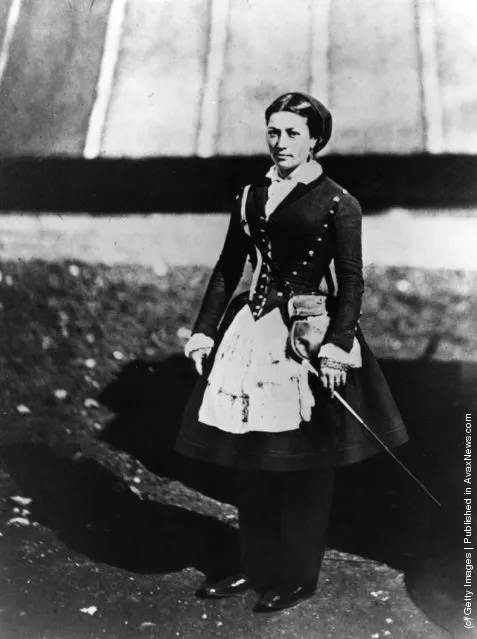
“The Crimean War (October 1853 – February 1856) was a conflict fought between the Russian Empire and an alliance of the French Empire, the British Empire, the Ottoman Empire, and the Kingdom of Sardinia. The war was part of a long-running contest between the major European powers for influence over territories of the declining Ottoman Empire. Most of the conflict took place on the Crimean Peninsula, but there were smaller campaigns in western Anatolia, Caucasus, the Baltic Sea, the Pacific Ocean and the White Sea”. – Wikipedia

Photo: A vivandiere, a female soldier selling provisions and spirits, with the Allied forces during the Crimean War. (Photo by Hulton Archive/Getty Images)
Details
18 Jul 2011 11:57:00
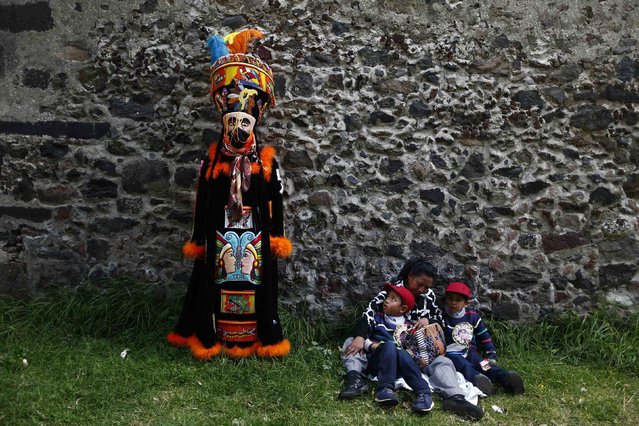
A boy sitting with his family looks up at a traditional Chinelo costumed dancer during a celebration 40 days after the birth of Jesus, in Xochimilco on the outskirts of Mexico City, February 2, 2015. (Photo by Edgard Garrido/Reuters)

A boy sitting with his family looks up at a traditional Chinelo costumed dancer during a celebration 40 days after the birth of Jesus, in Xochimilco on the outskirts of Mexico City, February 2, 2015. The tradition of the Chinelo dates back to colonial times and the outfits and masks, which are supposed to resemble the faces of the Europeans and always sport an uptilted beard, became more elaborate between the 1800s and 1900s to make fun of the upper social classes. (Photo by Edgard Garrido/Reuters)
Details
03 Feb 2015 13:09:00
The new Citroen Concept Car Divine DS is presented at the 2014 Paris Auto Show on October 2, 2014 in Paris on the first of the two press days. (Photo by Miguel Medina/AFP Photo)

The new Citroen Concept Car Divine DS is presented at the 2014 Paris Auto Show on October 2, 2014 in Paris on the first of the two press days. European carmakers are hoping to impress with new models at this week's Paris Motor Show and prove they have come out stronger from years of economic trouble and cost-cutting. (Photo by Miguel Medina/AFP Photo)
Details
05 Oct 2014 11:58:00