Loading...
Done
Greater Sage-Grouse

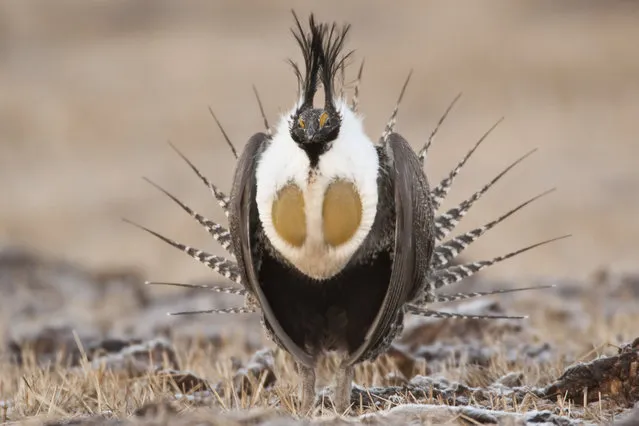
The Greater Sage-Grouse is certainly a formidable-looking bird. Being the largest grouse in North America and having tail feathers, which look like giant spikes, make for a ferocious sight. These birds are well known for their complicated courtship rituals, in which the males perform a special “strutting display” to attract the females. Another distinct feature of the Greater Sage-Grouse is two large yellow throat sacs (gular sacs), which are inflated by the males during the courtship display. Unlike pelicans, whose gular sacs are used to store fish while hunting, the throat sacks of the Greater Sage-Grouse are merely for display.
Details
21 Nov 2014 12:25:00
Skulls By Jim Skull

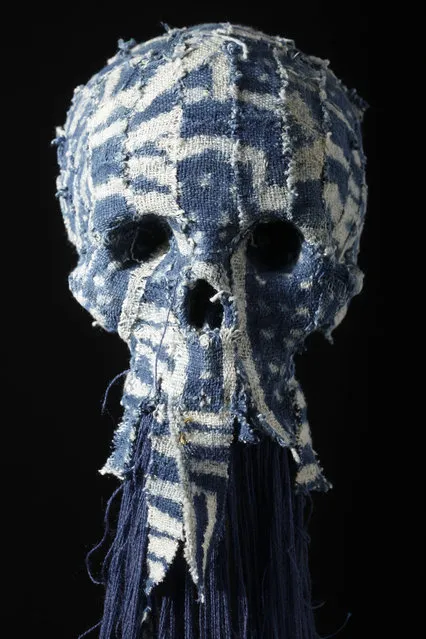
Inspired by personal experiences, a mix of cultures, rituals, and travelling the world, artist Jim Skull creates elaborate woven skull sculptures. He likes to be referred to as Jim Skull as a reflection of his interest in skulls; a symbol that he has been working with since the 1980s. He is currently living in France where he creates beautifully crafted sculptures out of rope, Papier-mâché, and other natural materials. He was born in New Caledonia and there’s no doubt that the influences of the tribal arts from Oceania, Africa, and North America are evident within his technique.
Details
11 Apr 2014 13:30:00


It looks like 2024 has ended and we are still alive (although of course it's not evening yet). Well, let's wish ourselves the same in the future. If someone wants to put USDT TRC20 under the tree: TDWPvSi7RY4wNZPukDRyKghhLGTGsRNRBe (nobody will put anything, of course – but you understand, it's a ritual). Happy New Year! And now disco.
Details
31 Dec 2024 04:28:00
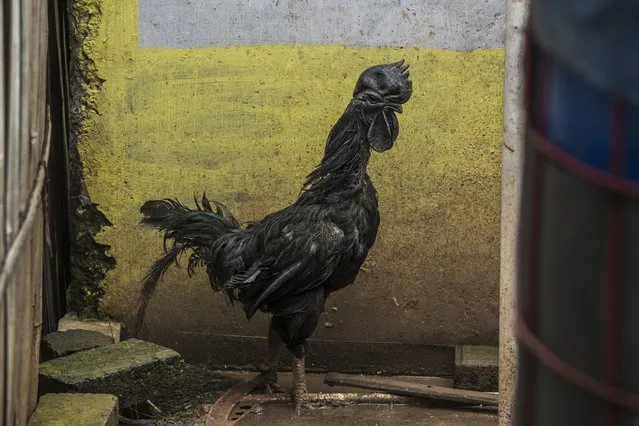
A rooster bred for its all black appearance walks through the yard of a small backyard farm on February 3, 2017 on the outskirts of Jakarta, Indonesia. (Photo by Ed Wray/Getty Images)

A rooster bred for its all black appearance walks through the yard of a small backyard farm on February 3, 2017 on the outskirts of Jakarta, Indonesia. The roosters, called Ayam Cemani, are completely black including their bones and meat and are often sold for use in rituals. (Photo by Ed Wray/Getty Images)
Details
06 Feb 2017 01:06:00
Devotees Practice Self Mutilation At Phuket Vegetarian Festival

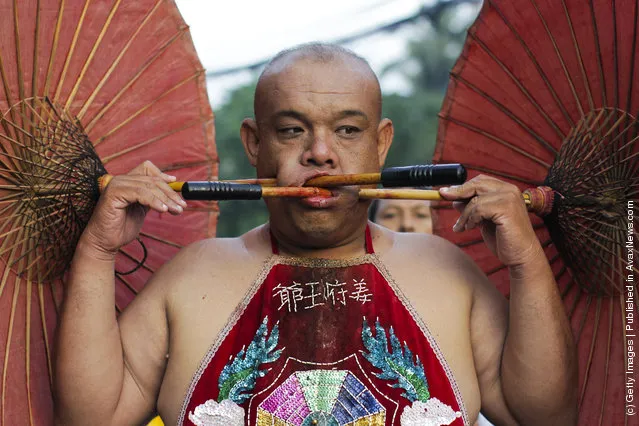
A devotee of the Chinese shrine of Kathu Shrine, pierces his cheeks with umbrellas during a procession of Vegetarian Festival on October 4, 2011 in Phuket, Thailand. Ritual Vegetarianism in Phuket Island traces it roots back to the early 1800's. The festival begins on the first evening of the ninth lunar month and lasts for nine days. Participants in the festival perform acts of body piercing as a means of shifting evil spirits from individuals onto themselves and bring the community good luck. (Photo by Athit Perawongmetha/Getty Images)
Details
04 Oct 2011 10:49:00


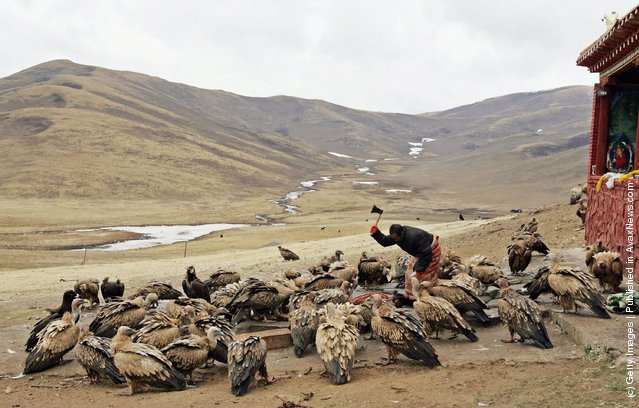
“Sky burial or ritual dissection was once a common funerary practice in Tibet wherein a human corpse is cut in specific locations and placed on a mountaintop, exposing it to the elements or the mahabhuta and animals – especially to birds of prey. The location of the sky burial preparation and place of execution are understood in the Vajrayana traditions as charnel grounds. In Tibet the practice is known as jhator, which literally means, «giving alms to the birds»”. – Wikipedia

Photo: A burial master chops bones of a body to feed vultures during a celestial burial ceremony on April 19, 2006 in Dari County of Guoluo Prefecture, Qinghai Province, northwest China. Celestial burial is a traditional funeral of Tibetan people, which began in the 7th century. (Photo by China Photos/Getty Images)
Details
18 Jun 2011 12:12:00
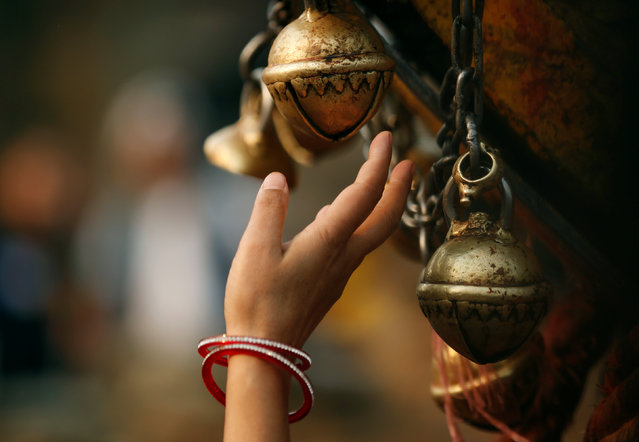
A hand of a devotee is pictured as she rings a bell while offering prayers to the chariot of God Bhairab during the Bisket festival in Bhaktapur, Nepal, April 13, 2016. (Photo by Navesh Chitrakar/Reuters)

A hand of a devotee is pictured as she rings a bell while offering prayers to the chariot of God Bhairab during the Bisket festival in Bhaktapur, Nepal, April 13, 2016. During the festival, also regarded as Nepalese New Year, images of the Hindu god Bhairava and his female counterpart Bhadrakali are enshrined in two large chariots and pulled to an open square after which rituals and festivities are performed. (Photo by Navesh Chitrakar/Reuters)
Details
15 Apr 2016 11:20:00
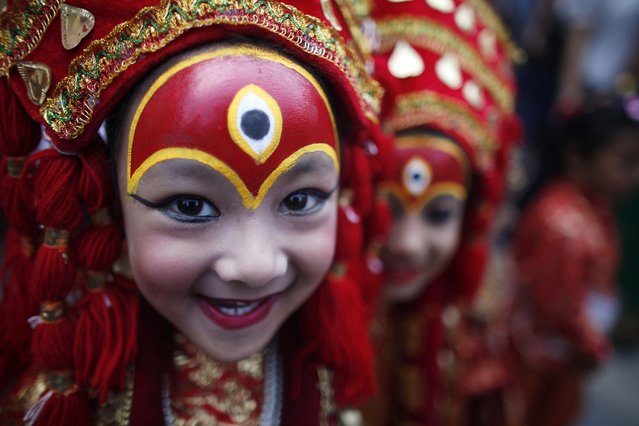
A young Nepalese girl dressed as a Kumari or living Goddess, smiles for camera as she waits for Kumari puja at Hanuman Dhoka, Basantapur Durbar Square in Katmandu, Nepal, Tuesday, Sept 17, 2013. More than hundred girls under the age of nine gathered for Kumari puja, a tradition of worshiping young pre-pubescent girls as manifestations of the divine female energy. The ritual holds a strong religious significance in Newar community. It is a community affair held primarily to save small girls from diseases and bad luck in the years to come. (AP Photo/Niranjan Shrestha)

The festival marks the end of the monsoon season and beginning of autumn. More than hundred girls under the age of nine gathered for the tradition of worshiping young pre-pubescent girls as manifestations of the divine female energy. The ritual holds a strong religious significance in Newar community. It is a community affair held primarily to save small girls from diseases and bad luck in the years to come. Photo: A young Nepalese girl dressed as a Kumari or living Goddess, smiles for camera as she waits for Kumari puja at Hanuman Dhoka, Basantapur Durbar Square in Katmandu, Nepal, Tuesday, September 17, 2013. (Photo by Niranjan Shrestha/AP Photo)
Details
18 Sep 2013 09:33:00