Loading...
Done
Baby Francois' Langur

“Francois' langur is one of several species of leaf monkeys. Over 50% of its diet is made up of young leaves. It will also consume fruits (17.2%), seeds, flowers, stems, roots, bark and occasionally minerals and insects off of rock surfaces and cliffs. This langur consumes its favorite food, young leaves, at the highest rate during the dry season, April through September, also known as the young leaf-lean period”. – Wikipedia

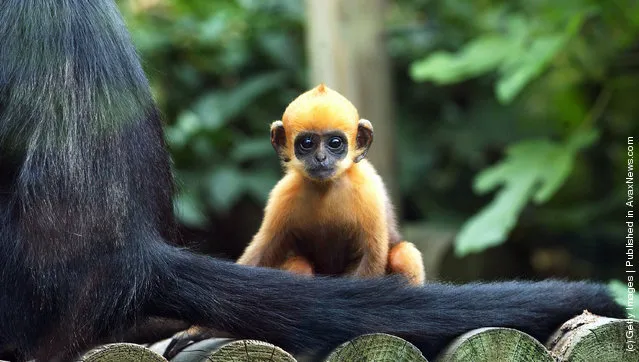
Photo: An endangered baby Francois' Langur monkey called Laa Laa settles in following her July 6 birth at London Zoo, Regent's Park on August 5, 2004 in London. The bright ginger youngster was born to glossy black parents Max and Shaneka and has the typical orange baby coat which is in stark contrast against the black of her parent's and older brother Grub's fur. (Photo by Steve Finn/Getty Images)
Details
22 Sep 2011 11:28:00
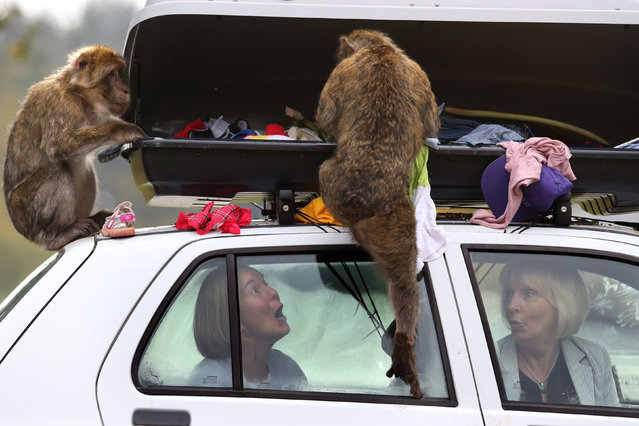
Sasha Muir and Margaret Davidson sit in a car as some of the 30 barbary macaques, known as the Middle Hill Troop after living between the top of Gibraltar rock and the town, show what happens when motorists forget to lock their luggage compartments, as Scotland’s only monkey drive-through section opens at Blair Drummond safari park in Stirling, Scotland on October 8, 2015. (Photo by Andrew Milligan/PA Wire)

Sasha Muir and Margaret Davidson sit in a car as some of the 30 barbary macaques, known as the Middle Hill Troop after living between the top of Gibraltar rock and the town, show what happens when motorists forget to lock their luggage compartments, as Scotland’s only monkey drive-through section opens at Blair Drummond safari park in Stirling, Scotland on October 8, 2015. (Photo by Andrew Milligan/PA Wire)
Details
13 Oct 2015 08:03:00
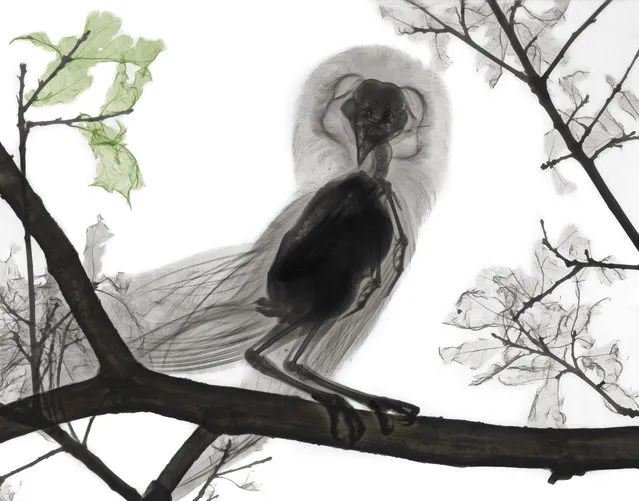
Coloured X-ray of a barn owl. A physicist has used X-ray to create an extraordinary collection of artwork. Arie van't Riets pictures reveal birds, fish, monkeys and flowers in an incredible new light. The 66-year-old, from Bathmen in the Netherlands, began X-raying flowers as a means to teach radiographers and physicians how the machine worked. But after adding a bit of colour to the pictures, the retired medical physicist realised the potential for an exciting new collection of art. (Photo by Arie van't Riet/Barcroft Media)

Coloured X-ray of a barn owl. A physicist has used X-ray to create an extraordinary collection of artwork. Arie van't Riets pictures reveal birds, fish, monkeys and flowers in an incredible new light. The 66-year-old, from Bathmen in the Netherlands, began X-raying flowers as a means to teach radiographers and physicians how the machine worked. But after adding a bit of colour to the pictures, the retired medical physicist realised the potential for an exciting new collection of art. (Photo by Arie van't Riet/Barcroft Media)
Details
08 Jul 2014 13:25:00
A member of security personnel stands on duty on an empty train platform inside a station on the Subway Line Number 1 on the eve of the Chinese Lunar New Year, in Beijing, China, February 7, 2016. According to local media, traffic in Beijing has seen a rare relief from its usual heavy pressure after 15 million people have left the city, heading for family reunions in their hometowns on the eve of the Chinese Lunar New Year of Monkey. (Photo by Jason Lee/Reuters)

A member of security personnel stands on duty on an empty train platform inside a station on the Subway Line Number 1 on the eve of the Chinese Lunar New Year, in Beijing, China, February 7, 2016. According to local media, traffic in Beijing has seen a rare relief from its usual heavy pressure after 15 million people have left the city, heading for family reunions in their hometowns on the eve of the Chinese Lunar New Year of Monkey. (Photo by Jason Lee/Reuters)
Details
08 Feb 2016 11:11:00
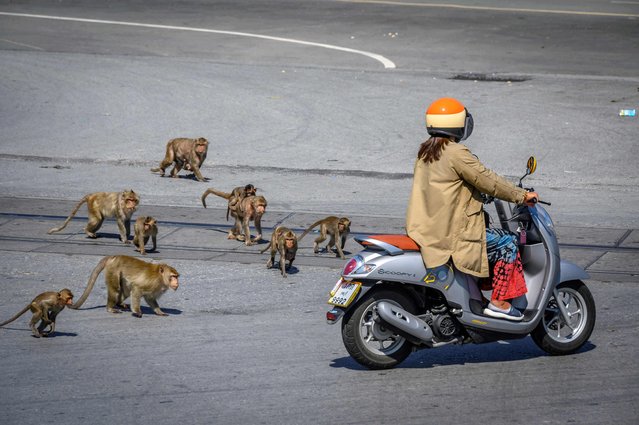
This picture taken on June 20, 2020 shows longtail macaques chasing a woman on a scooter in the town of Lopburi, some 155km north of Bangkok. Residents barricaded indoors, rival gang fights and no-go zones for humans. Welcome to Lopburi, an ancient Thai city overrun by monkeys super-charged on junk food, whose population is growing out of control. (Photo by Mladen Antonov/AFP Photo)

This picture taken on June 20, 2020 shows longtail macaques chasing a woman on a scooter in the town of Lopburi, some 155km north of Bangkok. Residents barricaded indoors, rival gang fights and no-go zones for humans. Welcome to Lopburi, an ancient Thai city overrun by monkeys super-charged on junk food, whose population is growing out of control. (Photo by Mladen Antonov/AFP Photo)
Details
12 Jul 2020 00:05:00
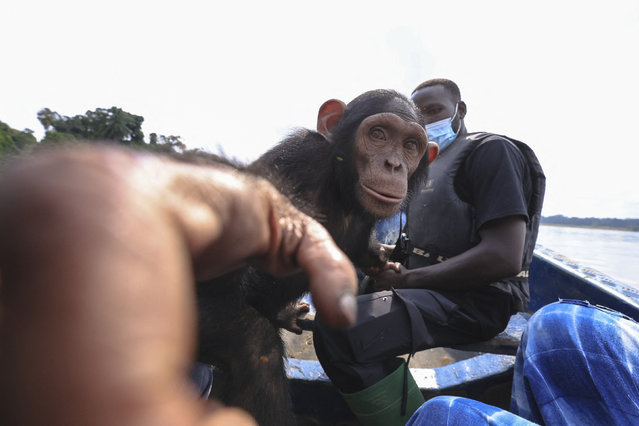
A young chimpanzee reacts on a pirogue with Rohmay Ndoulek, from the Papaye International association, during an outing in the Douala-Edea Natural Park in Marienberg on December 15, 2024. In the heart of Douala-Edea Natural Park, dedicated Cameroonian caretakers tend to and rehabilitate chimpanzees, victims of poaching and deforestation, at Papaye International, a sanctuary dubbed a “monkey paradise”. Founded in 2001, the association funded by 30 million friends and the Brigitte Bardot Foundation regularly receives eco-volunteers from all over the world. (Photo by Daniel Beloumou Olomo/AFP Photo)

A young chimpanzee reacts on a pirogue with Rohmay Ndoulek, from the Papaye International association, during an outing in the Douala-Edea Natural Park in Marienberg on December 15, 2024. In the heart of Douala-Edea Natural Park, dedicated Cameroonian caretakers tend to and rehabilitate chimpanzees, victims of poaching and deforestation, at Papaye International, a sanctuary dubbed a “monkey paradise”. Founded in 2001, the association funded by 30 million friends and the Brigitte Bardot Foundation regularly receives eco-volunteers from all over the world. (Photo by Daniel Beloumou Olomo/AFP Photo)
Details
12 Jan 2025 04:28:00
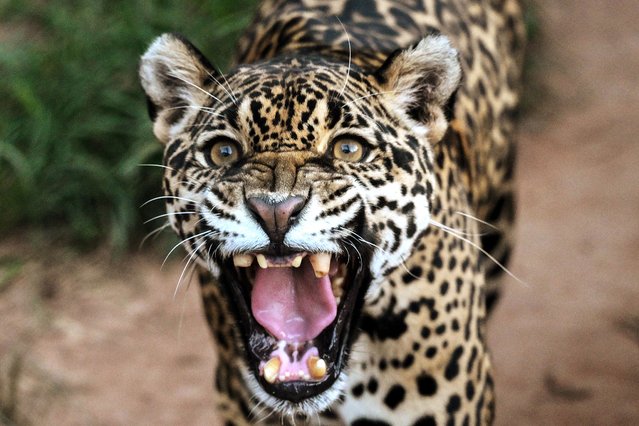
A jaguar (Panthera onca) growls at the Mata Ciliar association, an organization for the conservation of biodiversity, in Jundiai, Sao Paulo state, Brazil on May 29, 2025. Twenty-five pumas and ten jaguars are currently recovering at the Brazilian Center for the Conservation of Neotropical Felines at Mata Ciliar, a site as large as 40 football fields where monkeys, wild dogs, maned wolves, ocelots, and other regional animals are also rehabilitated. (Photo by Nelson Almeida/AFP Photo)

A jaguar (Panthera onca) growls at the Mata Ciliar association, an organization for the conservation of biodiversity, in Jundiai, Sao Paulo state, Brazil on May 29, 2025. Twenty-five pumas and ten jaguars are currently recovering at the Brazilian Center for the Conservation of Neotropical Felines at Mata Ciliar, a site as large as 40 football fields where monkeys, wild dogs, maned wolves, ocelots, and other regional animals are also rehabilitated. (Photo by Nelson Almeida/AFP Photo)
Details
22 Jun 2025 02:21:00
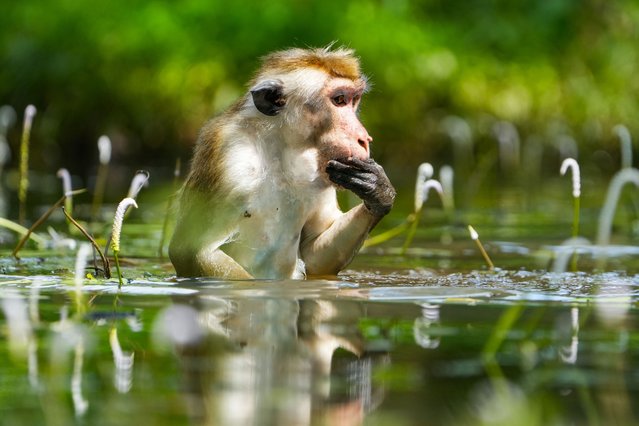
A toque macaque is eating flowers in the water at the pilgrimage site in Polonnaruwa, Sri Lanka, on January 13, 2024. The toque macaque (Macaca sinica), a reddish-brown-colored Old World monkey, is endemic to Sri Lanka, where it is known as the rilewa or rilawa. It is named for the whorl of hair at the crown of its head, which resembles a brimless toque cap. (Photo by Thilina Kaluthotage/NurPhoto/Rex Features/Shutterstock)

A toque macaque is eating flowers in the water at the pilgrimage site in Polonnaruwa, Sri Lanka, on January 13, 2024. The toque macaque (Macaca sinica), a reddish-brown-colored Old World monkey, is endemic to Sri Lanka, where it is known as the rilewa or rilawa. It is named for the whorl of hair at the crown of its head, which resembles a brimless toque cap. (Photo by Thilina Kaluthotage/NurPhoto/Rex Features/Shutterstock)
Details
10 Feb 2024 09:30:00