Loading...
Done
The Borges' family pet dog, Little, is placed on the back of Tom, their tiger, for a photo to be taken, in Maringa, Brazil, Friday, September 27, 2013. The Brazilian family is now locked in a legal dispute for the big cats, they have eight tigers and two lions, with federal wildlife officials working to take them away. While Borges does have a license to raise the animals, Brazilian wildlife officials say he illegally bred the cats, creating a public danger. (Photo by Renata Brito/AP Photo)

“Ary Borges and his family live in southern Brazil like most families the Borges' love animals and have an array of cats living in their home. The only difference between the cats owned by the Borges family and the cat that is cuddled up on your lap as you read this is the Borges' cats weigh over 700 pounds and could kill you just as soon as look at you. The Borges family shares their home with nine tigers, two lionesses, a chimp and a Chihuahua”. – Amanda Schiavo via Latin Times. Photo: The Borges' family pet dog, Little, is placed on the back of Tom, their tiger, for a photo to be taken, in Maringa, Brazil, Friday, September 27, 2013. (Photo by Renata Brito/AP Photo)
Details
04 Oct 2013 11:51:00
In this Thursday, July 10, 2014, photo, Mike Fitzgerald, right, teaches behind a sample display of cannabis-infused products during a cooking class at the New England Grass Roots Institute in Quincy, Mass. Some pot users turn to edibles because they don't like to inhale or smell the smoke, or just want variety or a longer lasting, more intense high. (Photo by Michael Dwyer/AP Photo)

The proliferation of marijuana edibles for both medical and recreational purposes is giving rise to a cottage industry of baked goods, candies, infused oils, cookbooks and classes that promises a slow burn as more states legalize the practice and awareness spreads about the best ways to deliver the drug. Edibles and infused products such as snack bars, olive oils and tinctures popular with medical marijuana users have flourished into a gourmet market of chocolate truffles, whoopie pies and hard candies as Colorado and Washington legalized the recreational use of marijuana in the past year. Photo: In this Thursday, July 10, 2014, photo, Mike Fitzgerald, right, teaches behind a sample display of cannabis-infused products during a cooking class at the New England Grass Roots Institute in Quincy, Mass. (Photo by Michael Dwyer/AP Photo)
Details
21 Jul 2014 11:02:00
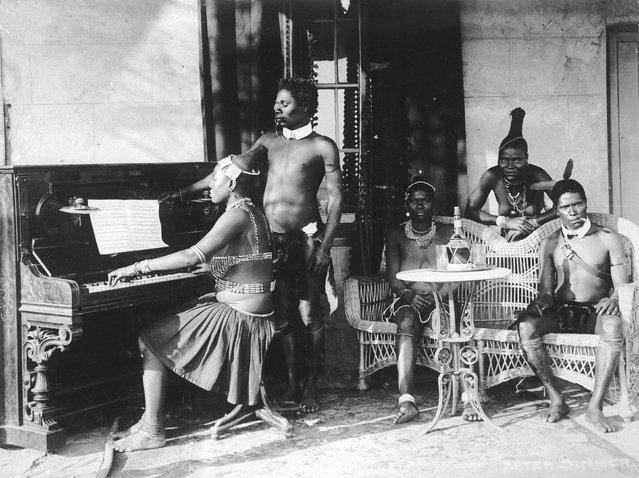
circa 1925:  A Zulu woman playing the piano while a group of others sit and listen.  (Photo by General Photographic Agency/Getty Images)

“The Zulu are the largest South African ethnic group, with an estimated 10–11 million people living mainly in the province of KwaZulu-Natal. Small numbers also live in Zimbabwe, Zambia, and Mozambique. Their language, Zulu, is a Bantu language; more specifically, part of the Nguni subgroup. The Zulu Kingdom played a major role in South African history during the 19th and 20th centuries. Under apartheid, Zulu people were classed as third-class citizens and suffered from state-sanctioned discrimination. They remain today the most numerous ethnic group in South Africa, and now have equal rights along with all other citizens”. – Wikipedia.

Photo: A Zulu woman playing the piano while a group of others sit and listen (to put it briefly, Englishmen scoff over Zulu). South Africa, circa 1925. (Photo by General Photographic Agency)

Details
03 Feb 2014 09:40:00
A female member of the anti-balaka, a Christian militia, patrols with other militiamen outside village of Zawa April 8, 2014. (Photo by Goran Tomasevic/Reuters)

Anti-balaka militia originally sprang up to protect the Christian population of the Central African Republic, but now stand accused of human rights abuses themselves. Last month, the African Union branded militia targeting Muslims in Central African Republic as “terrorists” and said they would be treated as enemy combatants, a day after killing a Congolese peacekeeper and amid deepening international frustration at continuing violence in the impoverished and landlocked country. Photo: A female member of the anti-balaka, a Christian militia, patrols with other militiamen outside village of Zawa April 8, 2014. (Photo by Goran Tomasevic/Reuters)
Details
10 Apr 2014 10:26:00
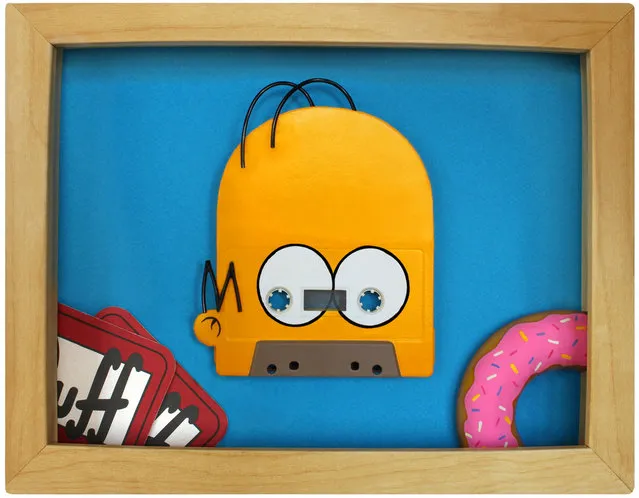
Cassette Tape Art By Benoit Jammes

So I'm a 33 year old graphic designer, and I live in Paris, France
This work on cassette tapes is entirely handmade, with a bit of work but so nostalgia... It so happened that I found a bunch of old cassettes at home; seeing them brought me back, in thought, to an earlier time, the 80s, and to me as a kid. In any case, I could not play them any more so resurrecting them sounded like a good idea...it was sound, it became visual! And I am pretty sure they are more happy now than in a shoebox :-)
I think people from my generation relate to this work because many enjoy the funny side of it, the references. They are happy to see that these old cassette tapes managed to start a new life!

Signed and numbered prints are available for sale.

Benoit Jammes

Details
11 Apr 2013 11:06:00
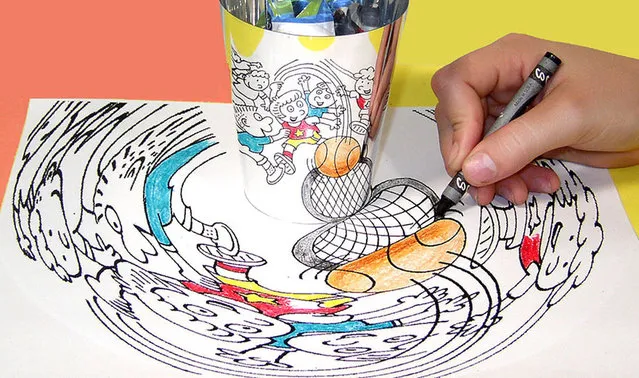
Anamorphic Art By Jonty Hurwitz

The truth can never be seen right away. Only by looking from a certain angle can we view the true nature of things. At other times, only with the help of some special object can we discern order in chaos. Anamorphosis is a form of art that allows us to see an object only by viewing it from a certain angle or by using cylindrical or conical mirror. Unsurprisingly, the first person in history to ever use this type of technique was the Leonardo Da Vinci. During late Renaissance period this technique was popularized as a children’s toy. Now, however, few people use this form of imagery due to its intricacy. Istvan Orosz, born in 1951, is one of the few people who specialize in anamorphosis. In our opinion, his most stunning piece of art is the one where a shipwreck scene turns into a portrait when viewed through a cylindrical mirror. (Photo by Jonty Hurwitz)
Details
05 Jan 2015 13:07:00
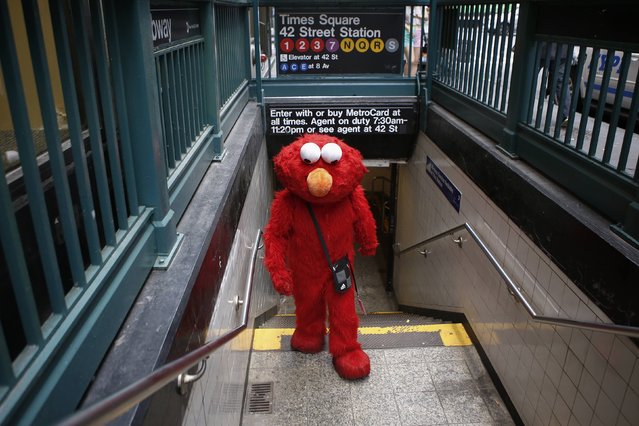
Jorge, an immigrant from Mexico, exits a subway station dressed as the Sesame Street character Elmo in Times Square, New York July 30, 2014. (Photo by Eduardo Munoz/Reuters)

Jorge, an immigrant from Mexico, exits a subway station dressed as the Sesame Street character Elmo in Times Square, New York July 30, 2014. Elmo and Cookie Monster have long delighted young viewers on TV's “Sesame Street”, but the recent antics of New York street performers dressed as the beloved characters have drawn the ire of city officials and now the show's producers. Sesame Workshop, which owns the rights to Big Bird, Ernie and the assorted puppet monsters on the 45-year-old program, said on July 29, 2014 it was drafting plans to stop performers who dress up as the characters from appearing in Times Square, where they pose for photos with tourists and then demand tips. (Photo by Eduardo Munoz/Reuters)
Details
05 Aug 2014 11:50:00
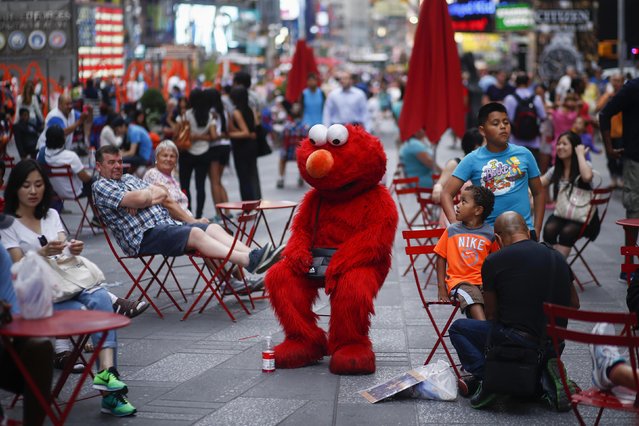
Jorge, an immigrant from Mexico, dressed as the Sesame Street character Elmo rests in Times Square, New York July 29, 2014.  Elmo and Cookie Monster have long delighted young viewers on TV's “Sesame Street”, but the recent antics of New York street performers dressed as the beloved characters have drawn the ire of city officials and now the show's producers. (Photo by Eduardo Munoz/Reuters)

Jorge, an immigrant from Mexico, dressed as the Sesame Street character Elmo rests in Times Square, New York July 29, 2014. Elmo and Cookie Monster have long delighted young viewers on TV's “Sesame Street”, but the recent antics of New York street performers dressed as the beloved characters have drawn the ire of city officials and now the show's producers. Sesame Workshop, which owns the rights to Big Bird, Ernie and the assorted puppet monsters on the 45-year-old program, said on July 29, 2014 it was drafting plans to stop performers who dress up as the characters from appearing in Times Square, where they pose for photos with tourists and then demand tips. (Photo by Eduardo Munoz/Reuters)
Details
02 Aug 2014 13:25:00