Loading...
Done
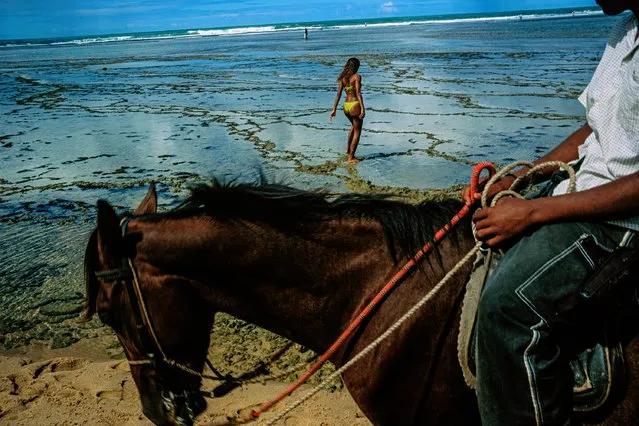
Praia du Forte, Bahia. “This was the lead picture for a National Geographic story on Bahia, because it was both mysterious as well as a “geography” picture showing where the slaves arrived from Nigeria. Beach pictures seem like they should be easy to take, but for me they are actually quite difficult. Too easy to fall into cliche. When I saw the kid coming on the horse, I quickly ran to see if I could make something with a woman in a bikini that was not a bikini shot”. (Photo by David Alan Harvey/The Guardian)

Praia du Forte, Bahia. “This was the lead picture for a National Geographic story on Bahia, because it was both mysterious as well as a “geography” picture showing where the slaves arrived from Nigeria. Beach pictures seem like they should be easy to take, but for me they are actually quite difficult. Too easy to fall into cliche. When I saw the kid coming on the horse, I quickly ran to see if I could make something with a woman in a bikini that was not a bikini shot”. (Photo by David Alan Harvey/The Guardian)
Details
20 Aug 2016 11:35:00
Students of the "Escola de Papai Noel do Brasil" (Brazil's school of Santa Claus)  travel on a ferry through Guanabara bay, during their graduation ceremony in Rio de Janeiro, Brazil, November 10, 2015. (Photo by Pilar Olivares/Reuters)

Students of the "Escola de Papai Noel do Brasil" (Brazil's school of Santa Claus) travel on a ferry through Guanabara bay, during their graduation ceremony in Rio de Janeiro, Brazil, November 10, 2015. The school holds 4 days' lessons in Santa-training, teaching Christmas carols, how to interact with children, and also how to wear the heavy red suit in Rio's typical 104-degree (40 degrees celsius) summer weather that is common around the holidays. (Photo by Pilar Olivares/Reuters)
Details
13 Nov 2015 08:01:00
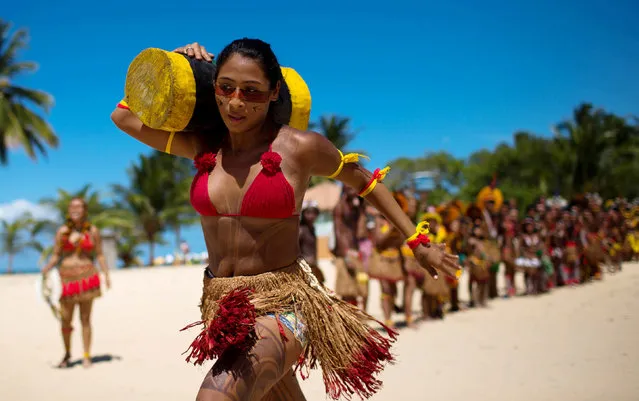
A native Brazilian competes in a tora competition, which is a race while carrying a log, during the Indigenous Youth Games of Pataxos nation in Santa Cruz de Cabralia, Bahia state, Brazil, April 18, 2016. (Photo by Roosevelt Cassio/Reuters)

A native Brazilian competes in a tora competition, which is a race while carrying a log, during the Indigenous Youth Games of Pataxos nation in Santa Cruz de Cabralia, Bahia state, Brazil, April 18, 2016. (Photo by Roosevelt Cassio/Reuters)
Details
20 Apr 2016 12:24:00
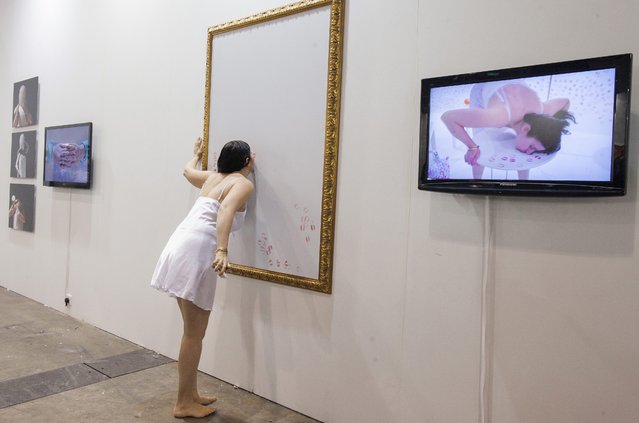
Turkish artist Nezaket Ekici performs a live art performance entitled 'Emotion in Motion' on the first day of Art Basel 2015, Hong Kong, China, 13 March 2015. Art Basel 2015 features 233 galleries from 37 countries and territories. (Photo by Alex Hofford/EPA)

Turkish artist Nezaket Ekici performs a live art performance entitled 'Emotion in Motion' on the first day of Art Basel 2015, Hong Kong, China, 13 March 2015. The Hong Kong show of Art Basel features 233 galleries from 37 countries and territories, presenting works ranging from the Modern period of the early 20th century to the most contemporary artists of today, according to the official press release. (Photo by Alex Hofford/EPA)
Details
18 Mar 2015 11:22:00
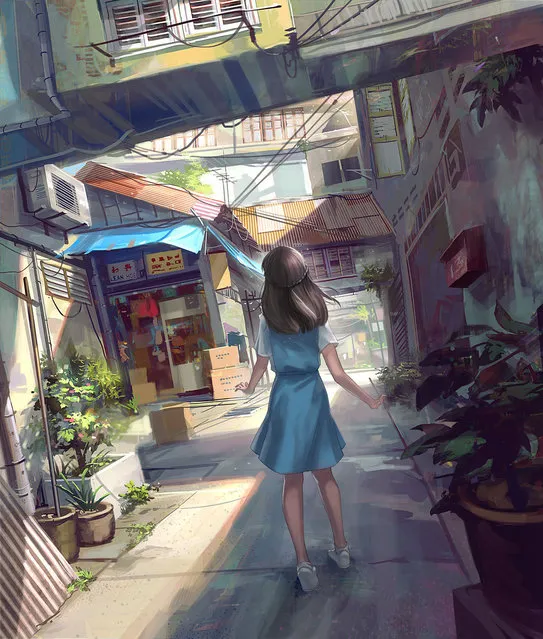
The Art Of FeiGiap

There's something inherently Ghibli-esque about Chong FeiGiap's beautiful paintings, capturing that sense of wonder typically present in the best animes the studio had to offer, as well as a dash of Tekkon Kinkreet's amazingly colorful, complex cities.
Details
03 Oct 2013 11:12:00
A visitor passes behind the sculpture “Puma-Dentist” made with plastic, wax and original heads of a puma and a hind by Austrian artist Deborah Sengl during an exhibition at the art gallery Deschler in Berlin April 15, 2008. (Photo by Fabrizio Bensch/Reuters)

A visitor passes behind the sculpture “Puma-Dentist” made with plastic, wax and original heads of a puma and a hind by Austrian artist Deborah Sengl during an exhibition at the art gallery Deschler in Berlin April 15, 2008. (Photo by Fabrizio Bensch/Reuters)
Details
11 Mar 2014 07:55:00
Members of Brazil's Movimento dos Sem-Teto (Roofless Movement) stand in the hallway of one of the 11 empty buildings that the movement took over recently, in the centre of Sao Paulo, November 6, 2012. According to City Hall, there are some 400,000 people in need of stable housing, including the 4,000 families of the Roofless Movement who are squatting in abandoned or vacant buildings that range from apartment blocks to hotels, in Sao Paulo, the largest city in South America. Picture taken November 6, 2012

Members of Brazil's Movimento dos Sem-Teto (Roofless Movement) stand in the hallway of one of the 11 empty buildings that the movement took over recently, in the centre of Sao Paulo, November 6, 2012. According to City Hall, there are some 400,000 people in need of stable housing, including the 4,000 families of the Roofless Movement who are squatting in abandoned or vacant buildings that range from apartment blocks to hotels, in Sao Paulo, the largest city in South America. (Photo by Nacho Doce/Reuters)
Details
18 Dec 2012 09:40:00
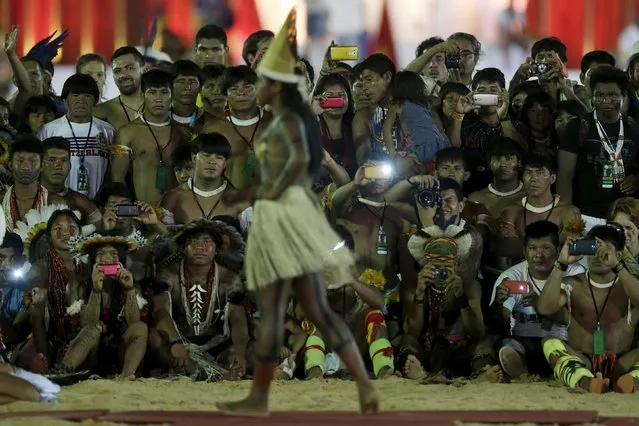
An indigenous woman participates in a parade called "International Indigenous Beauty" during the first World Games for Indigenous Peoples in Palmas, Brazil, October 24, 2015. (Photo by Ueslei Marcelino/Reuters)

An indigenous woman participates in a parade called "International Indigenous Beauty" during the first World Games for Indigenous Peoples in Palmas, Brazil, October 24, 2015. Billed as the indigenous Olympics, the games are expected to attract nearly 2,000 athletes from dozens of Brazilian ethnicities, as well as from such far-flung nations as Ethiopia and New Zealand. (Photo by Ueslei Marcelino/Reuters)
Details
28 Oct 2015 08:04:00