Loading...
Done
A reveler strikes a pose during an unofficial carnival block party referred to as “blocos”, in Rio de Janeiro, Brazil, Saturday, February 26, 2022. (Photo by Silvia Izquierdo/AP Photo)

A reveler strikes a pose during an unofficial carnival block party referred to as “blocos”, in Rio de Janeiro, Brazil, Saturday, February 26, 2022. City Hall banned all blocos, the tightly packed street parties attended by those who cannot or don't want to buy pricey tickets for the official parade at the Sambadrome, due to a wave of the Omicron variant. (Photo by Silvia Izquierdo/AP Photo)
Details
28 Feb 2022 04:52:00
Watchdog Group Mocks Google On Capitol Hill

J. Schwartz (C) and Marianne Wittelsberger (2nd R) of Consumer Watchdog dress as members of the “Google Track Team” in a hallway of the Dirksen Senate Office Building prior to a hearing on Google September 21, 2011 on Capitol Hill in Washington, DC. Members of Consumer Watchdog attended the antitrust hearing dressed as the “Google Track Team” in white tracksuits emblazoned with Google's motto, “Don't be evil”, wearing “Wi-Spy” glasses and pretending to track unsuspecting people during the event. (Photo by Alex Wong/Getty Images)
Details
23 Sep 2011 10:26:00
Semiotic Alpine Escape By Armin Senoner

Armin Senoner conceptualizes class system based semiotic alpine escape all visuals courtesy of armin senoner. From birth, every human is organized through the hierarchical class system. Without regard to personal characteristics in the least, each is donned with a label; lower, middle, or upper. Society at large is innately regulated because by it, the rich do anything to remain at the top, the middle tries to overthrow the rich, and the poor just try to survive. Modern times, though less brutal, is no less restrained by the unspoken rules of social division.
Details
01 Jul 2015 13:22:00
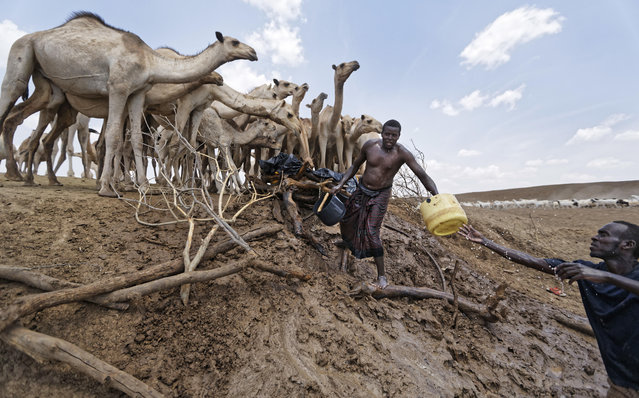
Camel herders scoop up water in plastic buckets from one of the few watering holes in the area, to water their animals near the drought-affected village of Bandarero, near Moyale town on the Ethiopian border, in northern Kenya, Friday, March 3, 2017. The U.N. humanitarian chief, Stephen O'Brien, toured Bandarero village on Friday and called on the international community to act to “avert the very worst of the effects of drought and to avert a famine to make sure we don't go from what is deep suffering to a catastrophe”. (Photo by Ben Curtis/AP Photo)

Camel herders scoop up water in plastic buckets from one of the few watering holes in the area, to water their animals near the drought-affected village of Bandarero, near Moyale town on the Ethiopian border, in northern Kenya, Friday, March 3, 2017. The U.N. humanitarian chief, Stephen O'Brien, toured Bandarero village on Friday and called on the international community to act to “avert the very worst of the effects of drought and to avert a famine to make sure we don't go from what is deep suffering to a catastrophe”. (Photo by Ben Curtis/AP Photo)
Details
05 Mar 2017 00:03:00
Voodoo pilgrims bathe in a waterfall believed to have purifying powers during the annual celebration in Saut d' Eau, Haiti, Saturday, July 16, 2016. Annually, the falls are the site of a large, important religious pilgrimage, during the festival of Our Lady of Carmel, from July 14–16. A Eucharistic rite is held during the festival, as well as various vodou rituals, but the penultimate devotional activity is bathing in the waters of the falls, and asking favors of the Virgin or Erzulie. After bathing, voodoo pilgrims throw away the dresses they wore to the site, and don new clothes for good luck. (Photo by Dieu Nalio Chery/AP Photo)

Voodoo pilgrims bathe in a waterfall believed to have purifying powers during the annual celebration in Saut d' Eau, Haiti, Saturday, July 16, 2016. Annually, the falls are the site of a large, important religious pilgrimage, during the festival of Our Lady of Carmel, from July 14–16. A Eucharistic rite is held during the festival, as well as various vodou rituals, but the penultimate devotional activity is bathing in the waters of the falls, and asking favors of the Virgin or Erzulie. After bathing, voodoo pilgrims throw away the dresses they wore to the site, and don new clothes for good luck. (Photo by Dieu Nalio Chery/AP Photo)
Details
18 Jul 2016 13:02:00
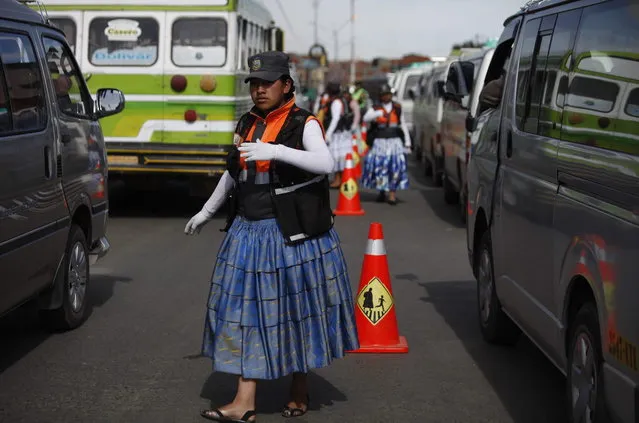
In this December 3, 2013 photo, an Aymara woman cops directs traffic on the streets of El Alto, Bolivia. The women wear the bright petticoats and shawls of indigenous women in the Andes, called cholitas in Bolivian slang, the main difference being that instead of bowler hats they wear khaki green police-style caps. Some don fluorescent traffic vests. (Photo by Juan Karita/AP Photo)

“This city in Bolivia's highlands has hired Aymara women dressed in traditional multilayered Andean skirts and brightly embroidered vests to work as traffic cops and bring order to its road chaos. About 20 of the “traffic cholitas” have been trained to direct cars and buses in El Alto, a teeming, impoverished sister city of La Paz in Bolivia's Andes mountains”. – El Alto via Associated Press. Photo: In this December 3, 2013 photo, an Aymara woman cops directs traffic on the streets of El Alto, Bolivia. The women wear the bright petticoats and shawls of indigenous women in the Andes, called cholitas in Bolivian slang, the main difference being that instead of bowler hats they wear khaki green police-style caps. Some don fluorescent traffic vests. (Photo by Juan Karita/AP Photo)
Details
25 Dec 2013 10:48:00
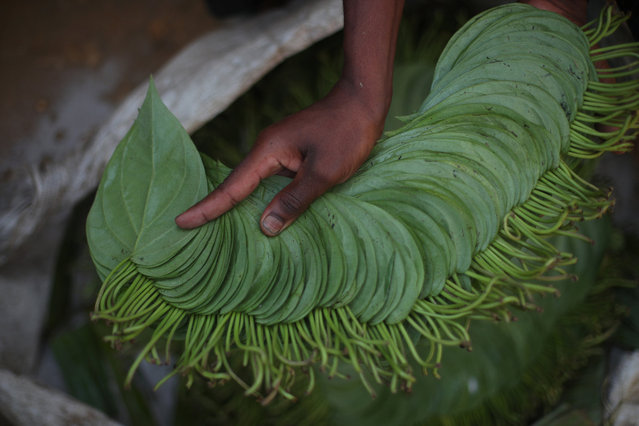
Faruk, 17, a Rohingya refugee trader holds betel leaves which are on sale at a stall in Palong Khali refugee camp near Cox's Bazar, Bangladesh, November 3, 2017. He left his village in Myanmar when the military opened fire towards the Rohingya. “I buy this betel leaf from Palong Khali market, in one bundle there are 160 pieces, I buy it for 80 taka and I sell it for 100 taka. Bangladeshi's and I sell for the same rate in the camp. Outside in the local market it is 80 taka per bundle. My problem is that I don't have money so I can't buy anything to eat, I can't buy fish to eat”, he said. (Photo by Hannah McKay/Reuters)

Faruk, 17, a Rohingya refugee trader holds betel leaves which are on sale at a stall in Palong Khali refugee camp near Cox's Bazar, Bangladesh, November 3, 2017. He left his village in Myanmar when the military opened fire towards the Rohingya. “I buy this betel leaf from Palong Khali market, in one bundle there are 160 pieces, I buy it for 80 taka and I sell it for 100 taka (1 Bangladeshi Taka = 0.012 US Dollar). Bangladeshi's and I sell for the same rate in the camp. Outside in the local market it is 80 taka per bundle. My problem is that I don't have money so I can't buy anything to eat, I can't buy fish to eat”, he said. (Photo by Hannah McKay/Reuters)
Details
27 Nov 2017 08:54:00
Tourists use a selfie stick on the Trocadero Square, with  the Eiffel Tower in background, in Paris, Tuesday, January 6, 2015. (Photo by Remy de la Mauviniere/AP Photo)

Tourists use a selfie stick on the Trocadero Square, with the Eiffel Tower in background, in Paris, Tuesday, January 6, 2015. Selfie sticks have become popular among tourists because you don't have to ask strangers to take your picture, and you can capture a wide view in a selfie without showing your arm. But some people find selfie sticks obnoxious, arguing that they detract from the travel experience. (Photo by Remy de la Mauviniere/AP Photo)
Details
09 Jan 2015 13:15:00