Loading...
Done
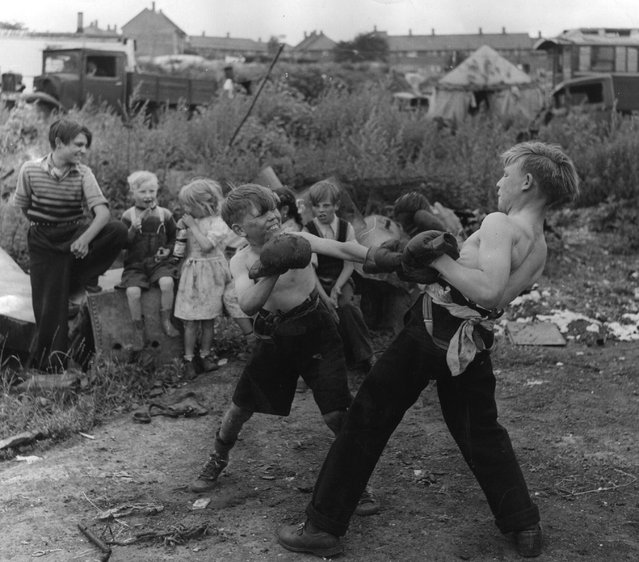
The unromantic gypsies. Children boxing in a gypsy camp in Kent, England on July 1, 1951. Like all boys these gypsy lads like to try their hand at boxing. Encouraged by their friends they fight it out on Corke's Meadow. Few Romanies now live a life of wandering romance. Most are like the three hundred squatters of Corke's Meadow, Kent, which is part of a “gypsy problem” that involves about 100,000 today. Of those about 25,000 can be rightly called gypsies, the rest are Mumpers and Posh-rats and Hobos. Corke's Meadow has both kinds. “Picture Post” cameraman Bert Hardy photographs the Corke's Meadow gypsies in their encampment. (Photo by Hulton-Deutsch Collection/Corbis via Getty Images)

The unromantic gypsies. Children boxing in a gypsy camp in Kent, England on July 1, 1951. Like all boys these gypsy lads like to try their hand at boxing. Encouraged by their friends they fight it out on Corke's Meadow. Few Romanies now live a life of wandering romance. Most are like the three hundred squatters of Corke's Meadow, Kent, which is part of a “gypsy problem” that involves about 100,000 today. Of those about 25,000 can be rightly called gypsies, the rest are Mumpers and Posh-rats and Hobos. Corke's Meadow has both kinds. “Picture Post” cameraman Bert Hardy photographs the Corke's Meadow gypsies in their encampment. (Photo by Hulton-Deutsch Collection/Corbis via Getty Images)
Details
12 Mar 2017 00:01:00
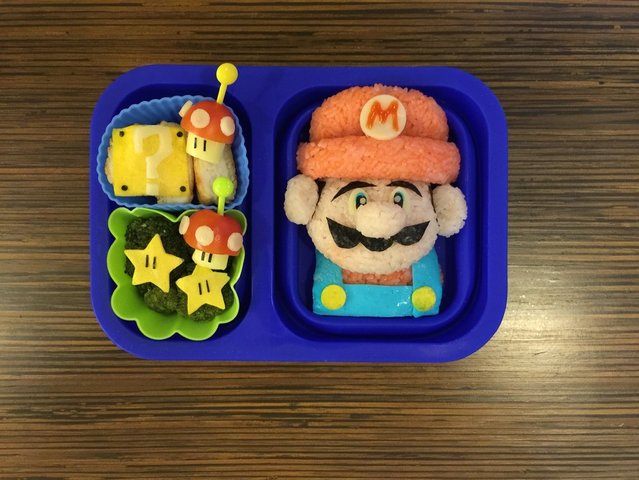
Food-Art By Nikki Garcia

A Filipino mother Nikki Garcia combined her love for arts and crafts with the Japanese tradition of bento boxes to combat her children’s eating habits.
Details
05 Jan 2016 08:04:00


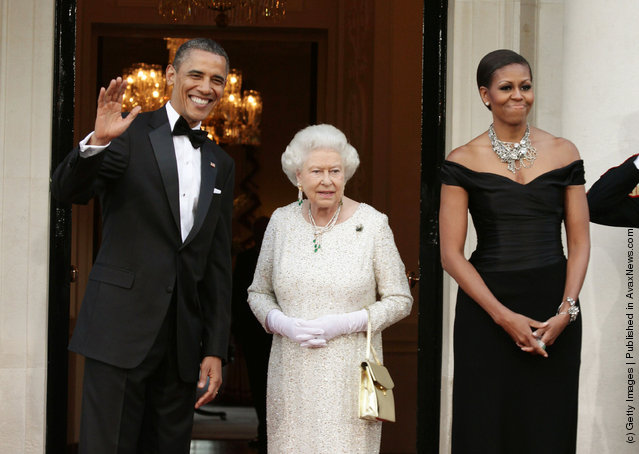
(L-R) U.S. President Barack Obama, Queen Elizabeth II and First Lady Michelle Obama arrive at Winfield House, the residence of the Ambassador of the United States of America, in Regent's Park, on May 25, 2011 in London, England. The 44th President of the United States, Barack Obama, and First Lady Michelle are in the UK for a two day State Visit at the invitation of HM Queen Elizabeth II. Last night they attended a state banquet at Buckingham Palace and today's events include talks at Downing Street and the President will address both houses of Parliament at Westminster Hall. (Photo by Yui Mok - WPA Pool/Getty Images)
Details
26 May 2011 10:29:00
Prayers And Messages To God Are Removed From The Western Wall

Men help remove messages and prayers written by thousands of people addressed to God from the cracks in the Western Wall in preparation for the up coming Jewish Passover holiday on March 28, 2012 in Jerusalem's old city, Israel. All the notes once collected will be buried in a special place at the Mount of Olives.according tro Jewish law. Passover begins in the evening of Friday, April 6 and commemorates the story of the Exodus where the ancient Israelites were freed from slavery in Egypt. (Photo by Uriel Sinai/Getty Images)
Details
29 Mar 2012 12:32:00


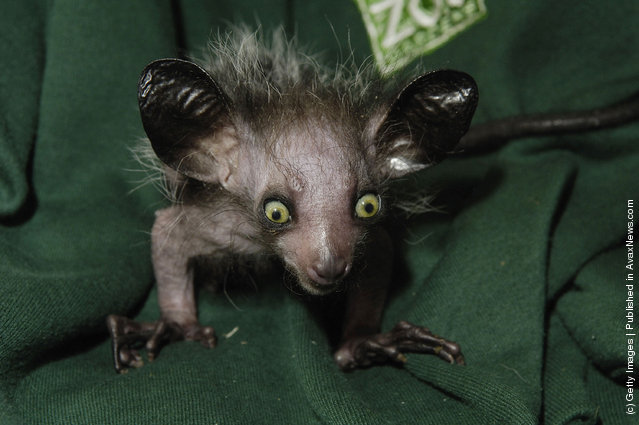
“The aye-aye (Daubentonia madagascariensis) is a lemur, a strepsirrhine primate native to Madagascar that combines rodent-like teeth and a special thin middle finger to fill the same ecological niche as a woodpecker. It is the world's largest nocturnal primate, and is characterized by its unusual method of finding food; it taps on trees to find grubs, then gnaws holes in the wood and inserts its narrow middle finger to pull the grubs out. The only other animal species known to find food in this way is the striped possum. From an ecological point of view the aye-aye fills the niche of a woodpecker as it is capable of penetrating wood to extract the invertebrates within”. – Wikipedia

Photo: In this handout image from Bristol Zoo is seen the first captive bred aye-aye in the UK named “Kintana” (meaning star in Malagasy) April 15, 2005 at Bristol Zoo Gardens, England. The zoo announced today only the second baby aye-aye to be hand-reared in the world (the first was in Jersey Zoo) and has now made his first public appearance since his birth on 11 February 2005. (Photo by Rob Cousins/Bristol Zoo via Getty Images)
Details
13 Apr 2011 13:33:00
In this November 18, 2014 photo, Murshida, 12, sits on the lap of her mother Marjina as the train leaves for their village in West Bengal, at a railway station in New Delhi, India. Six months ago, Marjina stepped off a train in New Delhi with her two children, hoping to find a better life after her husband abandoned them without so much as a goodbye. (Photo by Altaf Qadri/AP Photo)

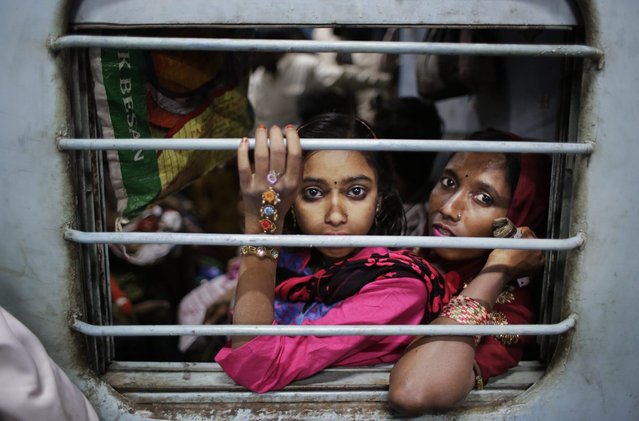
In this November 18, 2014 photo, Murshida, 12, sits on the lap of her mother Marjina as the train leaves for their village in West Bengal, at a railway station in New Delhi, India. Six months ago, Marjina stepped off a train in New Delhi with her two children, hoping to find a better life after her husband abandoned them without so much as a goodbye. The family spent their days at a landfill picking through other people’s garbage to find salvageable bits to resell or recycle. After six months of poverty, illness and shame, they returned to that train station in New Delhi, headed back to an uncertain future to their hometown in West Bengal. (Photo by Altaf Qadri/AP Photo)
Details
09 Dec 2014 09:47:00
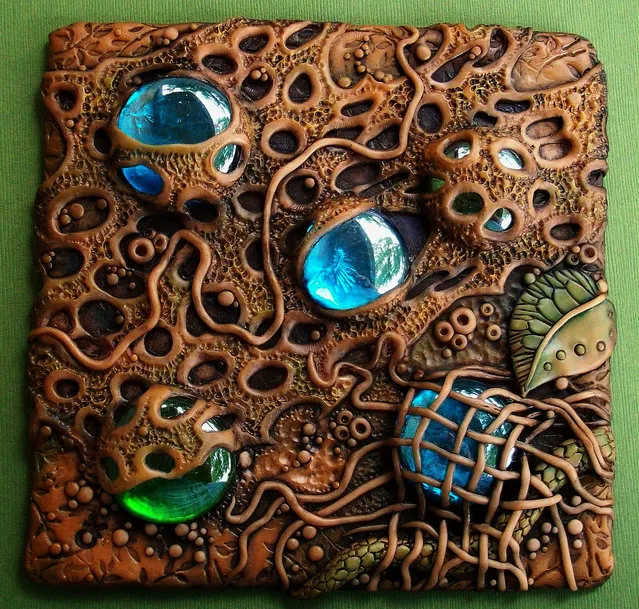
The Craft And Art Of Clay By Chris Kapono

My name is Chris Kapono and I am a self-taught artist living in Missouri. I have been drawing and painting ever since I can remember and art has been a big part of my life. My love of animals and nature is reflected in my art and sometimes interesting things I find on walks in the woods will find their way into some of my pieces!

Chris Kapono

Details
26 Aug 2015 14:25:00
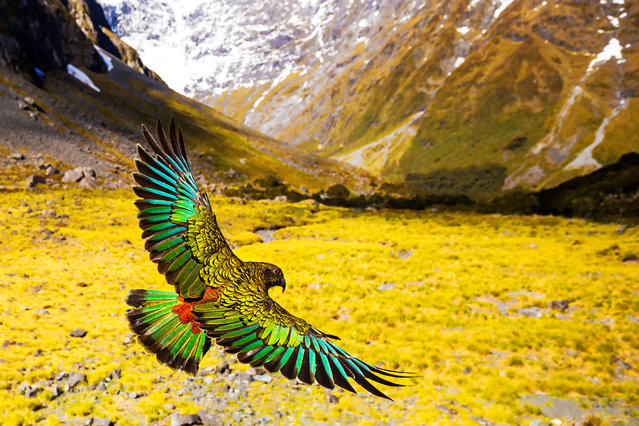
Kea are the only true alpine parrots in the world and thrive as cunning opportunists in the freezing conditions of the Southern Alps. Kea are thought to have developed their wide array of food-finding strategies during the last great ice age, where they learned to adapt using their unusual powers of curiosity. (Photo by Tom Walker/BBC Pictures/The Guardian)

Kea are the only true alpine parrots in the world and thrive as cunning opportunists in the freezing conditions of the Southern Alps. Kea are thought to have developed their wide array of food-finding strategies during the last great ice age, where they learned to adapt using their unusual powers of curiosity. (Photo by Tom Walker/BBC Pictures/The Guardian)
Details
19 Jul 2016 13:03:00