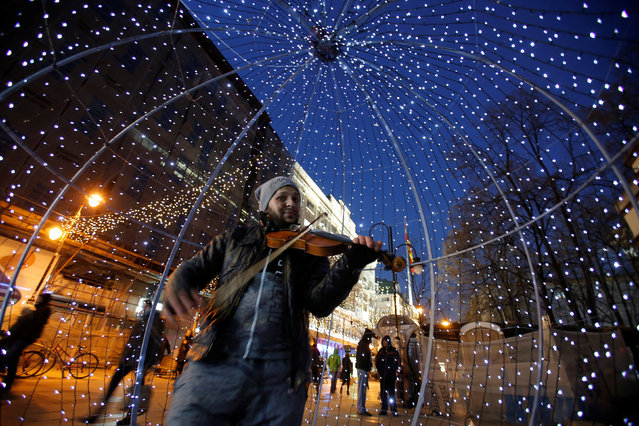
People are seen near a Christmas decoration installed on city Square for the upcoming New Year and Christmas season in Skopje, Macedonia December 23, 2016. (Photo by Ognen Teofilvovski/Reuters)
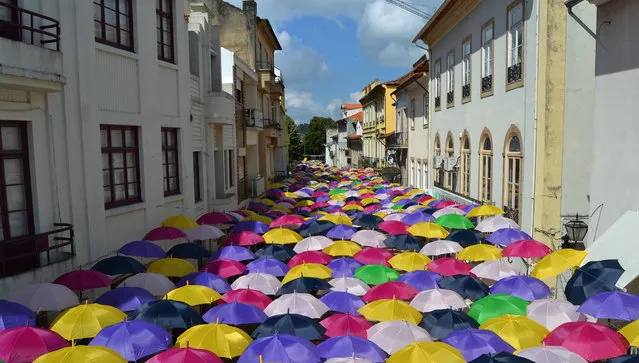
Agueda in Portugal is the setting for this wonderful installation by Sextafeira called Floating Umbrellas. This colorful creation is a part of the Agitagueda art festival. Due to the fact that the same idea was used last year this is the second time the streets of this town have been covered with loads of vivid umbrellas, providing shade, as well as a wonderful sight. The people loved it so much that the repetitive nature of the installation does not carry the risk of becoming boring, but rather turning into a wonderful tradition.
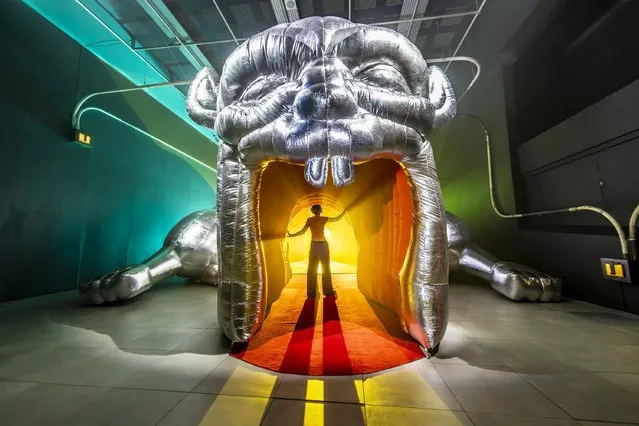
Surrender by Jenkin Van Zyl, a surreal installation at Fact Liverpool on November 16, 2023 featuring film and sculptural works inside a large inflatable silver rat. (Photo by James Glossop/The Times)
Professor Xie Yong works on an art installation of a beaver, which is made out of plastic and around 300,000 needles, in Shenyang, Liaoning province, July 23, 2013. The needles, according to Xie, represent the pain felt by animals when their fur is taken off to produce clothing. (Photo by Reuters/Stringer)
Roma people are seen in a Romani camp installed along La Petite Ceinture, an abandoned railroad line, in Paris, France, February 2, 2016. More than 350 Roma people, who have been living here since the last summer, face eviction from the makeshift camp this week. (Photo by Jacky Naegelen/Reuters)
The giant inflatable Rubber Duck installation by Dutch artist Florentijn Hofman floats on the Parramatta River, as part of the 2014 Sydney Festival, in Western Sydney, January 10, 2014. The creation is five stories tall and five stories wide and has been seen floating in various cities around the world since 2007. (Photo by Jason Reed/Reuters)
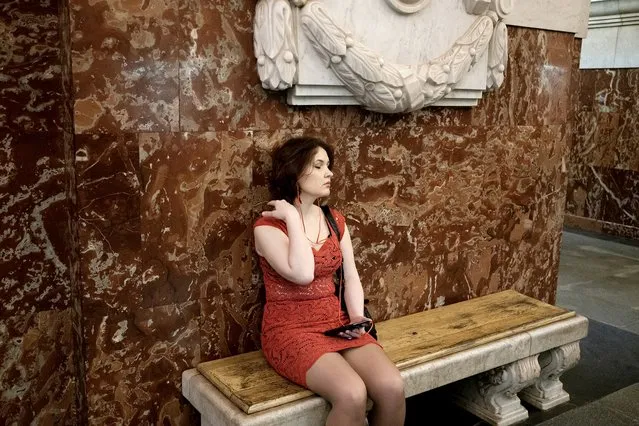
At the Krasnopresnenskaya station, the benches come from the Cathedral of Christ-Sauveur, which was built from 1839 to 1883 in memory of the victory of Russia against the army of Napoleon I. The cathedral was destroyed under Stalin in 1931, but the benches remained intact. Metro architects decided to install them in some stations. (Photo by Didier Bizet/The Washington Post)