Loading...
Done
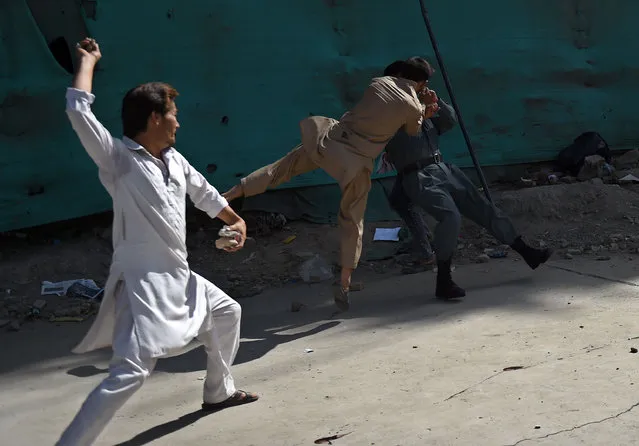
Afghan protesters beat a policeman after a suicide attack that targeted crowds of minority Shiite Hazaras during a demonstration at the Deh Mazang Circle of Kabul on July 23, 2016. Islamic State jihadists claimed responsibility for twin explosions July 23 that ripped through crowds of Shiite Hazaras in Kabul, killing at least 61 people and wounding 207 others in apparently their deadliest attack in the Afghan capital. The bombings during a huge protest over a power transmission line could deepen sectarian divisions in a country well known for communal harmony despite decades of war. (Photo by Wakil Kohsar/AFP Photo)

Afghan protesters beat a policeman after a suicide attack that targeted crowds of minority Shiite Hazaras during a demonstration at the Deh Mazang Circle of Kabul on July 23, 2016. Islamic State jihadists claimed responsibility for twin explosions July 23 that ripped through crowds of Shiite Hazaras in Kabul, killing at least 61 people and wounding 207 others in apparently their deadliest attack in the Afghan capital. The bombings during a huge protest over a power transmission line could deepen sectarian divisions in a country well known for communal harmony despite decades of war. (Photo by Wakil Kohsar/AFP Photo)
Details
25 Jul 2016 11:46:00
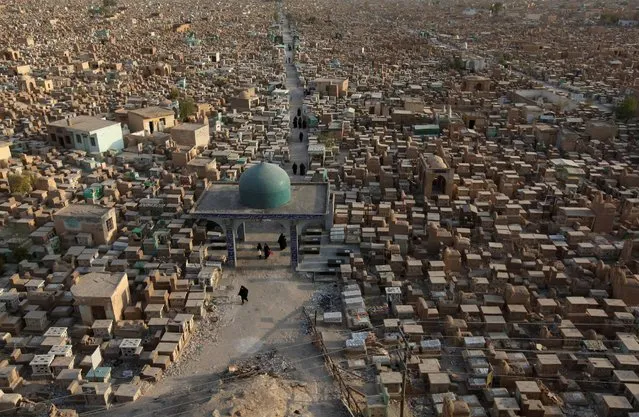
The Wadi al-Salam cemetery, Arabic for “Peace Valley”, is seen in Najaf, south of Baghdad, Iraq August 3, 2016. The world's largest cemetery, in Iraq's Shi'ite holy city of Najaf, is expanding at double its usual rate as Shi'ite militias bury their dead from the war against Islamic State. The Wadi al-Salam cemetery, Arabic for “Peace Valley” has a special place in the hearts of Shi'ite Muslims as it surrounds the Mausoleum of their first imam, Ali Bin Abi Talib, a cousin and son-in-law of Prophet Mohammad. (Photo by Alaa Al-Marjani/Reuters)

The Wadi al-Salam cemetery, Arabic for “Peace Valley”, is seen in Najaf, south of Baghdad, Iraq August 3, 2016. The world's largest cemetery, in Iraq's Shi'ite holy city of Najaf, is expanding at double its usual rate as Shi'ite militias bury their dead from the war against Islamic State. The Wadi al-Salam cemetery, Arabic for “Peace Valley” has a special place in the hearts of Shi'ite Muslims as it surrounds the Mausoleum of their first imam, Ali Bin Abi Talib, a cousin and son-in-law of Prophet Mohammad. (Photo by Alaa Al-Marjani/Reuters)
Details
24 Aug 2016 11:38:00
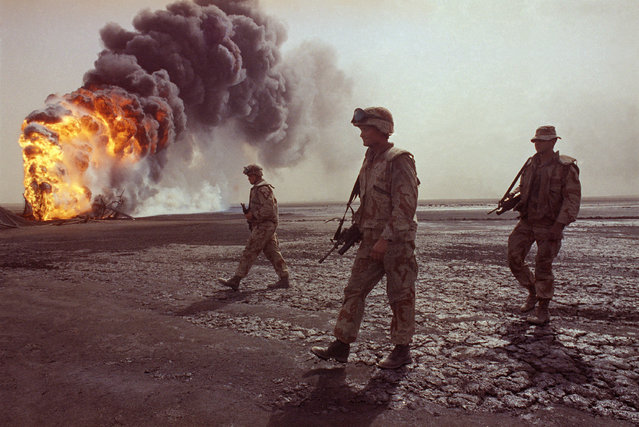
In this March 7, 1991 file photo, a U.S. Marine patrol walks across the charred oil landscape near a burning well during perimeter security patrol near Kuwait City. Twenty five years after the first U.S. Marines swept across the border into Kuwait in the 1991 Gulf War, American forces find themselves battling the extremist Islamic State group, born out of al-Qaida, in the splintered territories of Iraq and Syria. The Arab allies that joined the 1991 coalition are fighting their own conflicts both at home and abroad, as Iran vies for greater regional power following a nuclear deal with world powers. (Photo by John Gaps III/AP Photo)

In this March 7, 1991 file photo, a U.S. Marine patrol walks across the charred oil landscape near a burning well during perimeter security patrol near Kuwait City. Twenty five years after the first U.S. Marines swept across the border into Kuwait in the 1991 Gulf War, American forces find themselves battling the extremist Islamic State group, born out of al-Qaida, in the splintered territories of Iraq and Syria. The Arab allies that joined the 1991 coalition are fighting their own conflicts both at home and abroad, as Iran vies for greater regional power following a nuclear deal with world powers. (Photo by John Gaps III/AP Photo)
Details
23 Feb 2016 11:43:00
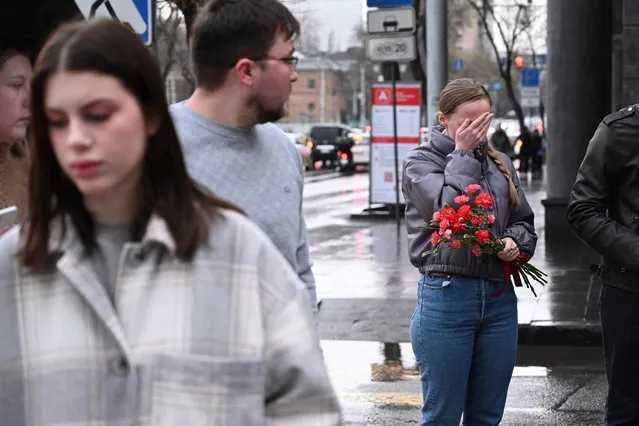
People mourn at a makeshift memorial in front of the Russian embassy in Yerevan on March 23, 2024, a day after a gun attack on the Crocus City Hall in Russia's Krasnogorsk. Camouflaged assailants opened fire at the packed Crocus City Hall in Moscow's northern suburb of Krasnogorsk on March 22, 2024, evening ahead of a concert by Soviet-era rock band Piknik in the deadliest attack in Russia for at least a decade. Russia on March 23, 2024, said it had arrested 11 people – including four gunmen – over the attack on a Moscow concert hall claimed by Islamic State, as the death toll rose to 133 people. (Photo by Karen Minasyan/AFP Photo)

People mourn at a makeshift memorial in front of the Russian embassy in Yerevan on March 23, 2024, a day after a gun attack on the Crocus City Hall in Russia's Krasnogorsk. Camouflaged assailants opened fire at the packed Crocus City Hall in Moscow's northern suburb of Krasnogorsk on March 22, 2024, evening ahead of a concert by Soviet-era rock band Piknik in the deadliest attack in Russia for at least a decade. Russia on March 23, 2024, said it had arrested 11 people – including four gunmen – over the attack on a Moscow concert hall claimed by Islamic State, as the death toll rose to 133 people. (Photo by Karen Minasyan/AFP Photo)
Details
13 Apr 2024 05:18:00
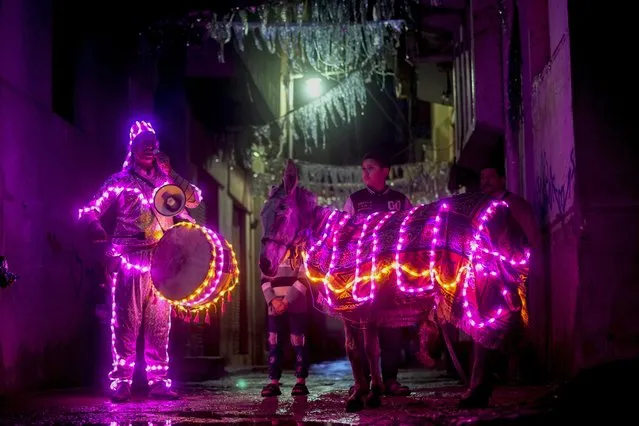
Mohammed El-Dahshan, 38-year-old “Mesaharati”, or dawn caller, accompanies his donkey wrapped with colored led lights to wake Muslims up for a meal before sunrise, during the Islamic holy month of Ramadan, in the Delta city of Dikernis, about 93 miles (150 km) North of Cairo, Egypt early Wednesday, April 12, 2023. Each night, El-Dahshan, sets out after midnight with his donkey banging his drum, chanting traditional religious phrases and calling out on residents by name to wake them in time for the vital pre-dawn meal known as “Suhour”. (Photo by Amr Nabil/AP Photo)

Mohammed El-Dahshan, 38-year-old “Mesaharati”, or dawn caller, accompanies his donkey wrapped with colored led lights to wake Muslims up for a meal before sunrise, during the Islamic holy month of Ramadan, in the Delta city of Dikernis, about 93 miles (150 km) North of Cairo, Egypt early Wednesday, April 12, 2023. Each night, El-Dahshan, sets out after midnight with his donkey banging his drum, chanting traditional religious phrases and calling out on residents by name to wake them in time for the vital pre-dawn meal known as “Suhour”. (Photo by Amr Nabil/AP Photo)
Details
15 May 2023 04:04:00
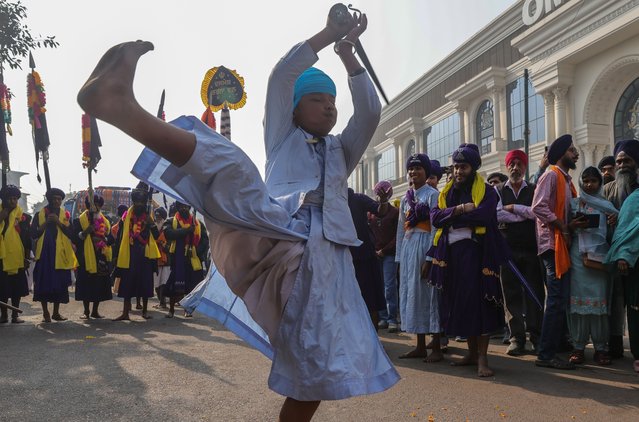
A Nihang Sikh, belonging to the Sikh warrior clan, performs Gatka, a form of Sikh martial arts, during a religious procession marking the 350th martyrdom anniversary of Guru Tegh Bahadur Ji in New Delhi, India, 25 November 2025. The procession commemorates the martyrdom of the 9th Sikh Guru, Sri Guru Tegh Bahadur Ji, who was executed in 1675 AD for refusing to convert to Islam on the orders of Mughal Emperor Aurangzeb. The event is observed at Gurudwara Sis Ganj in Delhi. Guru Tegh Bahadur, the youngest of the five sons of Guru Hargobind, was born in Amritsar in 1621. (Photo by Rajat Gupta/EPA)

A Nihang Sikh, belonging to the Sikh warrior clan, performs Gatka, a form of Sikh martial arts, during a religious procession marking the 350th martyrdom anniversary of Guru Tegh Bahadur Ji in New Delhi, India, 25 November 2025. The procession commemorates the martyrdom of the 9th Sikh Guru, Sri Guru Tegh Bahadur Ji, who was executed in 1675 AD for refusing to convert to Islam on the orders of Mughal Emperor Aurangzeb. The event is observed at Gurudwara Sis Ganj in Delhi. Guru Tegh Bahadur, the youngest of the five sons of Guru Hargobind, was born in Amritsar in 1621. (Photo by Rajat Gupta/EPA)
Details
06 Dec 2025 03:16:00
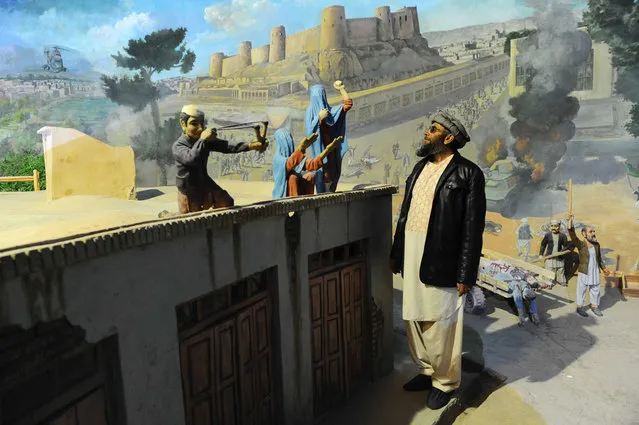
Museum assistant and former Soviet soldier, Sheikh Abdullah looks at a display in the Manzar-e Jahad, or Jihad Museum, which depicts the Soviet invasion of 1979 and the Afghan resistance, in Herat, on February 15, 2014. (Photo by Aref Karimi/AFP Photo via The Atlantic)

Museum assistant and former Soviet soldier, Sheikh Abdullah looks at a display in the Manzar-e Jahad, or Jihad Museum, which depicts the Soviet invasion of 1979 and the Afghan resistance, in Herat, on February 15, 2014. Sheikh Abdullah, who was a Soviet intelligence officer by the name of Khakimov Bakhrodin, was captured after being injured in battle with the Mujahideen. Abdullah stayed with his captors, converted to Islam and was renamed Abdullah. He never returned to his former homeland and now works at the Jihad Museum. (Photo by Aref Karimi/AFP Photo via The Atlantic)
Details
10 Mar 2014 09:08:00
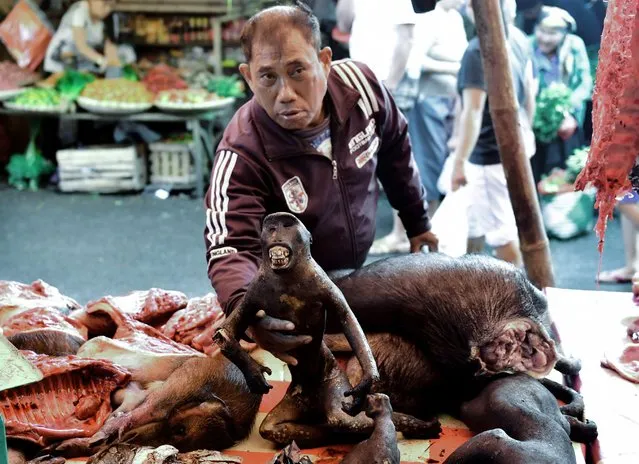
This picture taken on February 18, 2017 shows a customer holding a crested black macaque in Tomohon market in northern Sulawesi, Indonesia. (Photo by Bay Ismoyo/AFP Photo)

This picture taken on February 18, 2017 shows a customer holding a crested black macaque in Tomohon market in northern Sulawesi, Indonesia. Authorities and activists are stepping up efforts to persuade villagers on Sulawesi island to stop consuming the critically endangered crested black macaques, one of many exotic creatures that form part of the local indigenous community' s diet. The macaque' s meat is prized by the ethnic Minahasan people, a largely Christian group in the world' s most populous Muslim- majority country, who have no reservation about eating exotic animals, unlike Indonesia' s Islamic communities. (Photo by Bay Ismoyo/AFP Photo)
Details
04 Apr 2017 10:01:00