Loading...
Done
On August 31, 2012, a long filament of solar material that had been hovering in the sun's atmosphere, the corona, erupted out into space at 4:36 p.m. EDT. The coronal mass ejection, or CME, traveled at over 900 miles per second. The CME did not travel directly toward Earth, but did connect with Earth's magnetic environment, or magnetosphere, causing aurora to appear on the night of Monday, September 3. (Photo by NASA/GSFC/SDO)

On August 31, 2012, a long filament of solar material that had been hovering in the sun's atmosphere, the corona, erupted out into space at 4:36 p.m. EDT. The coronal mass ejection, or CME, traveled at over 900 miles per second. The CME did not travel directly toward Earth, but did connect with Earth's magnetic environment, or magnetosphere, causing aurora to appear on the night of Monday, September 3. (Photo by NASA/GSFC/SDO via The Atlantic)
Details
14 Sep 2012 09:01:00
Apollo 9 Command/Service Modules (CSM) nicknamed “Gumdrop” and Lunar Module (LM), nicknamed “Spider” are shown docked together as Command Module pilot David R. Scott stands in the open hatch. Astronaut Russell L. Schweickart, Lunar Module pilot, took this photograph of Scott during his EVA as he stood on the porch outside the Lunar Module. Apollo 9 was an Earth orbital mission designed to test docking procedures between the CSM and LM as well as test fly the Lunar Module in the relative safe confines of Earth orbit. (Photo by NASA)

Apollo 9 Command/Service Modules (CSM) nicknamed “Gumdrop” and Lunar Module (LM), nicknamed “Spider” are shown docked together as Command Module pilot David R. Scott stands in the open hatch. Astronaut Russell L. Schweickart, Lunar Module pilot, took this photograph of Scott during his EVA as he stood on the porch outside the Lunar Module. Apollo 9 was an Earth orbital mission designed to test docking procedures between the CSM and LM as well as test fly the Lunar Module in the relative safe confines of Earth orbit. (Photo by NASA)
Details
20 Jul 2014 11:47:00
Riot police hold their weapons during a protest by supporters of Kenyan opposition National Super Alliance (NASA) coalition, along a street in Nairobi, Kenya on October 11, 2017. (Photo by Thomas Mukoya/Reuters)

Riot police hold their weapons during a protest by supporters of Kenyan opposition National Super Alliance (NASA) coalition, along a street in Nairobi, Kenya on October 11, 2017. Opposition leader Raila Odinga, has called for protests this week, reiterated that he would not take part in a re- run of the presidential election on October 26, 2017 if his demands are not met, as Kenya' s Supreme Court last month overturned the August election of President Uhuru Kenyatta citing “irregularities” in the counting of results. (Photo by Thomas Mukoya/Reuters)
Details
12 Oct 2017 08:49:00
A meteor streaks over the sky during the Perseid meteor shower at the Maculje archaeological site near Novi Travnik August 12, 2014. According to NASA, the annual Perseid meteor shower reaches its peak on August 12 and 13 in Europe. The fireballs from the meteorites are fast and plentiful, although a nearly full moon (Supermoon) makes it difficult to view them this year, the agency adds. (Photo by Dado Ruvic/Reuters)

A meteor streaks over the sky during the Perseid meteor shower at the Maculje archaeological site near Novi Travnik August 12, 2014. According to NASA, the annual Perseid meteor shower reaches its peak on August 12 and 13 in Europe. The fireballs from the meteorites are fast and plentiful, although a nearly full moon (Supermoon) makes it difficult to view them this year, the agency adds. (Photo by Dado Ruvic/Reuters)
Details
14 Aug 2014 10:45:00
A model of the New Horizons spacecraft is seen at a live television program on NASA television celebrating the spacecraft's closest proximity to Pluto, at Johns Hopkins University Applied Physics Laboratory, site of the mission operations center, in Laurel, Maryland, USA, 14 July 2015. (Photo by Michael Reynolds/EPA)

A model of the New Horizons spacecraft is seen at a live television program on NASA television celebrating the spacecraft's closest proximity to Pluto, at Johns Hopkins University Applied Physics Laboratory, site of the mission operations center, in Laurel, Maryland, USA, 14 July 2015. At approximately 7:49 am ET (11:49 am GMT), 14 July, New Horizons was scheduled to be as close to Pluto as the spacecraft will get; about 7,800 miles (12,500 kilometers) above the surface, following a journey of more than nine years and three billion miles. This is the first mission to the Pluto System and the Kuiper Belt. (Photo by Michael Reynolds/EPA)
Details
15 Jul 2015 10:08:00
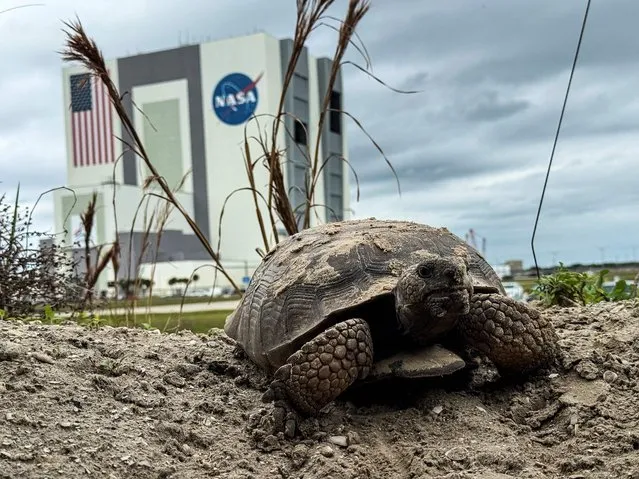
A gopher tortoise walks the grounds of NASA's Kennedy Space Center in Florida, near the Vehicle Assembly Building on January 18, 2024. An all-European crew including Turkey's first astronaut are poised to blast off to the International Space Station in a mission with Axiom Space, as countries hungry for a taste of space turn increasingly to the private sector. (Photo by Chandan Khanna/AFP Photo)

A gopher tortoise walks the grounds of NASA's Kennedy Space Center in Florida, near the Vehicle Assembly Building on January 18, 2024. An all-European crew including Turkey's first astronaut are poised to blast off to the International Space Station in a mission with Axiom Space, as countries hungry for a taste of space turn increasingly to the private sector. (Photo by Chandan Khanna/AFP Photo)
Details
26 Jan 2024 09:15:00
In a photo taken on July 6, 2017 soldiers of the Korean People' s Army (KPA) watch a fireworks display as part of celebrations marking the July 4 launch of the Hwasong-14 intercontinental ballistic missile, in Pyongyang Fireworks lit up the sky over Pyongyang' s Juche Tower as North Korea celebrated its launch of intercontinental ballistic missile, a milestone in its decades- long weapons drive. On July 4 – the United States' Independence Day – it launched a Hwasong-14 rocket that analysts and overseas officials said had a range of up to 8,000 kilometres, which would put Alaska and Hawaii within reach. (Photo by Kim Won-Jin/AFP Photo)

In a photo taken on July 6, 2017 soldiers of the Korean People' s Army (KPA) watch a fireworks display as part of celebrations marking the July 4 launch of the Hwasong-14 intercontinental ballistic missile, in Pyongyang Fireworks lit up the sky over Pyongyang' s Juche Tower as North Korea celebrated its launch of intercontinental ballistic missile, a milestone in its decades- long weapons drive. On July 4 – the United States' Independence Day – it launched a Hwasong-14 rocket that analysts and overseas officials said had a range of up to 8,000 kilometres, which would put Alaska and Hawaii within reach. (Photo by Kim Won-Jin/AFP Photo)
Details
14 Jul 2017 07:17:00
Russian cosmonaut Alexander Skvortsov, Expedition 40 flight engineer, attired in a Russian Orlan spacesuit, participates in a session of extravehicular activity (EVA) in support of science and maintenance on the International Space Station on August 18, 2014. During the five-hour, 11-minute spacewalk, Skvortsov and cosmonaut Oleg Artemyev (out of frame) deployed a small science satellite, retrieved and installed experiment packages and inspected components on the exterior of the orbital laboratory. (Photo by NASA)

Russian cosmonaut Alexander Skvortsov, Expedition 40 flight engineer, attired in a Russian Orlan spacesuit, participates in a session of extravehicular activity (EVA) in support of science and maintenance on the International Space Station on August 18, 2014. During the five-hour, 11-minute spacewalk, Skvortsov and cosmonaut Oleg Artemyev (out of frame) deployed a small science satellite, retrieved and installed experiment packages and inspected components on the exterior of the orbital laboratory. (Photo by NASA)
Details
13 Apr 2022 06:53:00