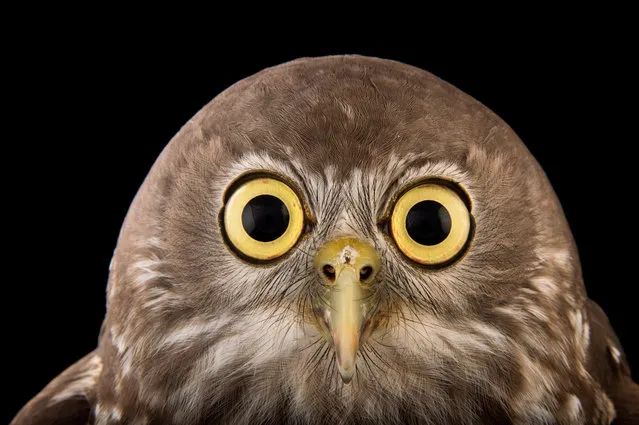
The National Geographic Photo Ark is a travelling exhibition of photographer Joel Sartore’s quest to create a photo archive of biodiversity around the world. So far, Sartore has captured studio portraits of more than 6,000 species – a number that he hopes to double. On 1 July, the ark will open at Melbourne zoo – the first time it has been exhibited in the southern hemisphere. More than 50 portraits will be on display, including many of Australian endangered animals being protected by programs at the zoo itself. These captions have been edited from text supplied by Melbourne zoo. Here: Barking owl. (Photo by Joel Sartore/National Geographic Photo Ark/The Guardian)
An art wall painting representing performance artist Marina Abramovic by Italian artist Maurizio Cattellan to publicize his upcoming exhibition The Artist is Present, in Shanghai, China, is displayed on a facade of a building, in Milan, Italy, Wednesday, September 19, 2018. (Photo by Luca Bruno/AP Photo)
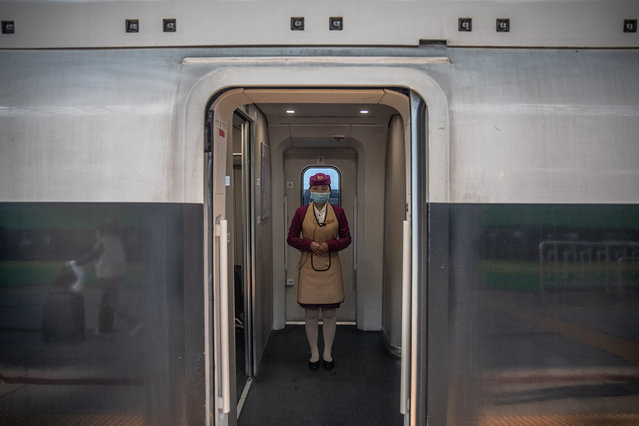
A train attendant wearing a protective face mask stands on a train to Wuhan, at the railway station in Beijing, China, 29 March 2020. Wuhan, the epicenter of the coronavirus outbreak, partly lifted the lockdown allowing people to enter the city after more than two months. Chinese authorities eased the quarantine measures as cases of Covid-19 across China have plummeted, according to Chinese government figures. (Photo by Roman Pilipey/EPA/EFE)
In this Wednesday, April 8, 2020, photo, youths remove their mask to record a dance routine on the streets of Wuhan in central China's Hubei province. Released from their apartments after a 2 1/2-month quarantine, residents of the city where the coronavirus pandemic began are cautiously returning to shopping and strolling in the street but say they still go out little and keep children home while they wait for schools to reopen. (Photo by Ng Han Guan/AP Photo)
People take turns stomping the Christopher Columbus statue after it was toppled in front of the Minnesota State Capitol in St. Paul, Minn., on Wednesday, June 10, 2020. (Photo by Leila Navidi/Star Tribune via AP Photo)
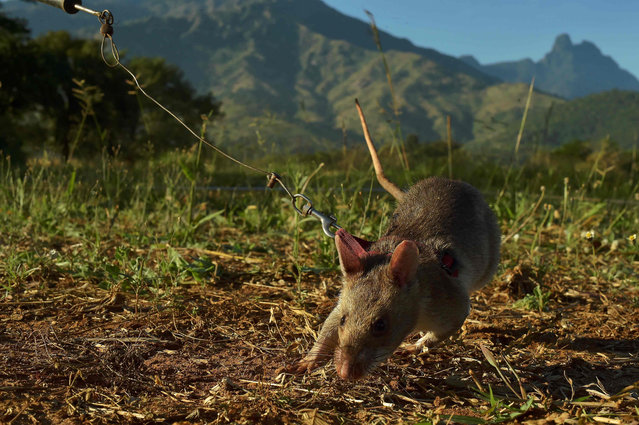
An African giant pouched rat sniffs for traces of landmine explosives at APOPO's training facility in Morogoro on June 17, 2016. APOPO trains the rats to detect both tuberculosis and landmines at its facility. Every year landmines kill or maim thousands of people worldwide. The trained rats sniff for explosive and so are able to detect the presence of landmines far faster than conventional methods which involve metal detection. (Photo by Carl De Souza/AFP Photo)
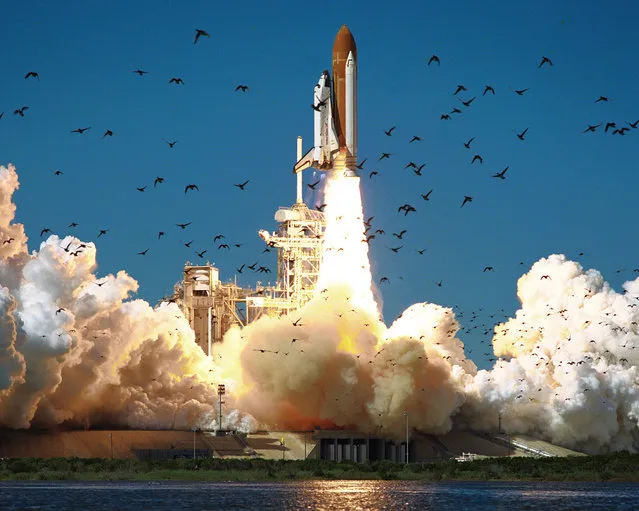
A wide-angle view shows the ascent of the shuttle Challenger on January 28, 1986. In the seconds after ignition, the rocket engines' hot blast began the process of destruction. (Photo by NASA)