Loading...
Done
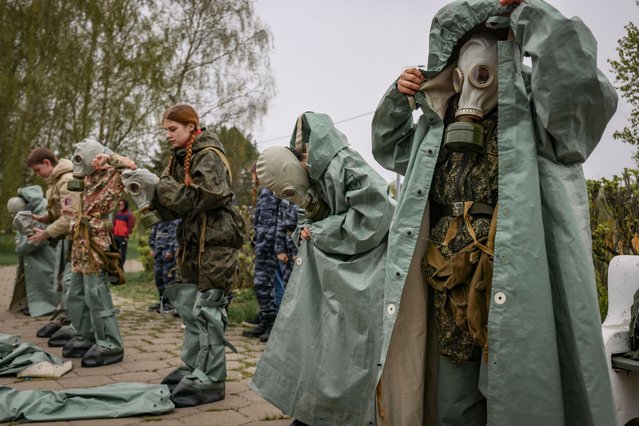
“Yunarmiya” (Young Army) All-Russia National Military Patriotic Social Movement Association members compete during the 7th military-patriotic game “Yunarmiya, forward!” dedicated to Victory Day at the Museum-reserve “Gorki Leninskie” in Gorki Leninskie, Russia, 29 April 2025. A total of 160 teams of Yunarmiya and military-patriotic detachments attended the games, each team consisting of seven people aged between 12 and 17 years old. The games are a continuation of the Soviet military-sports competitions for children and teenagers, “Zarnitsa” (since 1967) and “Orlyonok (Eaglet)” (since 1972). (Photo by Sergei Ilnitsky/EPA/EFE)

“Yunarmiya” (Young Army) All-Russia National Military Patriotic Social Movement Association members compete during the 7th military-patriotic game “Yunarmiya, forward!” dedicated to Victory Day at the Museum-reserve “Gorki Leninskie” in Gorki Leninskie, Russia, 29 April 2025. A total of 160 teams of Yunarmiya and military-patriotic detachments attended the games, each team consisting of seven people aged between 12 and 17 years old. The games are a continuation of the Soviet military-sports competitions for children and teenagers, “Zarnitsa” (since 1967) and “Orlyonok (Eaglet)” (since 1972). (Photo by Sergei Ilnitsky/EPA/EFE)
Details
04 Jun 2025 02:14:00
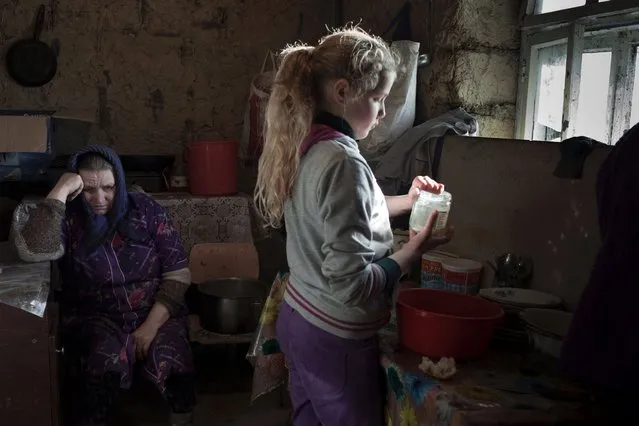
According to the U.S. government, Moldova, one of the poorest countries in Europe, depends on about $1.6 billion annually sent back from the roughly one million Moldovans who left for work in in Europe, Russia, and other former Soviet Bloc countries. Photographer Myriam Meloni went to Moldova to document what she refers to as “social orphans” – children whose parents have emigrated to another country in search of a job and a better future for their families. Here: Lulia is seen washing dishes in her grandmother's house, where she lives. (Photo by Myriam Meloni)

According to the U.S. government, Moldova, one of the poorest countries in Europe, depends on about $1.6 billion annually sent back from the roughly one million Moldovans who left for work in in Europe, Russia, and other former Soviet Bloc countries. Photographer Myriam Meloni went to Moldova to document what she refers to as “social orphans” – children whose parents have emigrated to another country in search of a job and a better future for their families. Here: Lulia is seen washing dishes in her grandmother's house, where she lives. (Photo by Myriam Meloni)
Details
12 Mar 2016 14:57:00
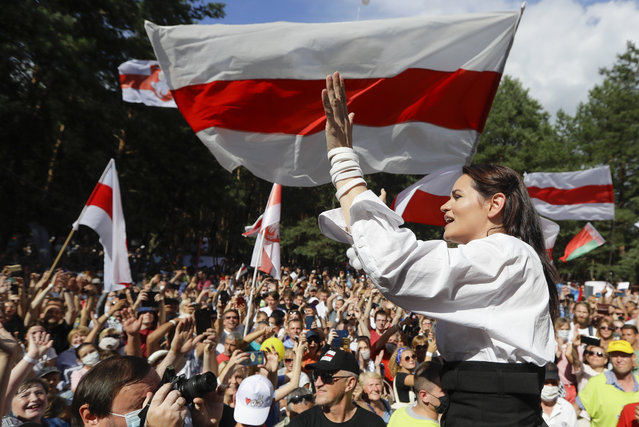
In this file photo taken on Sunday, August 2, 2020, Sviatlana Tsikhanouskaya, candidate for the presidential elections greets people waving old Belarus flags during a meeting to show her support, in Brest, 326 km (203,7 miles) southwest of Minsk, Belarus. Belarus’ authoritarian President Alexander  Lukashenko faces a perfect storm as he seeks a sixth term in the election held Sunday, Aug. 9, 2020 after 26 years in office. Mounting public discontent over the worsening economy and his government’s bungled handling of the coronavirus pandemic has fueled the largest opposition rallies since the Soviet collapse. (Photo by Sergei Grits/AP Photo)

In this file photo taken on Sunday, August 2, 2020, Sviatlana Tsikhanouskaya, candidate for the presidential elections greets people waving old Belarus flags during a meeting to show her support, in Brest, 326 km (203,7 miles) southwest of Minsk, Belarus. Belarus’ authoritarian President Alexander Lukashenko faces a perfect storm as he seeks a sixth term in the election held Sunday, Aug. 9, 2020 after 26 years in office. Mounting public discontent over the worsening economy and his government’s bungled handling of the coronavirus pandemic has fueled the largest opposition rallies since the Soviet collapse. (Photo by Sergei Grits/AP Photo)
Details
10 Aug 2020 00:01:00
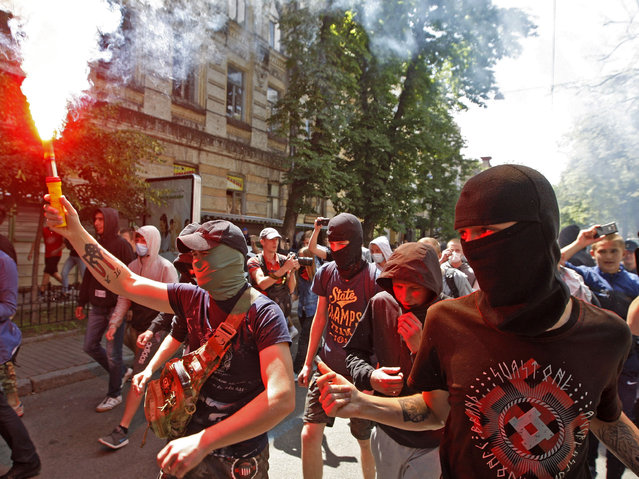
A man carries a smoke flare as far-right activists march during the Gay Pride parade on June 12, 2016 in Kiev. More than 700 gay rights activists marched through central Kiev on June 12 amid a massive police presence for the third such gay pride event in the ex-Soviet country where homophobia remains widespread. The June 12 march was the first ever gay pride rally to be held in central Kiev, prompting an unprecedented security operation with several thousand police and National Guard officers lining the route during the event, which lasted around 20 minutes. (Photo by Yuriy Kirnichny/AFP Photo)

A man carries a smoke flare as far-right activists march during the Gay Pride parade on June 12, 2016 in Kiev. More than 700 gay rights activists marched through central Kiev on June 12 amid a massive police presence for the third such gay pride event in the ex-Soviet country where homophobia remains widespread. The June 12 march was the first ever gay pride rally to be held in central Kiev, prompting an unprecedented security operation with several thousand police and National Guard officers lining the route during the event, which lasted around 20 minutes. (Photo by Yuriy Kirnichny/AFP Photo)
Details
13 Jun 2016 11:08:00

Combine harvesters work on a wheat field of the Solgonskoye farming company near the village of Talniki, southwest from Siberian city of Krasnoyarsk, Russia, August 27, 2015. (Photo by Ilya Naymushin/Reuters)

Combine harvesters work on a wheat field of the Solgonskoye farming company near the village of Talniki, southwest from Siberian city of Krasnoyarsk, Russia, August 27, 2015. Russia, one of the world's top wheat exporters, will harvest its third-largest grain crop in post-Soviet history this year, leading Russian consultancy SovEcon said on August 27 after upgrading its forecast. (Photo by Ilya Naymushin/Reuters)
Details
29 Aug 2015 10:47:00
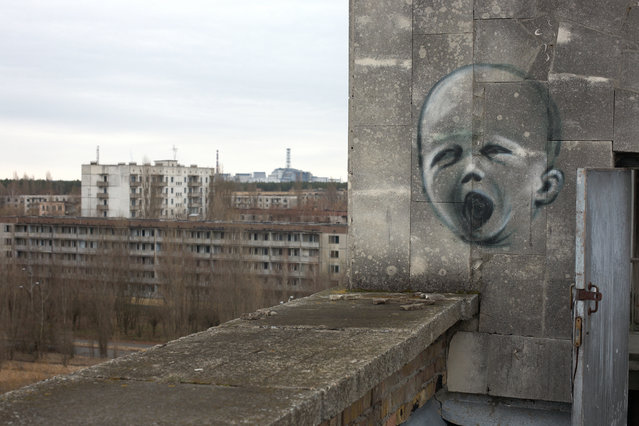
Graffiti of a crying baby on a wall, Chernobyl Power Plant, Chernobyl, Ukraine. (Photo by Hans Neleman/Getty Images)

The Chernobyl disaster was a catastrophic nuclear accident that occurred on 26 April 1986 at the Chernobyl Nuclear Power Plant in Ukraine, which was under the direct jurisdiction of the central authorities of the Soviet Union. The Chernobyl disaster is the worst nuclear power plant accident in history in terms of cost and resulting deaths, and is one of only two classified as a level 7 event (the maximum classification) on the International Nuclear Event Scale (the other being the Fukushima Daiichi nuclear disaster in 2011). Photo: Graffiti of a crying baby on a wall, Chernobyl Power Plant, Chernobyl, Ukraine. (Photo by Hans Neleman/Getty Images)
Details
27 Apr 2014 08:12:00
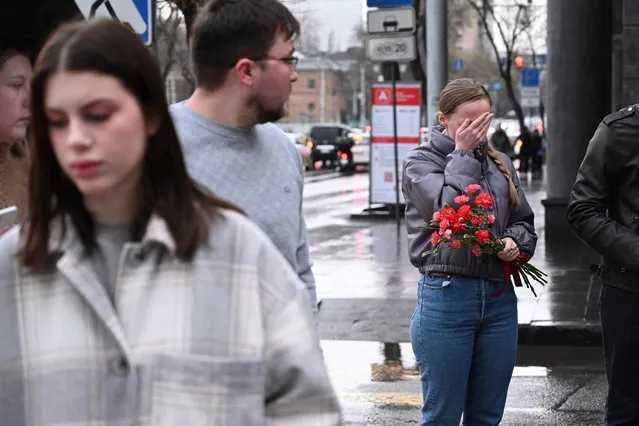
People mourn at a makeshift memorial in front of the Russian embassy in Yerevan on March 23, 2024, a day after a gun attack on the Crocus City Hall in Russia's Krasnogorsk. Camouflaged assailants opened fire at the packed Crocus City Hall in Moscow's northern suburb of Krasnogorsk on March 22, 2024, evening ahead of a concert by Soviet-era rock band Piknik in the deadliest attack in Russia for at least a decade. Russia on March 23, 2024, said it had arrested 11 people – including four gunmen – over the attack on a Moscow concert hall claimed by Islamic State, as the death toll rose to 133 people. (Photo by Karen Minasyan/AFP Photo)

People mourn at a makeshift memorial in front of the Russian embassy in Yerevan on March 23, 2024, a day after a gun attack on the Crocus City Hall in Russia's Krasnogorsk. Camouflaged assailants opened fire at the packed Crocus City Hall in Moscow's northern suburb of Krasnogorsk on March 22, 2024, evening ahead of a concert by Soviet-era rock band Piknik in the deadliest attack in Russia for at least a decade. Russia on March 23, 2024, said it had arrested 11 people – including four gunmen – over the attack on a Moscow concert hall claimed by Islamic State, as the death toll rose to 133 people. (Photo by Karen Minasyan/AFP Photo)
Details
13 Apr 2024 05:18:00


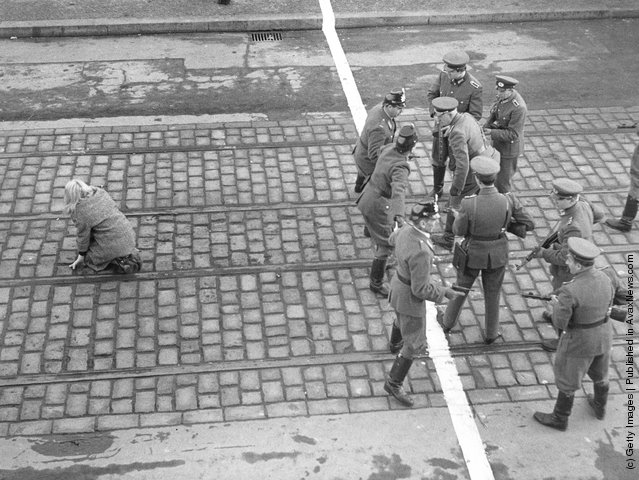
“The Berlin Wall (German: Berliner Mauer) was a barrier constructed by the German Democratic Republic (GDR, East Germany) starting on 13 August 1961, that completely cut off West Berlin from surrounding East Germany and from East Berlin. The barrier included guard towers placed along large concrete walls, which circumscribed a wide area (later known as the “death strip”) that contained anti-vehicle trenches, “fakir beds” and other defenses. The Soviet-dominated Eastern Bloc officially claimed that the wall was erected to protect its population from fascist elements conspiring to prevent the “will of the people” in building a socialist state in East Germany. However, in practice, the Wall served to prevent the massive emigration and defection that marked Germany and the communist Eastern Bloc during the post-World War II period”. – Wikipedia

Photo: West Berlin policemen and East German Volkspolizei face each other across the border in Berlin, circa 1955. (Photo by Three Lions/Hulton Archive/Getty Images)
Details
22 May 2011 10:49:00