Loading...
Done
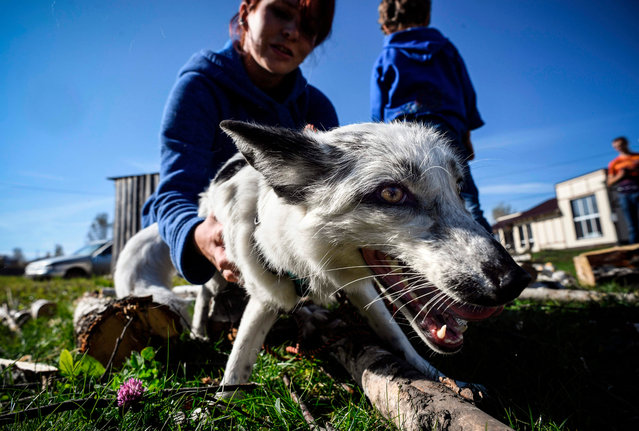
Tatyana Abramova, 33, plays with her home fox Plombir at her countryside house outside Siberian city of Novosibirsk on September 12, 2020. The official start of the Soviet experiment to better understand the domestication of animals by humans began in 1959, and was initiated by geneticists Dmitri Beliaiev and Lioudmila Trout on a farm in Akademgorodok, the scientific center of excellence in Siberia. Their primary objective was to domesticate foxes, to understand how the ancestor of wolves, another canine, evolved into a loyal and loving dog. And understand what this domestication tells us about the genetic evolution of species. (Photo by Alexander Nemenov/AFP Photo)

Tatyana Abramova, 33, plays with her home fox Plombir at her countryside house outside Siberian city of Novosibirsk on September 12, 2020. The official start of the Soviet experiment to better understand the domestication of animals by humans began in 1959, and was initiated by geneticists Dmitri Beliaiev and Lioudmila Trout on a farm in Akademgorodok, the scientific center of excellence in Siberia. Their primary objective was to domesticate foxes, to understand how the ancestor of wolves, another canine, evolved into a loyal and loving dog. And understand what this domestication tells us about the genetic evolution of species. (Photo by Alexander Nemenov/AFP Photo)
Details
25 Oct 2020 00:05:00
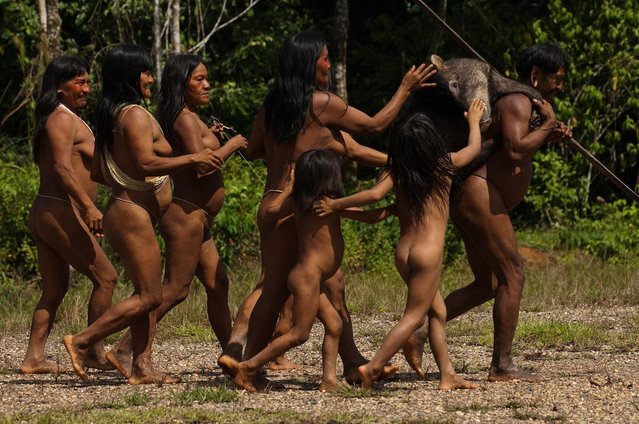
Spectacular images offering insight into the lives of the Huaorani people in the Ecuadorian Amazon have been revealed showing how they use traditional methods to hunt monkeys for food. The stunning pictures were taken by conservation photographer Pete Oxford from Torquay, Devon in the Ecuadorian Amazon. “The Huaorani Indians are a forest people highly in tune with their environment. Many are now totally acculturated since the 1950s by missionaries”, said Pete. “Today they face radical change to their culture to the proximity of oil exploration within their territory and the Yasuni National Park and Biosphere Reserve, they are vastly changed. Some still live very traditionally and for this shoot, through my Huaorani friend, a direct relative of those photographed he wanted to depict them as close to their original culture as possible. They still largely hunt with blow pipes and spears eating a lot of monkeys and peccaries”. The Huaorani are also known as the Waorani, Waodani or the Waos and are native Amerindians. Their lands are located between the Curaray and Napo rivers and speak the Huaorani language. Pete says that during his visit he was welcomed into the group and hopes that ancient cultures can be saved. Here: The tribe were seen celebrating after a hunter returned to camp with a wild pig. (Photo by Pete Oxford/Mediadrumworld.com)

Spectacular images offering insight into the lives of the Huaorani people in the Ecuadorian Amazon have been revealed showing how they use traditional methods to hunt monkeys for food. The stunning pictures were taken by conservation photographer Pete Oxford from Torquay, Devon in the Ecuadorian Amazon. Here: The tribe were seen celebrating after a hunter returned to camp with a wild pig. (Photo by Pete Oxford/Mediadrumworld.com)
Details
20 Jan 2017 07:58:00
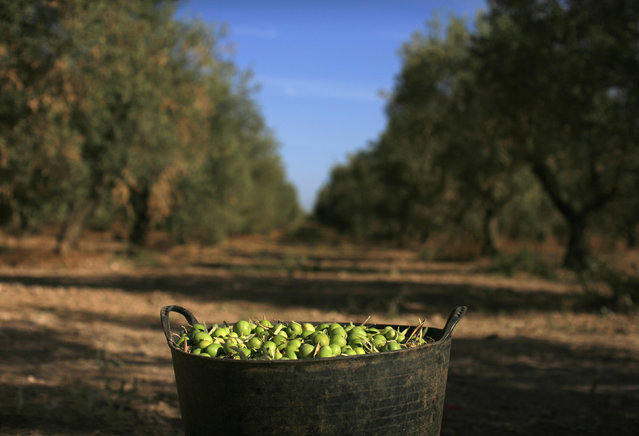
A basket of olives sits in an olive tree field in La Rinconada, near the Andalusian capital of Seville September 24, 2012. (Photo by Marcelo del Pozo/Reuters)

A basket of olives sits in an olive tree field in La Rinconada, near the Andalusian capital of Seville September 24, 2012. (Photo by Marcelo del Pozo/Reuters)
Details
22 Oct 2014 13:48:00
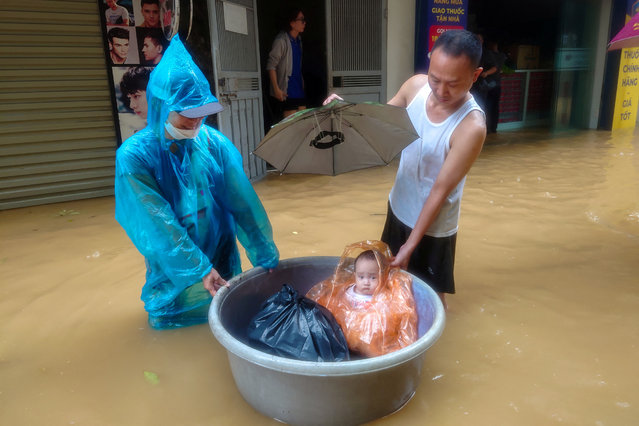
A boy sits in a floating basket as people wade through a flooded street following the impact of Typhoon Yagi, in Hanoi, Vietnam, on September 11, 2024. (Photo by Khanh Vu/Reuters)

A boy sits in a floating basket as people wade through a flooded street following the impact of Typhoon Yagi, in Hanoi, Vietnam, on September 11, 2024. (Photo by Khanh Vu/Reuters)
Details
26 Sep 2024 02:49:00
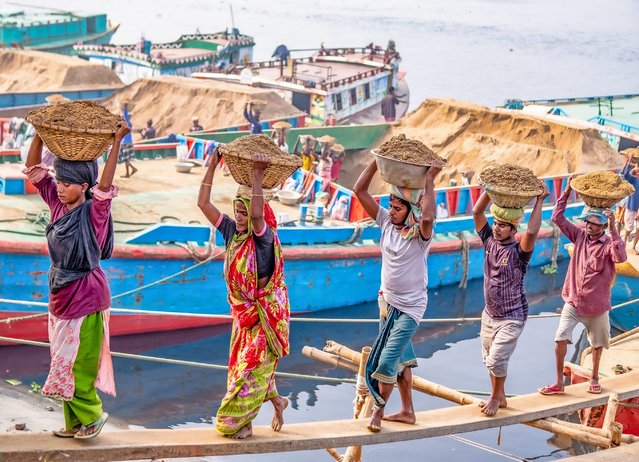
Workers unload baskets of sand from ships in Gabtoli Launch Ghat, Dhaka, Bangladesh in the first decade of February 2025. (Photo by Rakibul alam Khan/Solent News)

Workers unload baskets of sand from ships in Gabtoli Launch Ghat, Dhaka, Bangladesh in the first decade of February 2025. (Photo by Rakibul alam Khan/Solent News)
Details
14 May 2025 03:01:00
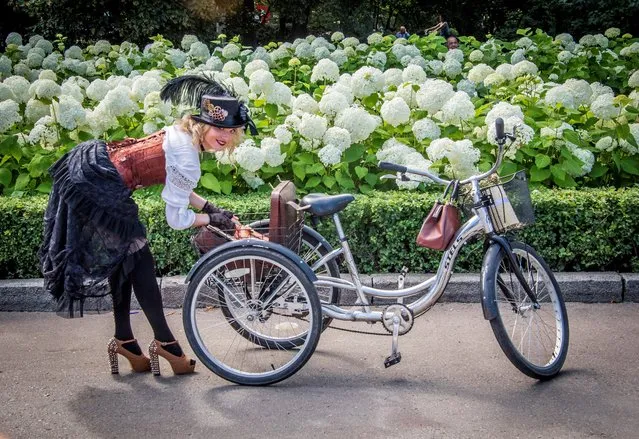
A participant in the 5th Lady on Bicycle annual festival opens her bag in the back basket of her tricycle in the Sokolniki park in Moscow on August 6, 2017. The festival's aim is to capture the city's fashionable women on vintage style bicycles. (Photo by Mladen Antonov/AFP Photo)

A participant in the 5th Lady on Bicycle annual festival opens her bag in the back basket of her tricycle in the Sokolniki park in Moscow on August 6, 2017. The festival's aim is to capture the city's fashionable women on vintage style bicycles. (Photo by Mladen Antonov/AFP Photo)
Details
07 Aug 2017 07:49:00
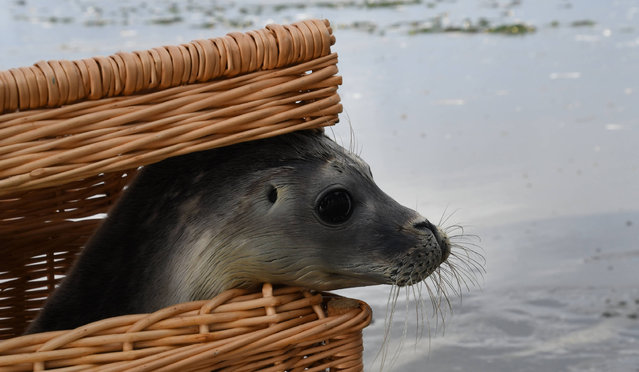
In this picture taken Thursday, August 4, 2016, seal Tristan looks out of a basket while being released into the North Sea together with others at the beach of the island Juist, Germany. He is part of the first group of released seals of the seal breeding station Norddeich this year. (Photo by Carmen Jaspersen/DPA via AP Photo)

In this picture taken Thursday, August 4, 2016, seal Tristan looks out of a basket while being released into the North Sea together with others at the beach of the island Juist, Germany. He is part of the first group of released seals of the seal breeding station Norddeich this year. (Photo by Carmen Jaspersen/DPA via AP Photo)
Details
07 Aug 2016 09:08:00
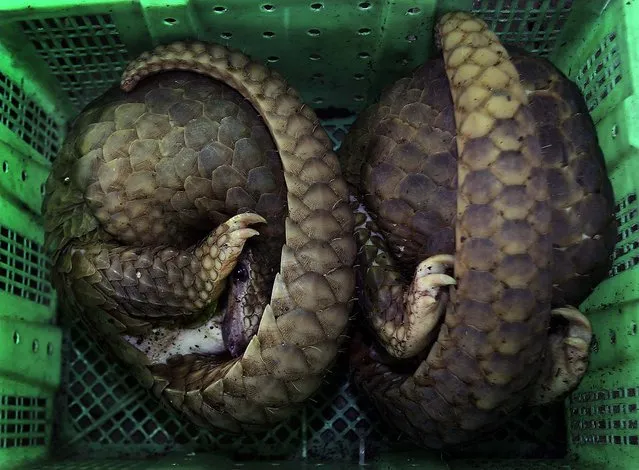
Two rescued pangolins sit in a basket during a news conference in Bangkok on June 7, 2012

Two rescued pangolins sit in a basket during a news conference in Bangkok on June 7, 2012. Thai customs rescued 110 pangolins worth about $35,500 that they say were to be sold outside the country as exotic food. The animals, hidden in a pickup truck, were seized at a customs checkpoint in Prachuap Khiri Khan province, south of Bangkok. (Photo by Sakchai Lalit/Associated Press)
Details
09 Jun 2012 12:20:00