Loading...
Done
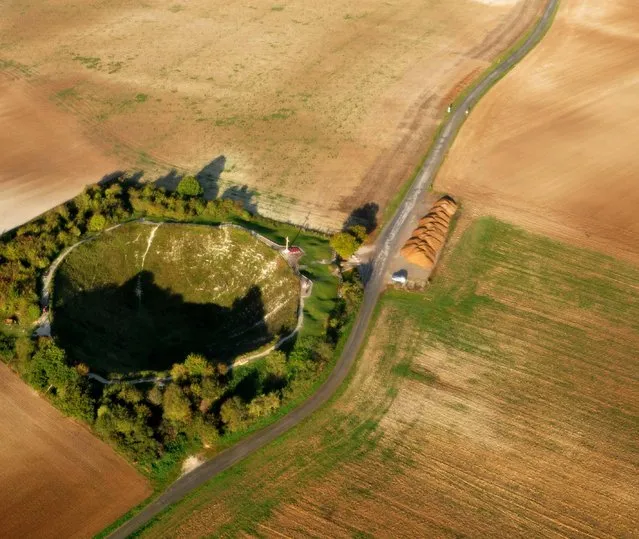
Lochnagar Crater Somme In France

It is amazing how much the humanity can change the face of the earth. Not only can it create huge craters, which look a lot like craters from meteors, they leave a big enough impact that it can be seen from space. Though this crater, caused by a massive explosion on 1 July 1916, looks large, being 90 feet deep and 300 feet across; it is nowhere big enough to be viewed for space. A common misconception is that the Great Wall of China can be seen from space. In reality, however, it is impossible. Not only is it of the same color as the earth near it, it is also not that wide. Deforestation, on the other hand, can be clearly seen from space. Also, at night, all the lights that the large cities produce are also very visible.
Details
17 Nov 2014 12:48:00
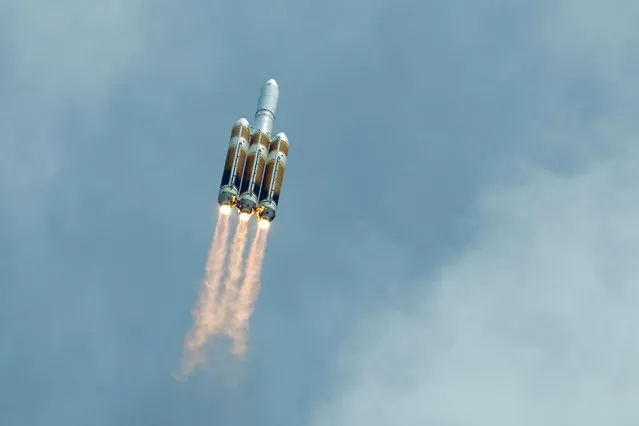
A United Launch Alliance Delta IV heavy rocket carrying classified spy satellite cargo for the U.S. National Reconnaissance Office lifts off from Space Launch Complex 37B at the Cape Canaveral Space Force Station, Tuesday, April 9, 2024, in Cape Canaveral, Fla. This is the final flight of a Delta IV heavy rocket. (Photo by John Raoux/AP Photo)

A United Launch Alliance Delta IV heavy rocket carrying classified spy satellite cargo for the U.S. National Reconnaissance Office lifts off from Space Launch Complex 37B at the Cape Canaveral Space Force Station, Tuesday, April 9, 2024, in Cape Canaveral, Fla. This is the final flight of a Delta IV heavy rocket. (Photo by John Raoux/AP Photo)
Details
21 Apr 2024 02:50:00
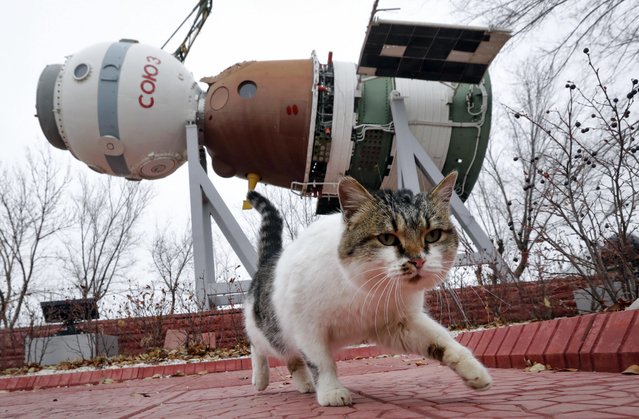
A cat walks past a Soyuz space ship installed at a museum, at the Russian leased Baikonur cosmodrome, Kazakhstan, Tuesday, November 15, 2016. The start of the new Soyuz mission to the International Space Station (ISS) is scheduled on early Friday, Nov. 18 local time. The Russian rocket will carry French astronaut Thomas Pesquet, Russian cosmonaut Oleg Novitsky and U.S. astronaut Peggy Annette Whitson. (Photo by Dmitri Lovetsky/AP Photo)

A cat walks past a Soyuz space ship installed at a museum, at the Russian leased Baikonur cosmodrome, Kazakhstan, Tuesday, November 15, 2016. The start of the new Soyuz mission to the International Space Station (ISS) is scheduled on early Friday, Nov. 18 local time. The Russian rocket will carry French astronaut Thomas Pesquet, Russian cosmonaut Oleg Novitsky and U.S. astronaut Peggy Annette Whitson. (Photo by Dmitri Lovetsky/AP Photo)
Details
16 Nov 2016 11:25:00
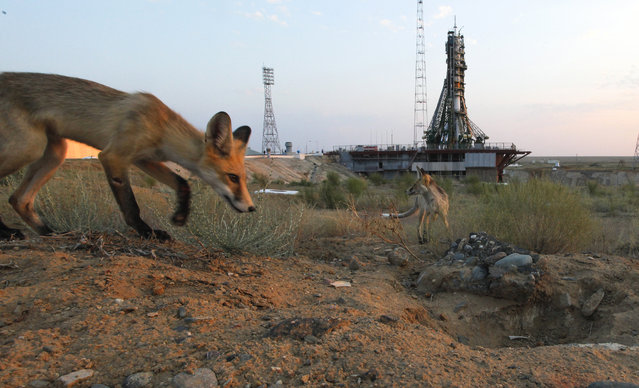
Wild foxes walk in front of a launch pad prior the launch of the Soyuz-FG rocket booster with Soyuz MS space ship carrying a new crew to the International Space Station, ISS at the Russian leased Baikonur cosmodrome, Kazakhstan, Thursday, July 7, 2016. The Russian rocket carries U.S. astronaut Kate Rubins, Russian cosmonaut Anatoly Ivanishin, and Japan astronaut Takuya Onishi. (Photo by Dmitri Lovetsky/AP Photo)

Wild foxes walk in front of a launch pad prior the launch of the Soyuz-FG rocket booster with Soyuz MS space ship carrying a new crew to the International Space Station, ISS at the Russian leased Baikonur cosmodrome, Kazakhstan, Thursday, July 7, 2016. The Russian rocket carries U.S. astronaut Kate Rubins, Russian cosmonaut Anatoly Ivanishin, and Japan astronaut Takuya Onishi. (Photo by Dmitri Lovetsky/AP Photo)

Details
08 Jul 2016 11:43:00
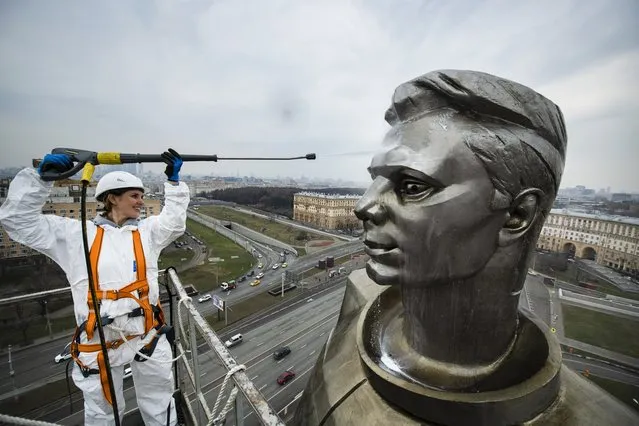
A worker cleans the statue of Yuri Gagarin, the first person who flew to space, ahead of Cosmonautics Day celebrated on April 12, in Moscow, Russia, Wednesday April 10, 2019. Cosmonautics Day marks when Soviet cosmonaut Yuri Gagarin became the first man to fly in space, in 1961, orbiting the earth once before making a safe landing. (Photo by Maxim Marmur/AP Photo)

A worker cleans the statue of Yuri Gagarin, the first person who flew to space, ahead of Cosmonautics Day celebrated on April 12, in Moscow, Russia, Wednesday April 10, 2019. Cosmonautics Day marks when Soviet cosmonaut Yuri Gagarin became the first man to fly in space, in 1961, orbiting the earth once before making a safe landing. (Photo by Maxim Marmur/AP Photo)
Details
12 Apr 2019 00:07:00


“The Lockheed Martin X-33 is an unmanned, sub-scale technology demonstrator suborbital spaceplane developed in the 1990s under the U.S. government-funded Space Launch Initiative program”. – Wikipedia

Photo: An Artist's Rendering Shows How Nasa's X-33 Technology Demonstrator, A Cost-Cutting Fully Reusable Single-Stage-To-Orbit Space Vehicle, Will Look Upon Completion. The 67 Foot-Long, 278,600 Pound, Twin Engine Space Vehicle, Capable Of Reaching Speeds In Excess Of Mach 15, Will Lead To The Construction Of A 127 Foot-Long, 2,186,000 Pound Version With Seven Engines And A 50,000 Pound Payload Capacity Called The “Venturestar”. (Photo By Nasa/Getty Images)
Details
22 Mar 2011 12:05:00
This handout photo taken and released on October 5, 2021 by Russian Space Agency Roscosmos shows Russian crew member, actress Yulia Peresild forming a heart with her hands as her spacesuit is tested prior to the launch onboard the Soyuz MS-19 spacecraft at the Russian-leased Baikonur cosmodrome. (Photo by Andrey Shelepin/Russian Space Agency Roscosmos/AFP Photo)

This handout photo taken and released on October 5, 2021 by Russian Space Agency Roscosmos shows Russian crew member, actress Yulia Peresild forming a heart with her hands as her spacesuit is tested prior to the launch onboard the Soyuz MS-19 spacecraft at the Russian-leased Baikonur cosmodrome. (Photo by Andrey Shelepin/Russian Space Agency Roscosmos/AFP Photo)
Details
06 Oct 2021 08:02:00
A woman walks under snowfall in front of a Soyuz rocket installed as a monument in Baikonur city, near the Russian leased Kazakh Baikonur cosmodrome on December 5, 2021. Space tourists Yusaku Maezawa and his assistant Yozo Hirano, led by Roscosmos cosmonaut Alexander Misurkin, will take part in a mission on the Soyuz MS-20 spacecraft to the International Space Station (ISS) scheduled for December 8, 2021. (Photo by Kirill Kudryavtsev/AFP Photo)

A woman walks under snowfall in front of a Soyuz rocket installed as a monument in Baikonur city, near the Russian leased Kazakh Baikonur cosmodrome on December 5, 2021. Space tourists Yusaku Maezawa and his assistant Yozo Hirano, led by Roscosmos cosmonaut Alexander Misurkin, will take part in a mission on the Soyuz MS-20 spacecraft to the International Space Station (ISS) scheduled for December 8, 2021. (Photo by Kirill Kudryavtsev/AFP Photo)
Details
06 Dec 2021 08:09:00