Loading...
Done
World's Largest Self-Anchored Suspension Bridge

Catwalks hang over a section of the newly constructed eastern span of the San Francisco-Oakland Bay Bridge during a media tour of the self-anchored suspension span tower on August 29, 2011 in Oakland, California. Contruction crews have erected twelve foot wide catwalks that connect to the San Francisco-Oakland Bay Bridge self-anchored suspension span's tower and crews will begin to lay the nearly one mile of main cable beginning in early 2012. The bridge has been under constrution since 2002 with an estimated price tag of $6.3 billion and will have the world's tallest Self-Anchored Suspension (SAS) tower once completed. (Photo by Justin Sullivan/Getty Images)
Details
31 Aug 2011 09:04:00
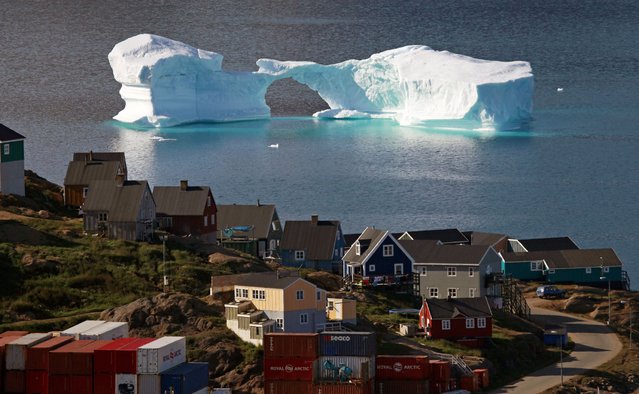
File photo of an iceberg floating near a harbour in the town of Kulusuk, east Greenland August 1, 2009. The United Nations 19th Climate Change Conference (COP19) will take place November 11-22, 2013 in Warsaw. The main goal of the talks with almost almost 200 nations assembled, is to lay the foundation for the new global climate agreement, aiming at further emission reduction, which is to be signed in 2015 in Paris and be launched in 2020. (Photo by Bob Strong/Reuters)

It's taken roughly five months, but a massive iceberg has separated from Antarctica's Pine Island Glacier. According to NASA's Earth Observatory, the estimated size of this iceberg, named B-31, is around 660 square kilometres (33 km long by 20 km wide) – a city-sized block of ice that has slowly migrated away from the continent, and is now floating out to sea. Take a look at some massive icebergs afloat in the oceans. Photo: File photo of an iceberg floating near a harbour in the town of Kulusuk, east Greenland August 1, 2009. (Photo by Bob Strong/Reuters)
Details
27 Apr 2014 07:47:00
A woman squeezes between two public buses in downtown Lima, March 17, 2014. Bogota and two other Latin American capitals – Mexico City, and Lima in Peru – were named as the three capitals with the least safe transport systems for women in the Thomson Reuters Foundation poll of more than 6,550 women and gender and city planning experts. (Photo by Enrique Castro-Mendivil/Reuters)

A woman squeezes between two public buses in downtown Lima, March 17, 2014. Bogota and two other Latin American capitals – Mexico City, and Lima in Peru – were named as the three capitals with the least safe transport systems for women in the Thomson Reuters Foundation poll of more than 6,550 women and gender and city planning experts. Women in Latin America say they face a wide range of daily threats on public transport, and not enough is done to ensure their safety. (Photo by Enrique Castro-Mendivil/Reuters)
Details
04 Nov 2014 12:00:00
A Mongolian Shamaness or Buu, beats her drum while taking part with others in a fire ritual meant to summon spirits to mark the period of the Summer Solstice in the grasslands on June 22, 2018 outside Ulaanbaatar, Mongolia. (Photo by Kevin Frayer/Getty Images)

A Mongolian Shamaness or Buu, beats her drum while taking part with others in a fire ritual meant to summon spirits to mark the period of the Summer Solstice in the grasslands on June 22, 2018 outside Ulaanbaatar, Mongolia. Banned for 70 years under Communist rule, shamanism has seen a resurgence in Mongolia since 1992, when the ancient practice became protected by the country's Constitution. Known as Tengrism, in which Shamans channel ancestral spirits, it is widely regarded as Mongolia's national religion and part of its indigenous identity. (Photo by Kevin Frayer/Getty Images)
Details
30 Jun 2018 00:05:00
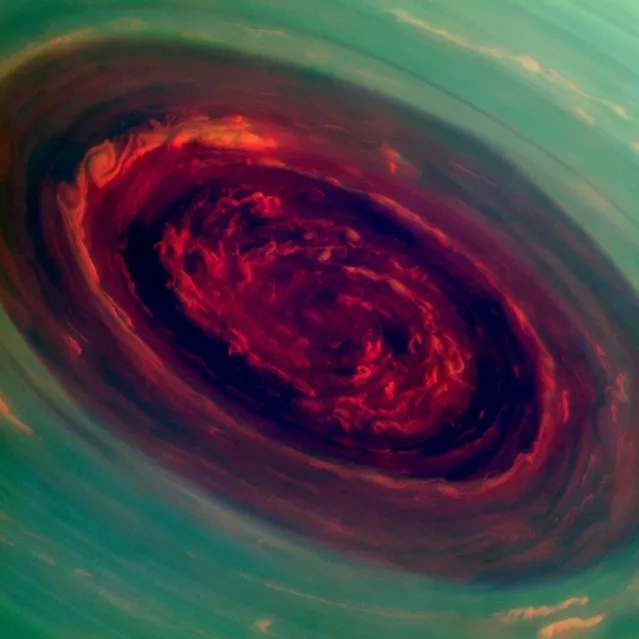
The spinning vortex of Saturn's north polar storm resembles a deep red rose of giant proportions surrounded by green foliage in this false-color image from NASA's Cassini spacecraft. (Photo by NASA/JPL-Caltech/SSI)

NASA's Cassini spacecraft has provided scientists the first close-up, visible-light views of a behemoth hurricane swirling around Saturn's north pole. In high-resolution pictures and video, scientists see the hurricane's eye is about 1,250 miles (2,000 kilometers) wide, 20 times larger than the average hurricane eye on Earth. Thin, bright clouds at the outer edge of the hurricane are traveling 330 mph(150 meters per second). The hurricane swirls inside a large, mysterious, six-sided weather pattern known as the hexagon. Photo: The spinning vortex of Saturn's north polar storm resembles a deep red rose of giant proportions surrounded by green foliage in this false-color image from NASA's Cassini spacecraft. (Photo by NASA/JPL-Caltech/SSI)
Details
31 May 2015 09:11:00


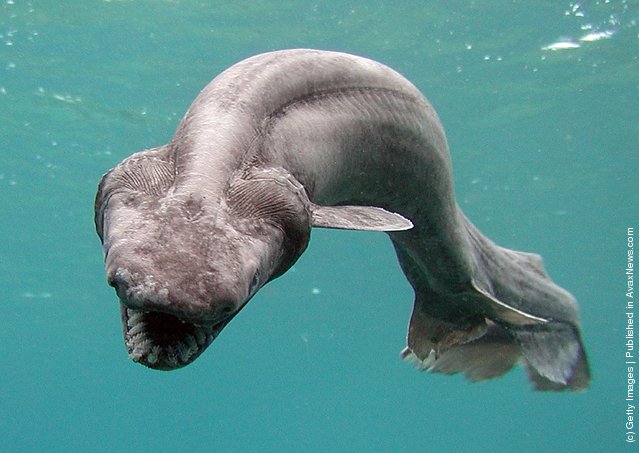
“The frilled shark (Chlamydoselachus anguineus) is one of two extant species of shark in the family Chlamydoselachidae, with a wide but patchy distribution in the Atlantic and Pacific Oceans. This uncommon species is found over the outer continental shelf and upper continental slope, generally near the bottom though there is evidence of substantial upward movements. It has been caught as deep as 1,570 m (5,150 ft), whereas in Suruga Bay, Japan it is most common at depths of 50–200 m (160–660 ft). Exhibiting several “primitive” features, the frilled shark has often been termed a «living fossil»”. – Wikipedia

Photo: A 1.6 meter long Frill shark swims in a tank after being found by a fisherman at a bay in Numazu, on January 21, 2007 in Numazu, Japan. The frill shark, also known as a Frilled shark usually lives in waters of a depth of 600 meters and so it is very rare that this shark is found alive at sea-level. It's body shape and the number of gill are similar to fossils of sharks which lived 350,000,000 years ago. (Photo by Awashima Marine Park/Getty Images)
Details
05 May 2011 10:01:00


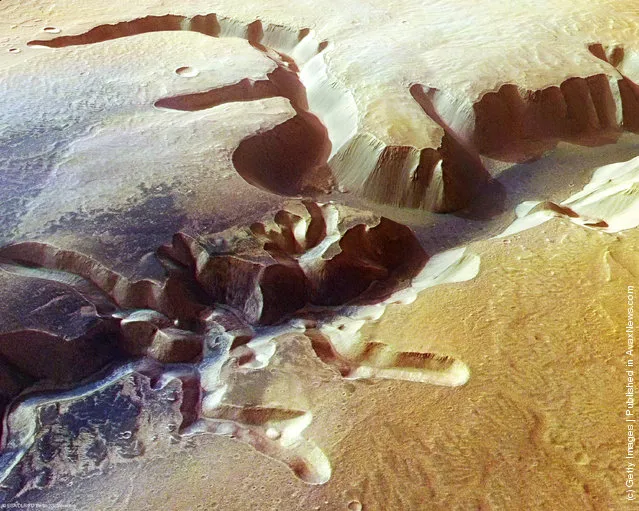
“Echus Chasma is a chasma in the Lunae Planum high plateau north of the Valles Marineris canyon system of Mars. Clay has been found in Echus Chasma that means that water once sat there for a time. Echus Chasma is approximately 100 km long and 10 km wide, with valleys ranging in depth from around 1 km to 4 km”. – Wikipedia

Photo: In this handout image supplied by the European Space Agency (ESA) on July 16, 2008, The Echus Chasma, one of the largest water source regions on Mars, is pictured from ESA's Mars Express. The data was acquired on September 25, 2005. The dark material shows a network of light-coloured, incised valleys that look similar to drainage networks known on Earth. It is still debated whether the valleys originate from precipitation, groundwater springs or liquid or magma flows on the surface. (Photo by ESA via Getty Images)
Details
18 Jul 2011 11:47:00
Ugly Girl

Chinese woman Zhang Jing, known as the “Ugly Girl” smiles after doctors removed the stitches from her fourth session of cosmetic surgery at a hospital on March 23, 2005 in Shanghai, China. Zhang Jing, 26 years old, from Tianjin Municipality, was forced to leave school because her classmates sneered at her appearance during her teenage years. After leaving junior high school, Zhang found herself still unacceptable by society, she struggled to look for a job, but was turned down by one thousand job applications in ten years. Zhang's story was widely reported by the media in 2003, this helped her find a job and get three chances of free plastic surgery. (Photo by China Photos/Getty Images)
Details
31 Aug 2011 10:11:00