Loading...
Done
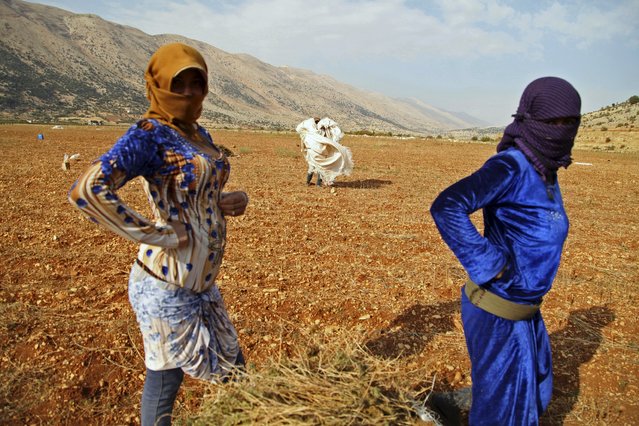
Aisha, 15, (L) (who asked to withhold her last name), a Syrian refugee from Raqqa, waits with a fellow refugee while harvesting cannabis in the Bekaa valley, Lebanon October 19, 2015. Syrian refugees work to harvest and process spiky-leafed cannabis plants in neighbouring Lebanon’s Bekaa Valley. (Photo by Alia Haju/Reuters)

Aisha, 15, (L) (who asked to withhold her last name), a Syrian refugee from Raqqa, waits with a fellow refugee while harvesting cannabis in the Bekaa valley, Lebanon October 19, 2015. Syrian refugees work to harvest and process spiky-leafed cannabis plants in neighbouring Lebanon’s Bekaa Valley. Often farmers of cotton and wheat back home in Raqqa province – now the de facto capital of Islamic State – the conflict in Syria drove them to seek safety in a region where Syrian migrant workers used to spend a few months a year before returning home. (Photo by Alia Haju/Reuters)
Details
24 Dec 2015 08:03:00
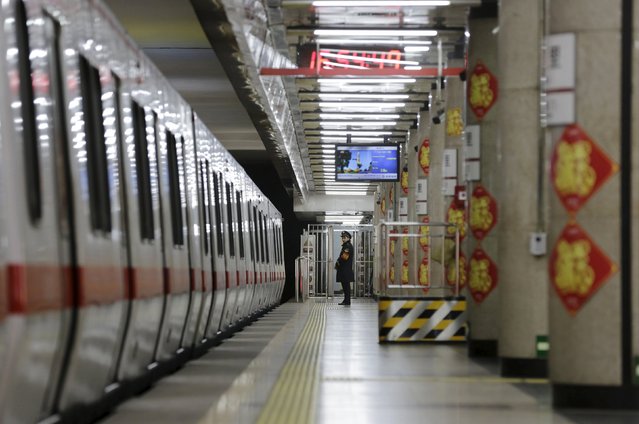
A member of security personnel stands on duty on an empty train platform inside a station on the Subway Line Number 1 on the eve of the Chinese Lunar New Year, in Beijing, China, February 7, 2016. According to local media, traffic in Beijing has seen a rare relief from its usual heavy pressure after 15 million people have left the city, heading for family reunions in their hometowns on the eve of the Chinese Lunar New Year of Monkey. (Photo by Jason Lee/Reuters)

A member of security personnel stands on duty on an empty train platform inside a station on the Subway Line Number 1 on the eve of the Chinese Lunar New Year, in Beijing, China, February 7, 2016. According to local media, traffic in Beijing has seen a rare relief from its usual heavy pressure after 15 million people have left the city, heading for family reunions in their hometowns on the eve of the Chinese Lunar New Year of Monkey. (Photo by Jason Lee/Reuters)
Details
08 Feb 2016 11:11:00


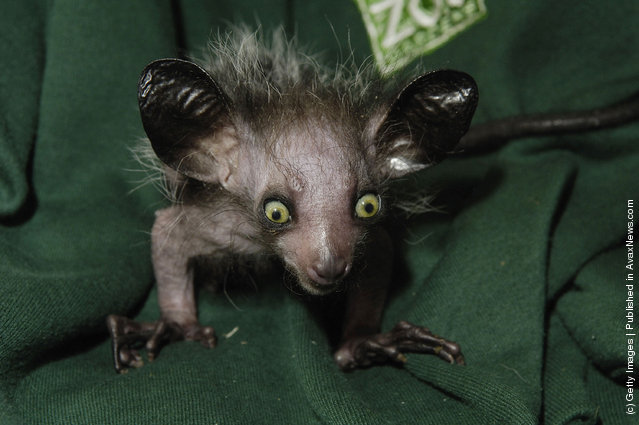
“The aye-aye (Daubentonia madagascariensis) is a lemur, a strepsirrhine primate native to Madagascar that combines rodent-like teeth and a special thin middle finger to fill the same ecological niche as a woodpecker. It is the world's largest nocturnal primate, and is characterized by its unusual method of finding food; it taps on trees to find grubs, then gnaws holes in the wood and inserts its narrow middle finger to pull the grubs out. The only other animal species known to find food in this way is the striped possum. From an ecological point of view the aye-aye fills the niche of a woodpecker as it is capable of penetrating wood to extract the invertebrates within”. – Wikipedia

Photo: In this handout image from Bristol Zoo is seen the first captive bred aye-aye in the UK named “Kintana” (meaning star in Malagasy) April 15, 2005 at Bristol Zoo Gardens, England. The zoo announced today only the second baby aye-aye to be hand-reared in the world (the first was in Jersey Zoo) and has now made his first public appearance since his birth on 11 February 2005. (Photo by Rob Cousins/Bristol Zoo via Getty Images)
Details
13 Apr 2011 13:33:00
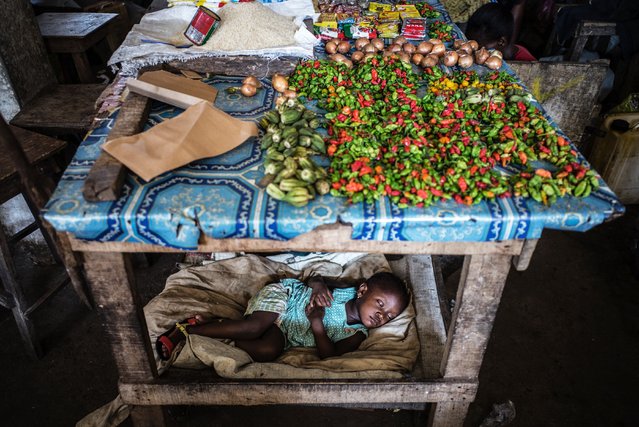
A child sleeps under a table at the Jorkpan market in Sinkor district in Monrovia, on May 2, 2016. (Photo by Marco Longari/AFP Photo)

A child sleeps under a table at the Jorkpan market in Sinkor district in Monrovia, Liberia on May 2, 2016. (Photo by Marco Longari/AFP Photo)
Details
10 May 2016 12:49:00
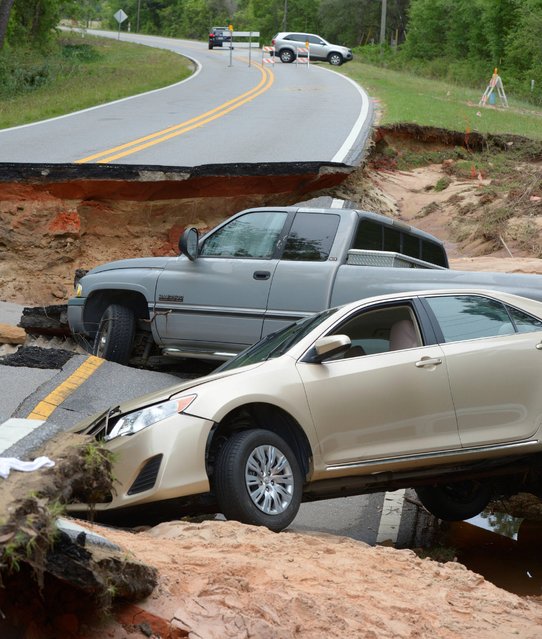
Autos sit on top of each other in a washed out section of Dog Track Road in the Millview community as Gulf Coast residents continue cleaning up from damage caused by torrential rains in Pensacola, Fla., Thursday, May 1, 2014. The National Weather Service, estimated 15-20 inches of rain has fallen in the Pensacola area in the past 2 days. (Photo by G. M. Andrews/AP Photo)

Autos sit on top of each other in a washed out section of Dog Track Road in the Millview community as Gulf Coast residents continue cleaning up from damage caused by torrential rains in Pensacola, Fla., Thursday, May 1, 2014. The National Weather Service, estimated 15-20 inches of rain has fallen in the Pensacola area in the past 2 days. (Photo by G. M. Andrews/AP Photo)
Details
03 May 2014 08:43:00
This picture taken on July 15, 2014 shows a bridge submerged in floodwaters in the ancient town of Fenghuang, central China's Hunan province. Rainstorms lashed central China's Hunan Province and southwest China's Guizhou Province, affecting over 1 million people and flooding a historical town, state media reported. (Photo by AFP Photo)

This picture taken on July 15, 2014 shows a bridge submerged in floodwaters in the ancient town of Fenghuang, central China's Hunan province. Rainstorms lashed central China's Hunan Province and southwest China's Guizhou Province, affecting over 1 million people and flooding a historical town, state media reported. (Photo by AFP Photo)
Details
19 Jul 2014 10:30:00
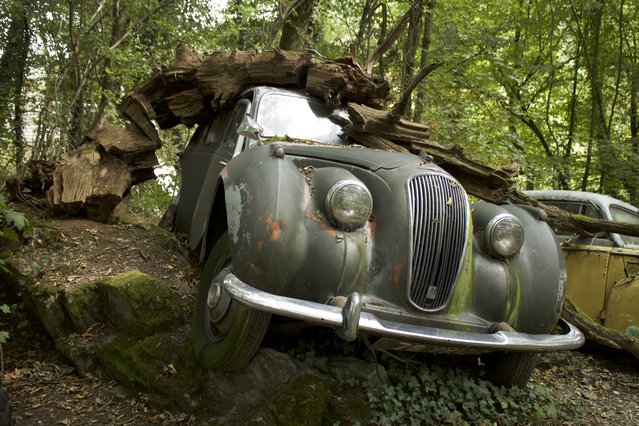
Michael Fröhlich's Jowett Javelin rotting car in his forest sculpture park in Neandertal Germany, September 11, 2016. An eccentric artist has collected fifty vintage cars and left them to rot in a forest – and now they're worth over $1 million. Former racing driver Michael Fröhlich, from Dusseldorf, Germany, has purposely crashed the cars into trees, buried them in mud and parked them on cliff faces in his estate's garden in the middle of the German Neanderthal. His collections includes a Jaguar XK120 worth $170,000, a Porsche 356 racer and a Buick worth $17,000. Perhaps his most interesting collectable is a Rolls Royce, with a purposefully misspelt “Buckingham Palace” – replacing the B with an F – emblazoned on the side with a replica of the Queen Elizabeth at the wheel. (Photo by Christoph Hagen/Barcroft Images)

Michael Fröhlich's Jowett Javelin rotting car in his forest sculpture park in Neandertal Germany, September 11, 2016. An eccentric artist has collected fifty vintage cars and left them to rot in a forest – and now they're worth over $1 million. Former racing driver Michael Fröhlich, from Dusseldorf, Germany, has purposely crashed the cars into trees, buried them in mud and parked them on cliff faces in his estate's garden in the middle of the German Neanderthal. His collections includes a Jaguar XK120 worth $170,000, a Porsche 356 racer and a Buick worth $17,000. (Photo by Christoph Hagen/Barcroft Images)
Details
24 Sep 2016 10:56:00
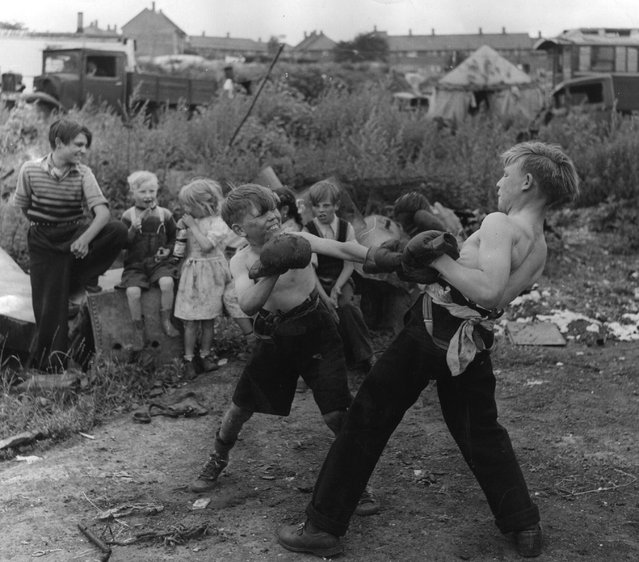
The unromantic gypsies. Children boxing in a gypsy camp in Kent, England on July 1, 1951. Like all boys these gypsy lads like to try their hand at boxing. Encouraged by their friends they fight it out on Corke's Meadow. Few Romanies now live a life of wandering romance. Most are like the three hundred squatters of Corke's Meadow, Kent, which is part of a “gypsy problem” that involves about 100,000 today. Of those about 25,000 can be rightly called gypsies, the rest are Mumpers and Posh-rats and Hobos. Corke's Meadow has both kinds. “Picture Post” cameraman Bert Hardy photographs the Corke's Meadow gypsies in their encampment. (Photo by Hulton-Deutsch Collection/Corbis via Getty Images)

The unromantic gypsies. Children boxing in a gypsy camp in Kent, England on July 1, 1951. Like all boys these gypsy lads like to try their hand at boxing. Encouraged by their friends they fight it out on Corke's Meadow. Few Romanies now live a life of wandering romance. Most are like the three hundred squatters of Corke's Meadow, Kent, which is part of a “gypsy problem” that involves about 100,000 today. Of those about 25,000 can be rightly called gypsies, the rest are Mumpers and Posh-rats and Hobos. Corke's Meadow has both kinds. “Picture Post” cameraman Bert Hardy photographs the Corke's Meadow gypsies in their encampment. (Photo by Hulton-Deutsch Collection/Corbis via Getty Images)
Details
12 Mar 2017 00:01:00