Loading...
Done
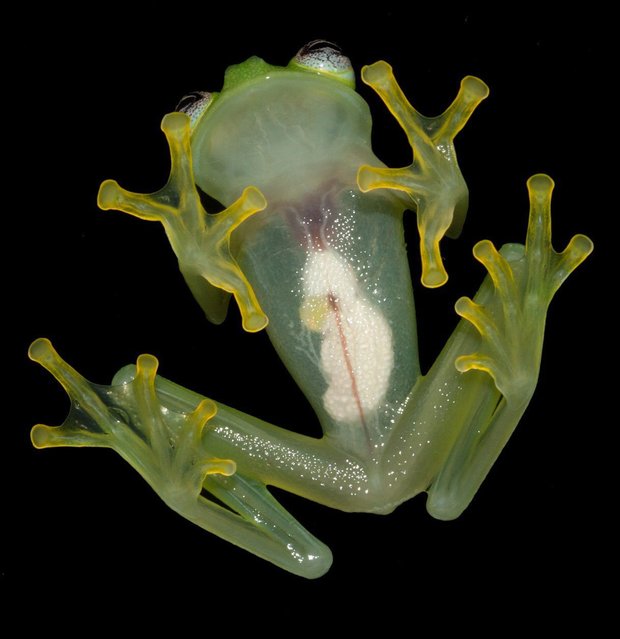
A handout photograph provided by Brian Kubicki of Costa Rican Amphibian Research Center on 26 April 2016 shows a “Crystal frog”, Hyalinobatrachium dianae (H. diane). This frog was discovered by US biologist Brian Kubicki and Costa Ricans Stanley Salazar and Robert Puschendorf in a rainy forest of Costa Rican caribbean after 40 years without notice of any new example of this kind. (Photo by Brian Kubicki/EPA/Costa Rican Amphibian Research Center)

A handout photograph provided by Brian Kubicki of Costa Rican Amphibian Research Center on 26 April 2016 shows a “Crystal frog”, Hyalinobatrachium dianae (H. diane). This frog was discovered by US biologist Brian Kubicki and Costa Ricans Stanley Salazar and Robert Puschendorf in a rainy forest of Costa Rican caribbean after 40 years without notice of any new example of this kind. (Photo by Brian Kubicki/EPA/Costa Rican Amphibian Research Center)
Details
02 May 2015 15:23:00
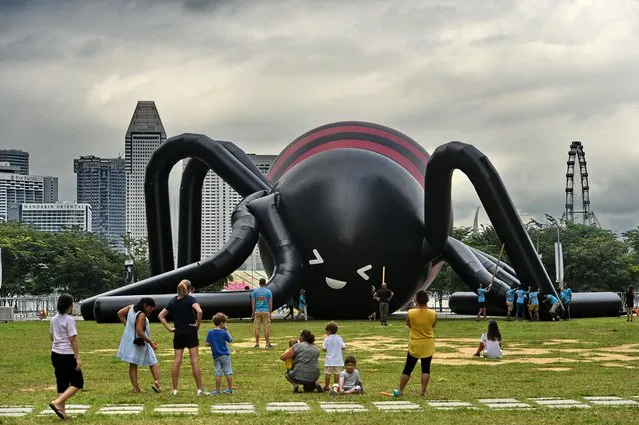
People watch as workers inflate a near-10 metre high giant spider by Singaporean artist Jackson Tan in Singapore's Marina Bay financial district on February 6, 2017. The spider is one of several inflatable creatures that will form the Art-Zoo, a section created by Singaporean artist Jackson Tan for the iLight Marina Bay annual light-art festival in the city-state. (Photo by Roslan Rahman/AFP Photo)

People watch as workers inflate a near-10 metre high giant spider by Singaporean artist Jackson Tan in Singapore's Marina Bay financial district on February 6, 2017. The spider is one of several inflatable creatures that will form the Art-Zoo, a section created by Singaporean artist Jackson Tan for the iLight Marina Bay annual light-art festival in the city-state. (Photo by Roslan Rahman/AFP Photo)
Details
07 Feb 2017 09:54:00
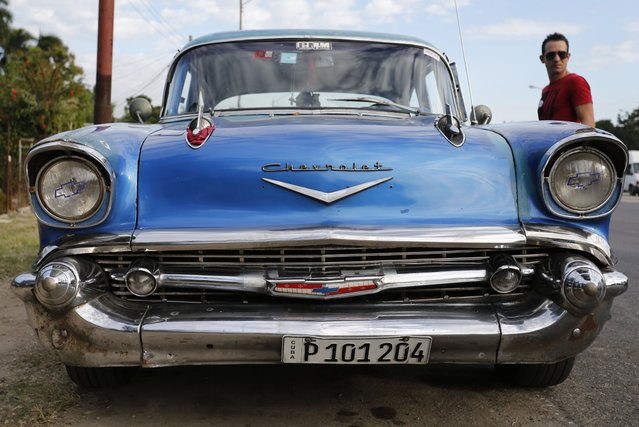
In this December 19, 2014 photo, a man stands beside his 1957 Chevrolet Bel-Air car in Havana, Cuba.  U.S. car sales have been banned in Cuba since 1959. Cubans have been have been forced to patch together Fords, Chevrolets and Chryslers that date back to before Fidel Castro's revolution which can make it appear like the country is stuck in a 1950s time warp. (Photo by Desmond Boylan/AP Photo)

In this December 19, 2014 photo, a man stands beside his 1957 Chevrolet Bel-Air car in Havana, Cuba. U.S. car sales have been banned in Cuba since 1959. Cubans have been have been forced to patch together Fords, Chevrolets and Chryslers that date back to before Fidel Castro's revolution which can make it appear like the country is stuck in a 1950s time warp. Since the Communist economic system isn't likely to change soon, many of those cars will have to stay on the road for years. (Photo by Desmond Boylan/AP Photo)
Details
26 Dec 2014 15:35:00
Cuban migrant Yamilen Arbelo, 40, walks down a hill as she crosses the border from Colombia through the jungle into La Miel, in the province of Guna Yala, Panama November 29, 2015. According to local authorities in La Miel, some 100 to 150 Cubans have been entering Panama from Colombia every day for the last three months. Scores of Cubans have come to Panama as they seek overland passage towards the United States fearing a recent detente between Washington and Havana could end their preferential treatment. (Photo by Carlos Jasso/Reuters)

Cuban migrant Yamilen Arbelo, 40, walks down a hill as she crosses the border from Colombia through the jungle into La Miel, in the province of Guna Yala, Panama November 29, 2015. According to local authorities in La Miel, some 100 to 150 Cubans have been entering Panama from Colombia every day for the last three months. Scores of Cubans have come to Panama as they seek overland passage towards the United States fearing a recent detente between Washington and Havana could end their preferential treatment. (Photo by Carlos Jasso/Reuters)
Details
01 Dec 2015 08:00:00
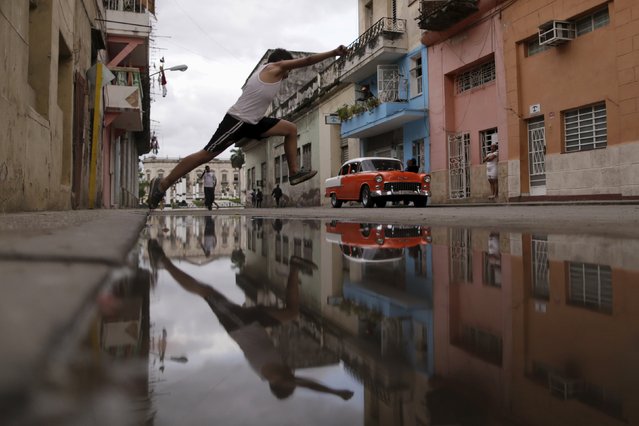
A boy jumps over a puddle of water on the outskirts of Havana, Cuba March 21, 2016. (Photo by Ueslei Marcelino/Reuters)

A boy jumps over a puddle of water on the outskirts of Havana, Cuba March 21, 2016. (Photo by Ueslei Marcelino/Reuters)
Details
23 Mar 2016 12:13:00
A young girl makes a “tomato angel” on a tomato covered street during the traditional tomato fight “Tomatina” during the fiestas in Bunol, Spain, 28 August 2013. This year's Tomatina is the first pay festival after Bunol's City Hall sold 15,000 tickets to take part in the tomato throwing. A total of 20,000 people, including 5,000 residents, will throw over 130,000 kg tomatoes. Local authorities decided to sell tickets this year to avoid the overcrowding in previous years in which over 50,000 people took part in the event. (Photo by Biel Alino/EPA)

A young girl makes a “tomato angel” on a tomato covered street during the traditional tomato fight “Tomatina” during the fiestas in Bunol, Spain, 28 August 2013. This year's Tomatina is the first pay festival after Bunol's City Hall sold 15,000 tickets to take part in the tomato throwing. A total of 20,000 people, including 5,000 residents, will throw over 130,000 kg tomatoes. Local authorities decided to sell tickets this year to avoid the overcrowding in previous years in which over 50,000 people took part in the event. (Photo by Biel Alino/EPA)
Details
29 Aug 2013 11:24:00
A Tai Yai boy waits for a ceremony to begin at Wat Don Chedi on April 7, 2014 in Mae Hong Son, Thailand. Poy Sang Long is a Buddhist novice ordination ceremony of the Shan people or Tai Yai, an ethnic group of Shan State in Myanmar and northern Thailand. Young boys aged between 7 and 14 are ordained as novices to learn the Buddhist doctrines. It's believed that they will gain merit for their parents by ordaining. (Photo by Taylor Weidman/Getty Images)

A Tai Yai boy waits for a ceremony to begin at Wat Don Chedi on April 7, 2014 in Mae Hong Son, Thailand. Poy Sang Long is a Buddhist novice ordination ceremony of the Shan people or Tai Yai, an ethnic group of Shan State in Myanmar and northern Thailand. Young boys aged between 7 and 14 are ordained as novices to learn the Buddhist doctrines. It's believed that they will gain merit for their parents by ordaining. (Photo by Taylor Weidman/Getty Images)
Details
09 Apr 2014 08:06:00


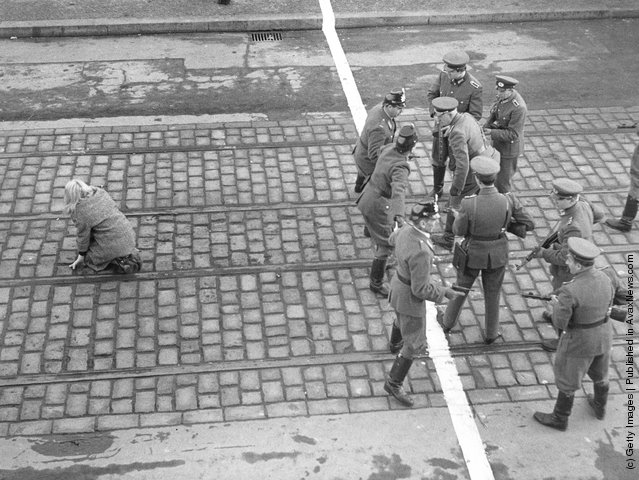
“The Berlin Wall (German: Berliner Mauer) was a barrier constructed by the German Democratic Republic (GDR, East Germany) starting on 13 August 1961, that completely cut off West Berlin from surrounding East Germany and from East Berlin. The barrier included guard towers placed along large concrete walls, which circumscribed a wide area (later known as the “death strip”) that contained anti-vehicle trenches, “fakir beds” and other defenses. The Soviet-dominated Eastern Bloc officially claimed that the wall was erected to protect its population from fascist elements conspiring to prevent the “will of the people” in building a socialist state in East Germany. However, in practice, the Wall served to prevent the massive emigration and defection that marked Germany and the communist Eastern Bloc during the post-World War II period”. – Wikipedia

Photo: West Berlin policemen and East German Volkspolizei face each other across the border in Berlin, circa 1955. (Photo by Three Lions/Hulton Archive/Getty Images)
Details
22 May 2011 10:49:00