Loading...
Done
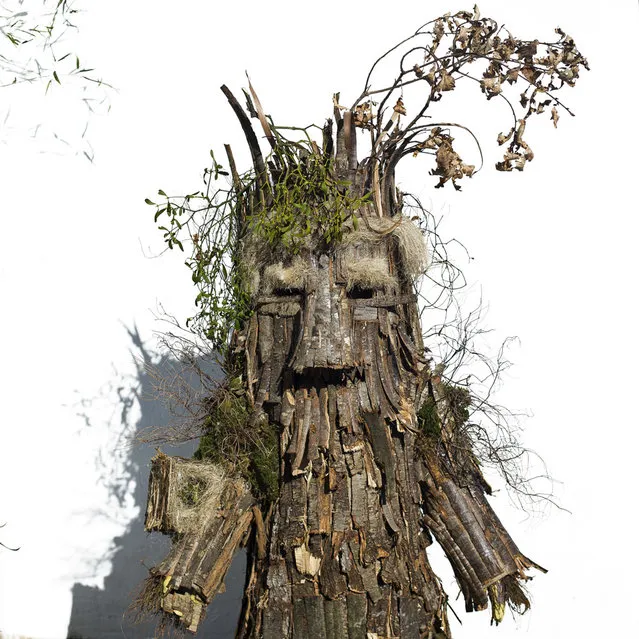
A man dressed as a  “Trapajon”, representing entities of nature, poses for a picture after taking part in the Vijanera Festival in Silio, northern Spain, Sunday, Jan. 6, 2013. The Vijanera masquerade, of pre-Roman origin, is the first carnival of the year in Europe symbolizing the triumph of good over evil and involving the participation of crowds of residents wearing different masks, animal skins and brightly colored clothing with its own complex function and symbolism and becoming the living example of the survival of archaic cults to nature. (Photo by Daniel Ochoa de Olza/AP Photo)

A man dressed as a “Trapajon”, representing entities of nature, poses for a picture after taking part in the Vijanera Festival in Silio, northern Spain, Sunday, Jan. 6, 2013. The Vijanera masquerade, of pre-Roman origin, is the first carnival of the year in Europe symbolizing the triumph of good over evil and involving the participation of crowds of residents wearing different masks, animal skins and brightly colored clothing with its own complex function and symbolism and becoming the living example of the survival of archaic cults to nature. (Photo by Daniel Ochoa de Olza/AP Photo)
Details
19 Jan 2013 13:01:00
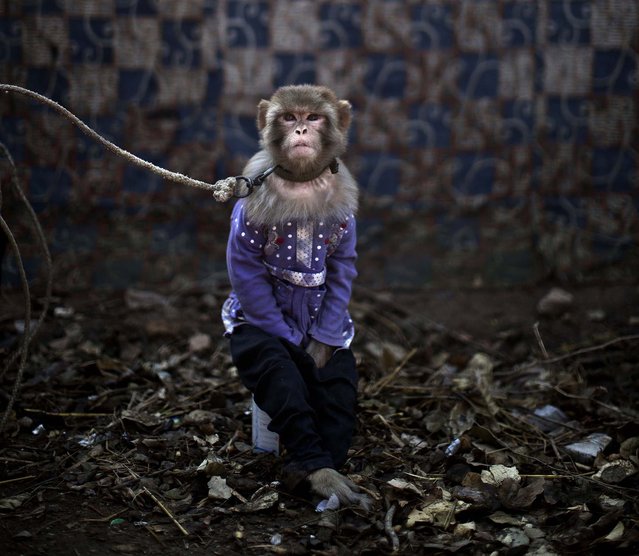
In this Tuesday, February 11, 2014, photo, a trained monkey, that makes a living for her Pakistani owner by performing to a crowd in public and private places, sits held by a leash, in Rawalpindi, Pakistan. For Pakistanis who raise and train the monkeys they are an important source of income in an impoverished country, and they form a strong bond with the animals. The monkeys are usually captured in the wild when they are babies and then trained. A trained monkey can fetch 20,000 to 30,000 rupees ($190 to $285). (Photo by Muhammed Muheisen/Associated Press)

In this Tuesday, February 11, 2014, photo, a trained monkey, that makes a living for her Pakistani owner by performing to a crowd in public and private places, sits held by a leash, in Rawalpindi, Pakistan. For Pakistanis who raise and train the monkeys they are an important source of income in an impoverished country, and they form a strong bond with the animals. The monkeys are usually captured in the wild when they are babies and then trained. A trained monkey can fetch 20,000 to 30,000 rupees ($190 to $285). (Photo by Muhammed Muheisen/Associated Press)
Details
23 Feb 2014 09:50:00
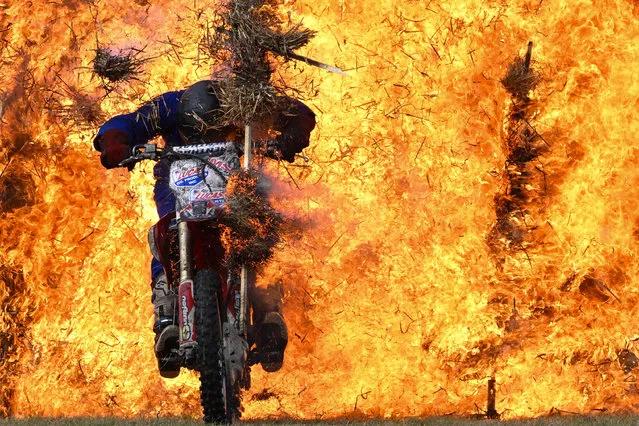
Moto Stunts International put on a display showing a motorcycle riding through fire, on August 24, 2023 in West Bay, Dorset. The Melplash Agricultural Society Show, held in West Dorset, is a prominent agricultural exhibition in the South West region. Besides providing a platform for trade, visitors can also witness animal judging and gain valuable insights into food production and farming practices. (Photo by Finnbarr Webster/Getty Images)

Moto Stunts International put on a display showing a motorcycle riding through fire, on August 24, 2023 in West Bay, Dorset. The Melplash Agricultural Society Show, held in West Dorset, is a prominent agricultural exhibition in the South West region. Besides providing a platform for trade, visitors can also witness animal judging and gain valuable insights into food production and farming practices. (Photo by Finnbarr Webster/Getty Images)
Details
05 Oct 2023 02:13:00
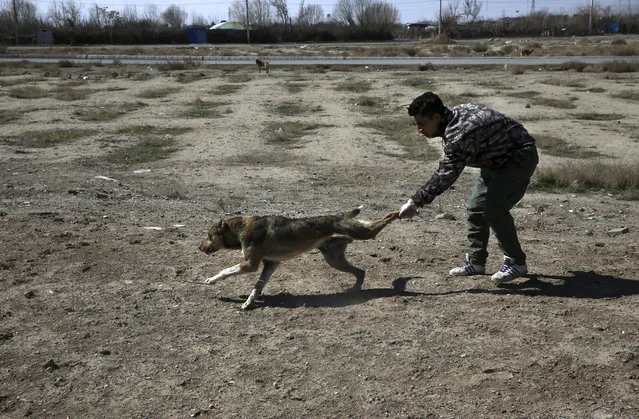
In this picture taken on Sunday, March 5, 2017, a Tehran's urban animal control worker catches a stray dog after being shot with his anesthetic dart on the outskirts of the capital Tehran, Iran. (Photo by Vahid Salemi/AP Photo)

In this picture taken on Sunday, March 5, 2017, a Tehran's urban animal control worker catches a stray dog after being shot with his anesthetic dart on the outskirts of the capital Tehran, Iran. The shelter has been hired by the Tehran city government to take a new, more humane approach to deal with the burgeoning problem of stray dogs in the capital. It’s a sign of changing attitudes among officials in a country where Islamic authorities long saw dogs as “un-Islamic” and would at times confiscate them from people who kept them as pets. (Photo by Vahid Salemi/AP Photo)
Details
17 Mar 2017 00:03:00
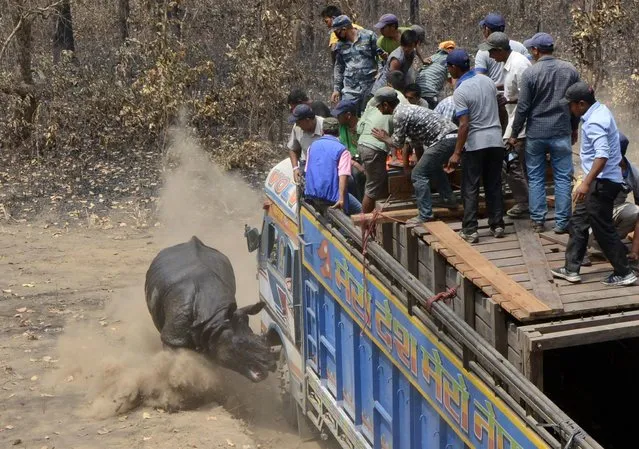
A Nepalese vetinary and technical team release a rhino after it is relocated in Chitwan National Park some of 250 Kilometer South of Kathmandu on April 4, 2017. Conservationists on April 3 captured a rare one-horned rhinoceros in Nepal as part of an attempt to increase the number of the vulnerable animals, which are prized by wildlife poachers. Five rhinos – one male and four female – will be released into a national park in Nepal's far west over the coming week in the hope of establishing a new breeding group. (Photo by Prakash Mathema/AFP Photo)

A Nepalese vetinary and technical team release a rhino after it is relocated in Chitwan National Park some of 250 Kilometer South of Kathmandu on April 4, 2017. Conservationists on April 3 captured a rare one-horned rhinoceros in Nepal as part of an attempt to increase the number of the vulnerable animals, which are prized by wildlife poachers. Five rhinos – one male and four female – will be released into a national park in Nepal's far west over the coming week in the hope of establishing a new breeding group. (Photo by Prakash Mathema/AFP Photo)
Details
05 Apr 2017 09:19:00
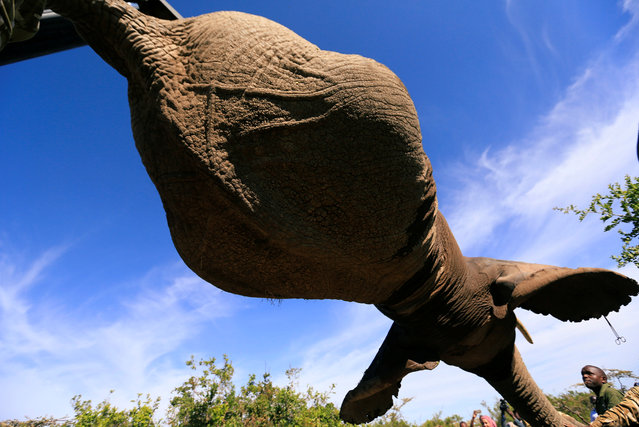
Kenya Wildlife Service (KWS) rangers load a tranquilized elephant onto a truck during a translocation exercise to Ithumba Camp in Tsavo East National Park, in Solio Ranch in Nyeri County, Kenya, February 21, 2018. Wildlife officials in Kenya kicked off a relocation operation for 30 elephants, fitting monitoring collars on the tranquilized animals before using cranes to swing them, inverted with bound feet and scything tusks, onto flatbed trucks. (Photo by Thomas Mukoya/Reuters)

Kenya Wildlife Service (KWS) rangers load a tranquilized elephant onto a truck during a translocation exercise to Ithumba Camp in Tsavo East National Park, in Solio Ranch in Nyeri County, Kenya, February 21, 2018. Wildlife officials in Kenya kicked off a relocation operation for 30 elephants, fitting monitoring collars on the tranquilized animals before using cranes to swing them, inverted with bound feet and scything tusks, onto flatbed trucks. (Photo by Thomas Mukoya/Reuters)
Details
23 Feb 2018 00:04:00
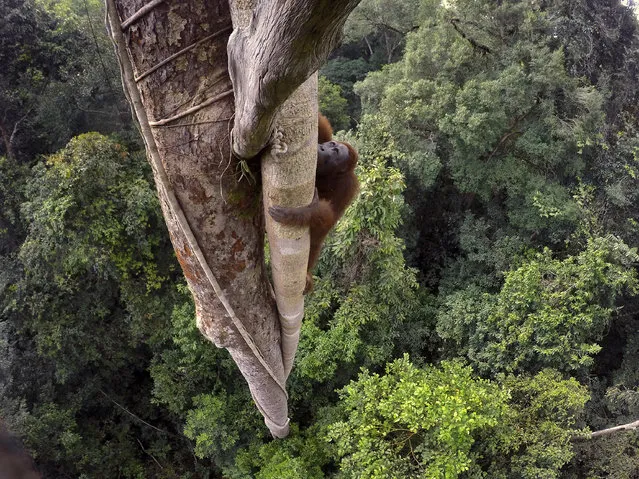
“Tough Times for Orangutans”. Nature, first prize stories. Tim Laman, USA. Location: West Kalimantan, Indonesia. A Bornean orangutan climbs over 30 meters up a tree in the rain forest of Gunung Palung National Park, West Kalimantan, Indonesia, August 12, 2015. The lives of wild orangutans are brought to light. Threats to these orangutans from fires, the illegal animal trade and loss of habitat due to deforestation have resulted in many orphan orangutans ending up at rehabilitation centers. (Photo by Tim Laman/World Press Photo Contest)

“Tough Times for Orangutans”. Nature, first prize stories. Tim Laman, USA. Location: West Kalimantan, Indonesia. A Bornean orangutan climbs over 30 meters up a tree in the rain forest of Gunung Palung National Park, West Kalimantan, Indonesia, August 12, 2015. The lives of wild orangutans are brought to light. Threats to these orangutans from fires, the illegal animal trade and loss of habitat due to deforestation have resulted in many orphan orangutans ending up at rehabilitation centers. (Photo by Tim Laman/World Press Photo Contest)
Details
19 Feb 2016 13:06:00
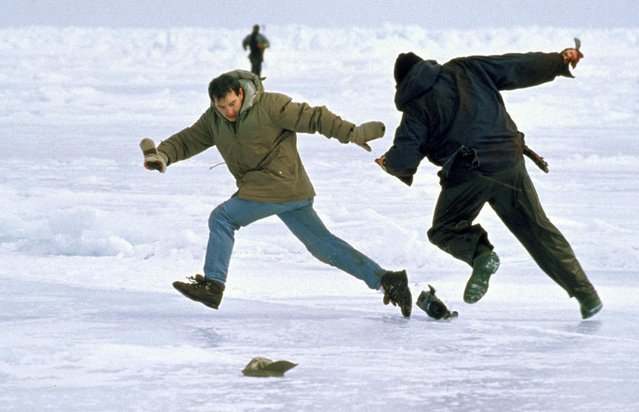
In this 1997 photo released by the International Fund for Animal Welfare, a seal hunter, right, threatens a cameraman with a knife during the filming of a seal hunt in the Gulf of St. Lawrence, Canada. “Huntwatch”, a documentary by the organization about the fight to end commercial seal hunts, premieres in September 2016 on Discovery. The producers say it includes grainy but powerful archive footage that had languished in the basement of the group’s headquarters on Cape Cod for nearly five decades. (Photo by Richard Sobol/IFAW via AP Photo)

In this 1997 photo released by the International Fund for Animal Welfare, a seal hunter, right, threatens a cameraman with a knife during the filming of a seal hunt in the Gulf of St. Lawrence, Canada. “Huntwatch”, a documentary by the organization about the fight to end commercial seal hunts, premieres in September 2016 on Discovery. The producers say it includes grainy but powerful archive footage that had languished in the basement of the group’s headquarters on Cape Cod for nearly five decades. (Photo by Richard Sobol/IFAW via AP Photo)
Details
17 Sep 2016 10:41:00