Loading...
Done
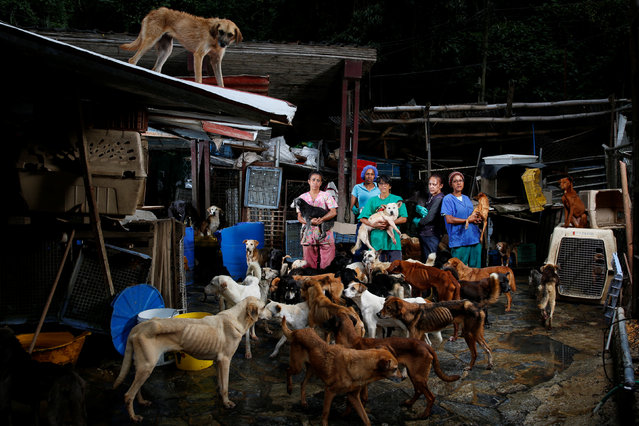
(L-R) Maria Silva, Milena Cortes, Maria Arteaga, Jackeline Bastidas and Gissy Abello pose for a picture at the Famproa dogs shelter where they work, in Los Teques, Venezuela, August 25, 2016. Venezuelans struggling to feed their families let alone their pets are dumping animals on the streets, in parks and at makeshift homes overrun with scrawny animals amid an economic crisis. An hour from Caracas in Los Teques, hundreds of dogs bark and run around the streets scavenging for food outside a makeshift shelter. People come by every few hours to hand over scrawny dogs which are fed by volunteers every day. Venezuela is undergoing a major economic and social crisis, with shortages of basic foods and medicines. Triple digit inflation is hitting everybody hard, including those who own pets. (Photo by Carlos Garcia Rawlins/Reuters)

(L-R) Maria Silva, Milena Cortes, Maria Arteaga, Jackeline Bastidas and Gissy Abello pose for a picture at the Famproa dogs shelter where they work, in Los Teques, Venezuela, August 25, 2016. Venezuelans struggling to feed their families let alone their pets are dumping animals on the streets, in parks and at makeshift homes overrun with scrawny animals amid an economic crisis. An hour from Caracas in Los Teques, hundreds of dogs bark and run around the streets scavenging for food outside a makeshift shelter. (Photo by Carlos Garcia Rawlins/Reuters)
Details
08 Sep 2016 10:01:00
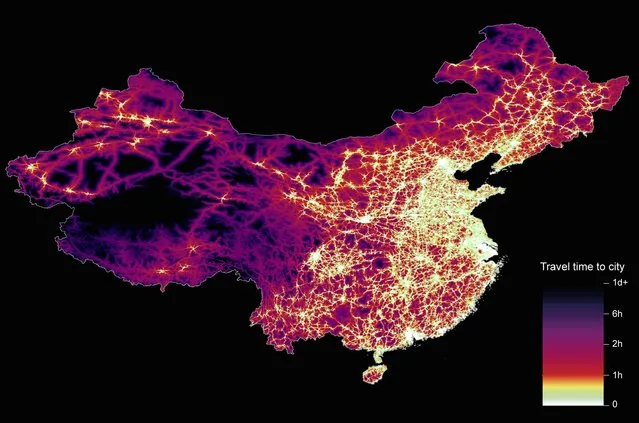
From Britain to China to Mali, new maps showing travel times to the nearest urban centre reveal huge differences between countries. Using Open Street Map and Google, a University of Oxford team have created a visual breakdown that suggests major inequalities when it comes to commuting. Here: China. The dataset used for China was unique as it relied solely on Open Street Map, due to restrictions on accessing Google data. The population is densely concentrated in the east and accessibility is increased, whereas rural provinces in the west remain remote. (Photo by Daniel Weiss/Jennifer Rozier/Malaria Atlas Project/University of Oxford )

From Britain to China to Mali, new maps showing travel times to the nearest urban centre reveal huge differences between countries. Using Open Street Map and Google, a University of Oxford team have created a visual breakdown that suggests major inequalities when it comes to commuting. Here: China. The dataset used for China was unique as it relied solely on Open Street Map, due to restrictions on accessing Google data. The population is densely concentrated in the east and accessibility is increased, whereas rural provinces in the west remain remote. (Photo by Daniel Weiss/Jennifer Rozier/Malaria Atlas Project/University of Oxford)
Details
12 Jan 2018 06:43:00
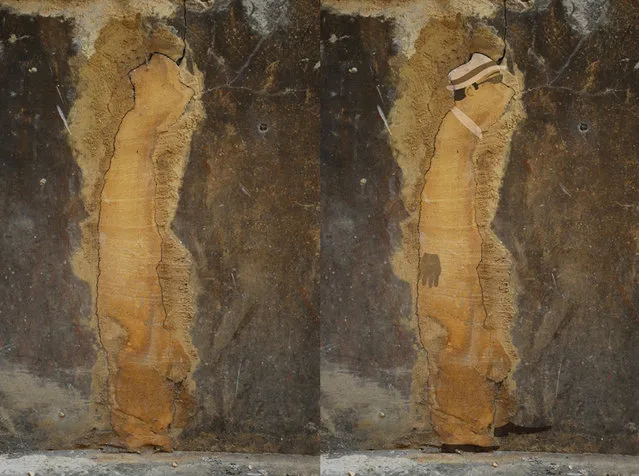
Stop Watch By Tineke Meirink

In her blog “Stop Watch” Dutch artist Tineke Meirink takes photos of everyday objects found on the streets, then she gives life to by adding a minimal digital illustratior.
Details
16 Feb 2014 12:22:00
Surgeons Prepare To Separate Conjoined Twin Toddlers

Conjoined twins Angelica (C) and Angelina Sabuco (L) play with child life specialist Allison Brooks during a press conference at the Lucile Packard Children's Hospital at Stanford on October 31, 2011 in Palo Alto, California. Two year-old conjoined twins Angelica and Angelina Subaco who are connected at the chest and abdomen are preparing for separation surgery by Dr. Gary Hartman. The surgery will last between 6 and 8 hours that is followed by three hours of reconstructive surgery for each girl. (Photo by Justin Sullivan/Getty Images)
Details
01 Nov 2011 11:10:00
Rioting in Tottenham in North London

Two girls are detained outside the Currys electrical store in Brixton on August 8, 2011 in London, England. Widespread rioting and looting took place across many parts of London in the early hours of Monday morning in a reaction to earlier rioting in Tottenham in North London. Major disturbances broke out late on Saturday night in Tottenham and the surrounding area after the killing of Mark Duggan, 29 and a father-of-four, by armed police in an attempted arrest on August 4. (Photo by Dan Kitwood/Getty Images)
Details
08 Aug 2011 11:37:00
Thailand's badminton player Ratchanok Intanon, who hopes to win gold at the Rio Olympics, receives a massage during a morning training session at a gym in Bangkok, Thailand, June 22, 2016. (Photo by Athit Perawongmetha/Reuters)

Thailand's badminton player Ratchanok Intanon, who hopes to win gold at the Rio Olympics, receives a massage during a morning training session at a gym in Bangkok, Thailand, June 22, 2016. As the humble daughter of factory workers at a Bangkok sweet-maker, badminton was a ticket out of poverty for Ratchanok Intanon, who hopes winning gold at the Rio Olympics might inspire more Thai girls to chase their dreams. (Photo by Athit Perawongmetha/Reuters)
Details
12 Jul 2016 12:24:00

A photographer takes  picture of an automotive model during the 36th Bangkok International Motor Show in Bangkok, Thailand, March 24, 2015. (Photo by Jurnasyanto Sukarno/JG Photo)

A photographer takes picture of an automotive model during the 36th Bangkok International Motor Show in Bangkok, Thailand, March 24, 2015. No automotive event is complete without the latest offering of high-end cars and motorcycles, and the obligatory accessories stationed at each booth: nubile, young auto-show girls in skimpy, skinsqueezing outfits. This year's Bangkok International Motor Show did not disappoint, attracting a larger horde of eager, flesh-seeking photographers than actual fans of automobiles. (Photo by Jurnasyanto Sukarno/JG Photo)
Details
29 Mar 2015 12:34:00
Gemma, right, and Joanne in their home in Angeles City. (Photo by Hannah Reyes Morales/The Washington Post)

Typhoon Yolanda – also known as Haiyan – struck the central part of the country November 8, 2013, leaving at least 6,300 people dead and over four million displaced. A month after Typhoon Haiyan, the United Nations Population Fund estimates that 5,000 women were subjected to sеxual violence. A study by the Health and Human Rights online publication shows the majority of young girls and women in Manila’s sеx industry come from poverty-stricken areas – such as Leyte, Samar, Cebu and southern Mindanao – and enter trafficking through force, deception, economic desperation and psychological manipulation. (Photo by Hannah Reyes Morales/The Washington Post)
Details
01 May 2017 09:59:00