Loading...
Done
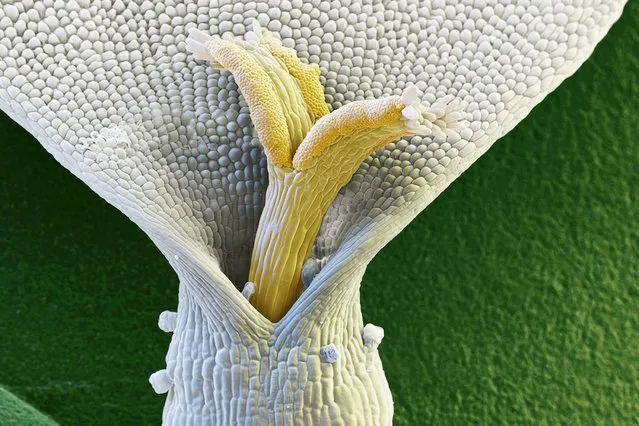
The floret of a Chamomile flower up close and personal. (Photo by Oliver Meckes/Barcroft Media)

These images have been created using a colour scanning electron microscope (SEM) by the award-winning Eye of Science, comprised of snapper Oliver Meckes and biologist Nicole Ottawa. For a decade the pair, based in Reutlingen in the south of Germany, worked with an old SEM they saved from the scrapheap, but for the last five years they have used a £250,000 FEI Quanta Series Field Emission SEM. Oliver said: “Flowers are beautiful in 'normal' view, but when you look closer, some parts get very bizarre and unexpected structures appear – flowers within flowers, worlds within worlds”. Photo: The floret of a Chamomile flower up close and personal. (Photo by Oliver Meckes/Barcroft Media)
Details
26 May 2014 13:51:00
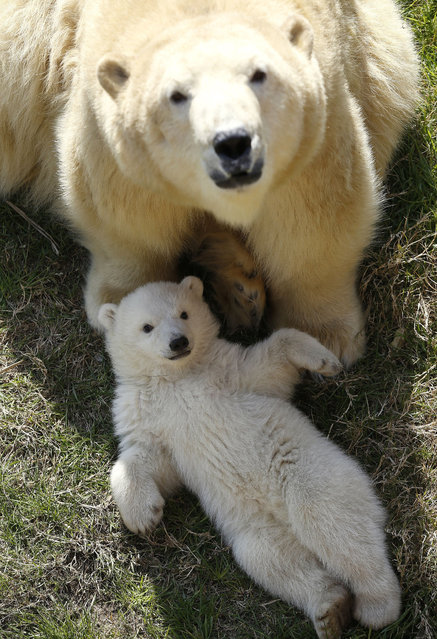
A polar bear cub, born on November 26, 2014, and its mother Flocke spend time outdoors on March 9, 2015 at the Marineland animal exhibition park in the French Riviera city of Antibes.        AFP PHOTO / VALERY HACHE        (Photo credit should read VALERY HACHE/AFP/Getty Images)

A polar bear cub, born on November 26, 2014, and its mother Flocke spend time outdoors on March 9, 2015 at the Marineland animal exhibition park in the French Riviera city of Antibes. AFP PHOTO / VALERY HACHE (Photo credit should read VALERY HACHE/AFP/Getty Images)
Details
13 Mar 2015 14:04:00
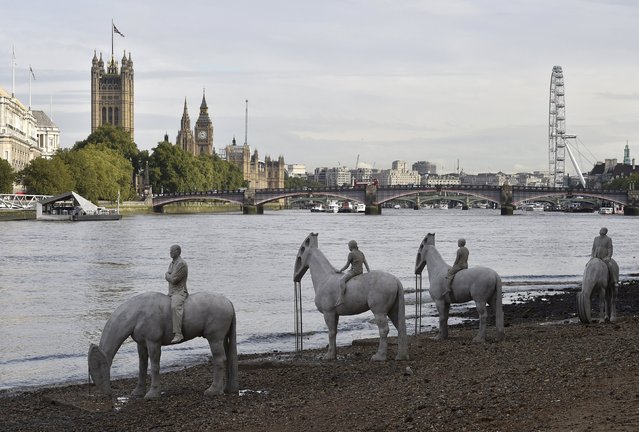
Sculptures entitled “The Rising Tide” by British sculptor Jason deCaires Taylor are seen beside the River Thames in front of the Houses of Parliament and the London Eye ferris wheel in London, September 3, 2015. The representations of four horses and riders are fully visible at low tide but become immersed underwater twice a day as the Thames rises to reach full tide. The installation will be on display throughout September as part of the annual Totally Thames festival. (Photo by Toby Melville/Reuters)

Sculptures entitled “The Rising Tide” by British sculptor Jason deCaires Taylor are seen beside the River Thames in front of the Houses of Parliament and the London Eye ferris wheel in London, September 3, 2015. The representations of four horses and riders are fully visible at low tide but become immersed underwater twice a day as the Thames rises to reach full tide. The installation will be on display throughout September as part of the annual Totally Thames festival. (Photo by Toby Melville/Reuters)
Details
04 Sep 2015 13:58:00
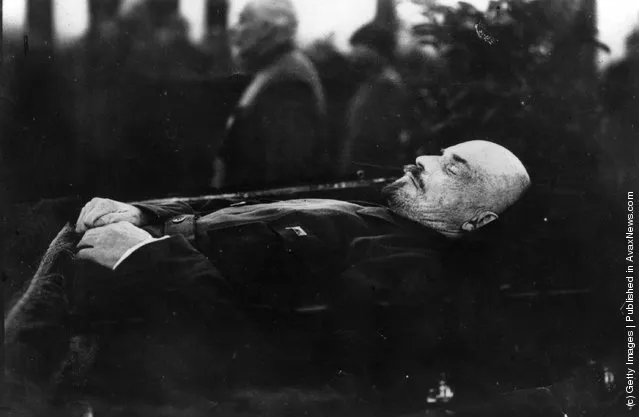
1924:  Vladimir Ilyich Lenin lying in state in the Kremlin

Photo: Vladimir Ilyich Lenin (1870 – 1924) lying in state in the Kremlin. (Photo by Hulton Archive/Getty Images). 1924

Important! For the same article in Russian language click here.

Something quite intriguing is happening within Russian-speaking internet during the last few – should you type a fully academic inquiry (at least, according to Russian academic requirements) in national search engines for "Lenin's mausoleum" – the first thing you get (even in top 10 searches) is website pages talking about black magic and occult. Website authors view this construction differently, but unconditionally agree on one thing: the mausoleum of the "leader of the world proletariat” – the essence of a magical artifact, a sort of “energy vampire”. It was built with a certain purpose: to drain the energy out of miserable Soviet citizens on one hand; and to poison the anthroposphere of one-sixth part of the earth with its vibes (the exact territory that was occupied by the former Soviet Union), depriving the Russian people of will to resist on the other hand. Complete nonsense? No doubt. Nevertheless, an intriguing one. Well, probably because some oddities do exist in mausoleum's history. These oddities are the thing we are going to discuss this time. First, let me refresh you memory on the subject.
Details
16 Oct 2011 11:27:00
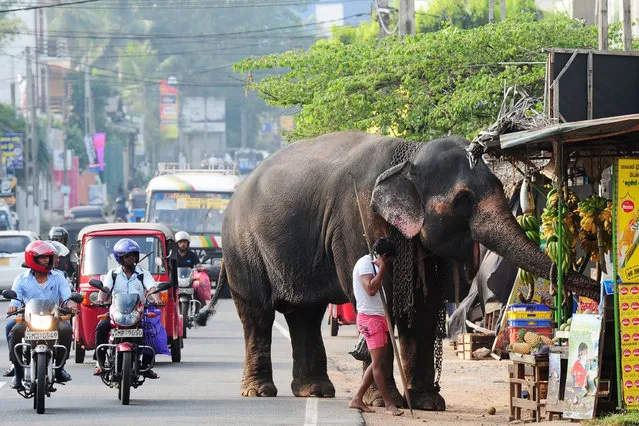
A Sri Lankan elephant, accompanied by his mahout, browse through a roadside fruit stall in Colombo on January 19, 2015. The Sri Lankan elephant is listed as endangered by the International Union for Conservation of Nature (IUCN) as the population has declined by at least 50 percent over the last three generations, with the species threatened by habitat loss, degradation and fragmentation. (Photo by Lakruwan Wanniarachchi/AFP Photo)

A Sri Lankan elephant, accompanied by his mahout, browse through a roadside fruit stall in Colombo on January 19, 2015. The Sri Lankan elephant is listed as endangered by the International Union for Conservation of Nature (IUCN) as the population has declined by at least 50 percent over the last three generations, with the species threatened by habitat loss, degradation and fragmentation. (Photo by Lakruwan Wanniarachchi/AFP Photo)
Details
23 Jan 2015 13:21:00
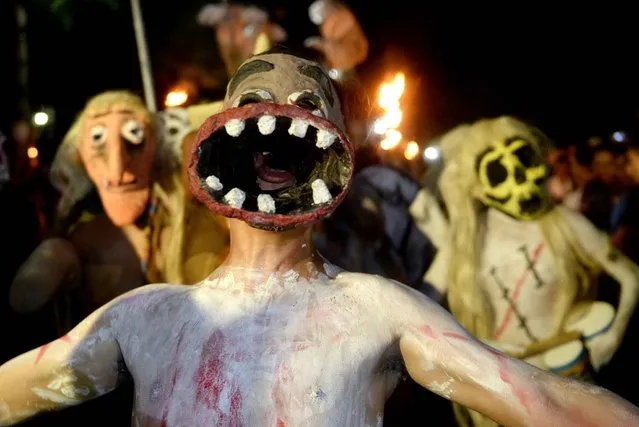
Young revelers take part in a parade called "La Calabiuza" on November 1, 2015, on the eve of the Day of the Dead in Tonacatepeque, 20 kms (13 miles) north of San Salvador. During the celebration, the residents of Tonacatepeque, originally an indigenous community, recall the characters from the mythology of Cuscatlan – pre-Columbian west and central regions of El Salvador – and their dead relatives. (Photo by Marvin Recinos/AFP Photo)

Young revelers take part in a parade called "La Calabiuza" on November 1, 2015, on the eve of the Day of the Dead in Tonacatepeque, 20 kms (13 miles) north of San Salvador. During the celebration, the residents of Tonacatepeque, originally an indigenous community, recall the characters from the mythology of Cuscatlan – pre-Columbian west and central regions of El Salvador – and their dead relatives. (Photo by Marvin Recinos/AFP Photo)
Details
04 Nov 2015 11:50:00
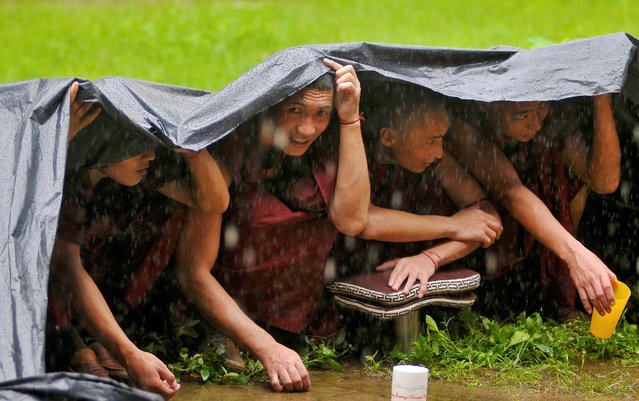
Buddhist monks take shelter under a tarpaulin sheet to protect themselves from the rain as they attend the birthday celebrations of the Tibetan spiritual leader the Dalai Lama (unseen) at Drepung Loseling Monastery in Mundgod, in the southern state of Karnataka, India, July 6, 2016. (Photo by Abhishek N. Chinnappa/Reuters)

Buddhist monks take shelter under a tarpaulin sheet to protect themselves from the rain as they attend the birthday celebrations of the Tibetan spiritual leader the Dalai Lama (unseen) at Drepung Loseling Monastery in Mundgod, in the southern state of Karnataka, India, July 6, 2016. (Photo by Abhishek N. Chinnappa/Reuters)
Details
07 Jul 2016 11:23:00
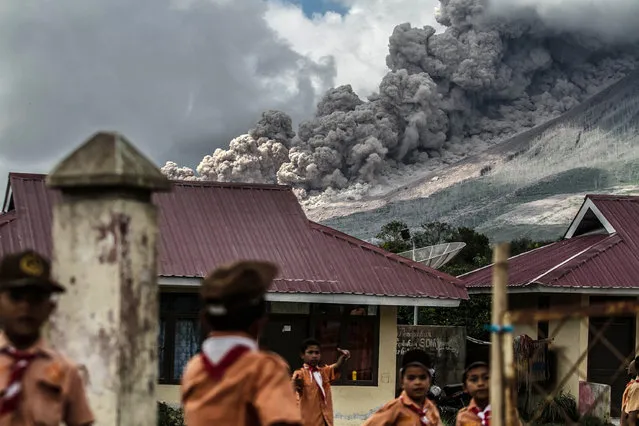
Elementary school children play outside their classrooms as mount Sinabung volcano spews thick volcanic ash in the background on February 10, 2017 in Karo, Indonesia. Mount Sinabung is one of the most active volcanoes in Indonesia and last erupted in May 2016, killing seven people. (Photo by Albert Damanik/Barcroft Images)

Elementary school children play outside their classrooms as mount Sinabung volcano spews thick volcanic ash in the background on February 10, 2017 in Karo, Indonesia. Mount Sinabung is one of the most active volcanoes in Indonesia and last erupted in May 2016, killing seven people. (Photo by Albert Damanik/Barcroft Images)
Details
11 Feb 2017 11:35:00