Loading...
Done
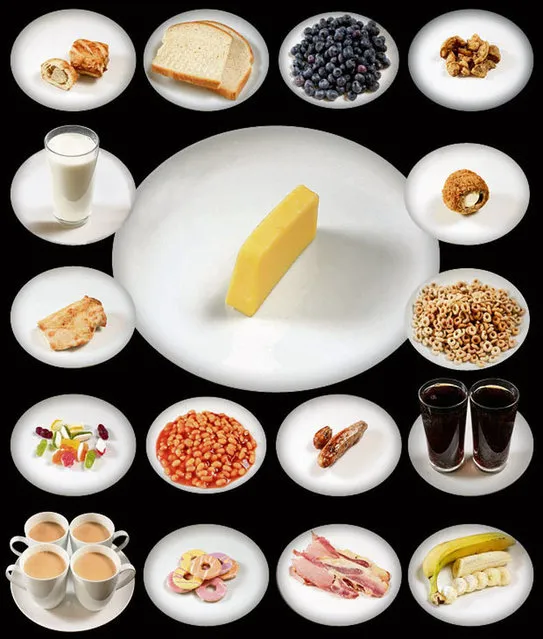
What 200 Calories Looks Like In Different Foods Part 2

Some foods have significantly more Calories than others but what does the difference actually look like. Each of the photographs below represents 200 Calories of the particular type of food; the images are sorted from low to high calorie density. When you consider that an entire plate of broccoli contains the same number of Calories as a small spoonful of peanut butter, you might think twice the next time you decide what to eat. According to the U.S. Department of Agriculture, the average adult needs to consume about 2000 – 2500 Calories to maintain their weight. In other words, you have a fixed amount of Calories to “spend” each day; based on the following pictures, which would you eat?


See Also: Ppart 1 _ Part 3
Details
01 Aug 2014 11:30:00
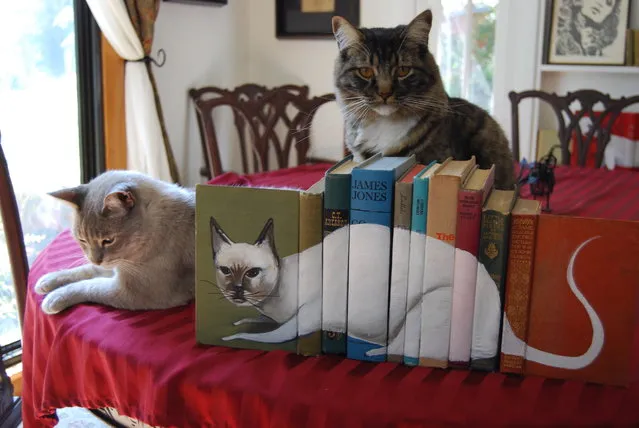
“Cats”. I really love animals and I think they are often overlooked or underestimated.  Sometimes I can see the feelings and emotions in animals when I can’t see them in humans, so it’s easier for me to express the feelings in a lot of my animal characters. (Photo and caption by Mike Stilkey)

Los Angeles native Mike Stilkey has always been attracted to painting and drawing not only on vintage paper, record covers and book pages, but on the books themselves. Using a mix of ink, colored pencil, paint and lacquer, Stilkey depicts a melancholic and at times a whimsical cast of characters inhabiting ambiguous spaces and narratives of fantasy and fairy tales. A lingering sense of loss and longing hints at emotional depth and draws the viewer into their introspective thrall with a mixture of capricious poetry, wit, and mystery. (Photo by Mike Stilkey)
Details
31 Jul 2014 10:17:00
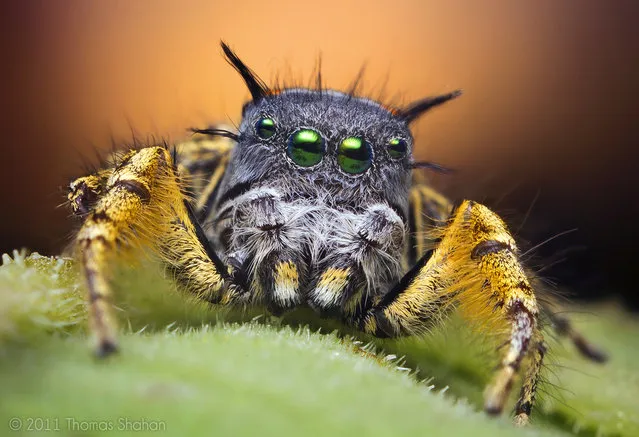
Adult Male Jumping Spider at Sunset – Phidippus mystaceus

“Hey! I'm Thomas Shahan, an artist and macrophotographer from Oklahoma. In my spare time over the past few years, I've been shooting portraiture of local arthropods. Why would I devote countless hours to tramping through forests, fields and the like searching for insects and spiders? Well, despite some common beliefs, arthropods (members of the phylum Arthropoda – insects, spiders, crustaceans...) represent an endlessly varied, wildly beautiful and fascinating bunch of animals with surprisingly personable faces and behavior. Often, all it takes is simply inspecting their lives on a closer level to turn repulsion to reverence”. – Thomas Shahan

Photo: Adult Male Jumping Spider at Sunset – Phidippus mystaceus. (Photo by Thomas Shahan; Source: Flickr)
Details
23 Apr 2012 14:07:00
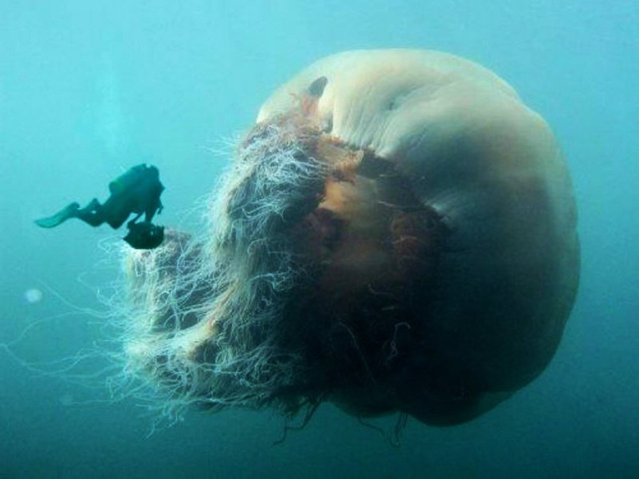
Giant Jellyfish Cyanea capillata

Cyanea capillata is the largest known species of jellyfish. Its range is confined to cold, boreal waters of the Arctic, northern Atlantic, and northern Pacific Oceans, seldom found farther south than 42°N latitude. Similar jellyfish, which may be the same species, are known to inhabit seas near Australia and New Zealand. The largest recorded specimen found, washed up on the shore of Massachusetts Bay in 1870, had a bell (body) with a diameter of 7 feet 6 inches (2.29 m) and tentacles 120 feet (37 m) long.Lion's mane jellyfish have been observed below 42°N latitude for some time—specifically in the larger bays of the east coast of the United States.
Details
24 Jul 2012 12:00:00


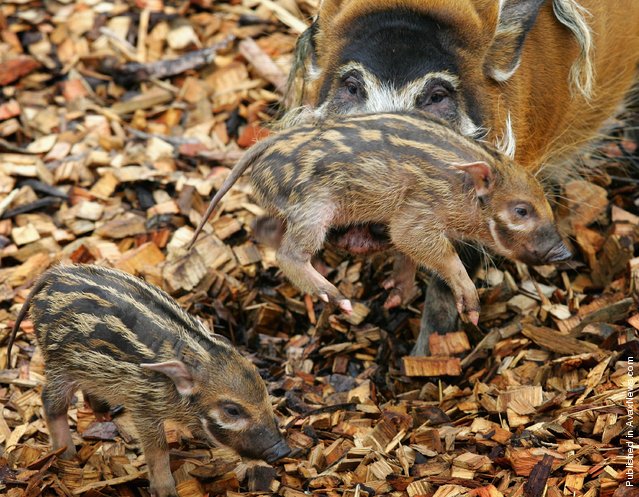
“The Red River Hog (Potamochoerus porcus), also known as the Bush Pig (but not to be confused with P. larvatus, common name “Bushpig”), is a wild member of the pig family living in Africa, with most of its distribution in the Guinean and Congolian forests. It is rarely seen away from rainforests, and generally prefers areas near rivers or swamps.

Red River Hogs eat grass, berries, roots, insects, molluscs, small vertebrates and carrion. They are capable of causing damage to plantations. Red River Hogs typically live in herds of 6-20 members led by a dominant boar. Sows rear 3-6 piglets at a time.”

Photo: Two 17 day old red river hoglet twins forage for food next to their mother Bahiti at London Zoo on August 23, 2007 in London, England. Red River hoglets inhabit the forests and swamps of West and Central Africa. The recent additions to the London Zoo pig pen have been eagerly awaited by zoo keepers. (Photo by Chris Jackson/Getty Images)
Details
18 Mar 2011 15:15:00
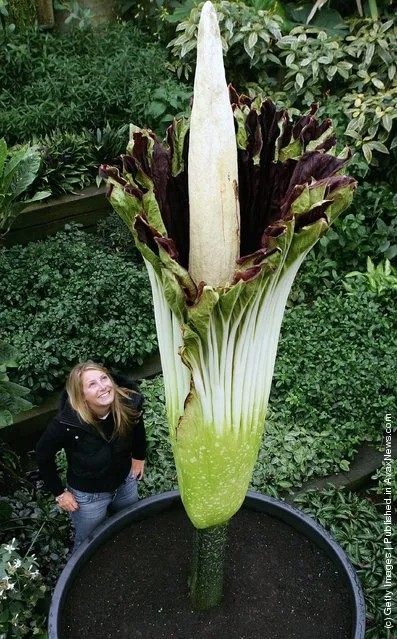
Kew Gardens employee Lauren Bird Royal examines the flowering of the Titan Arum lily at the Botanical Gardens

“The titan arum or Amorphophallus titanum (from Ancient Greek amorphos, “without form, misshapen” + phallos, “phallus”, and titan, “giant”) is a flowering plant with the largest unbranched inflorescence in the world. The titan arum's inflorescence is not as large as that of the Talipot palm, Corypha umbraculifera, but the inflorescence of the Talipot palm is branched rather than unbranched”. – Wikipedia

Photo: Kew Gardens employee Lauren Bird Royal examines the flowering of the Titan Arum lily at the Botanical Gardens at Kew on September 30, 2005 in London, England. For the first time in horticultural history, the Titan Arum lily can be seen at all three active stages in its lifecycle – in flower, fruit and leaf.The flowering corm is nearly three metres tall and weighs 91kg and is very rarely seen outside of the rainforests of Sumatra, Indonesia. (Photo by Scott Barbour/Getty Images)
Details
20 Sep 2011 11:13:00
The British Breitling Wingwalkers, Danielle Hughes and Emily Guilding, soar above the Palm Jumeirah in Dubai at 1,500 feet (460 meters) in excess of 100mp/h, ahead of their Dubai debut performance at the 2014 UIM Skydive Dubai XCAT World Powerboating Series, on Saturday, 13th December 2014. (Photo by Katsuhiko Tokunaga/Breitling via AP Images)

The British Breitling Wingwalkers, Danielle Hughes and Emily Guilding, soar above the Palm Jumeirah in Dubai at 1,500 feet (460 meters) in excess of 100mp/h, ahead of their Dubai debut performance at the 2014 UIM Skydive Dubai XCAT World Powerboating Series, on Saturday, 13th December 2014. The British team is the only aerobatic formation display team who employ full time wingwalkers and fly their two Breitling-liveried 1930's Boeing Stearman bi-planes at Air Shows and major sporting events around the world. (Photo by Katsuhiko Tokunaga/Breitling via AP Images)
Details
13 Dec 2014 13:11:00
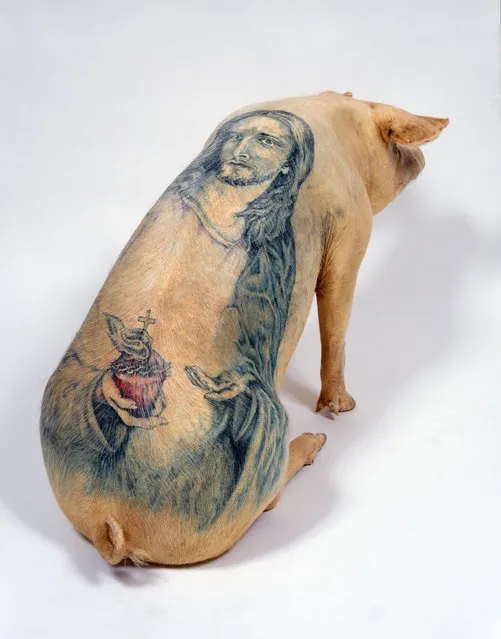
Tattooing Pigs By Wim Delvoye

Wim Delvoye is a notorious tattoo artist, who became famous when he started tattooing live pigs. He first began in 1997 and after animal rights activists found out about what he was doing, he had to move to China to continue his business. There is nothing special about the tattoos that Wim Delvoye creates, they look mediocre at best, and the only reason why he’s famous is his acts of animal cruelty. Nevertheless, Wim states that the pigs feel just fine and are well fed and taken care off. Full anesthesia is used to ensure that the pig doesn’t feel pain during the course of the whole procedure. During this time three tattoo artists work on the tattoo simultaneously to complete it as quickly as possible. Skins of those pigs are then sold for as much as £50k a piece.
Details
02 Apr 2015 09:06:00