Loading...
Done
Music student Daniele Gonzalez, (centre row, L), and Australian musician Susie Park from the Minnesota Orchestra (centre row, 2nd L), react during a rehearsal in Havana, May 15, 2015. (Photo by Alexandre Meneghini/Reuters)

Music student Daniele Gonzalez, (centre row, L), and Australian musician Susie Park from the Minnesota Orchestra (centre row, 2nd L), react during a rehearsal in Havana, May 15, 2015. The Minnesota Orchestra will offer two concerts in Havana and is the first major U.S. orchestra to play in Cuba since 1999. The trip cost nearly $1 million. It was underwritten by Marilyn Carlson Nelson, an heir to the Carlson hotel company fortune, and her husband Glen. The U.S. government gave special permission for a direct charter flight from Minneapolis to Havana for the event, putting 4 tons of equipment and 160 people on an Airbus 330. (Photo by Alexandre Meneghini/Reuters)
Details
17 May 2015 11:34:00
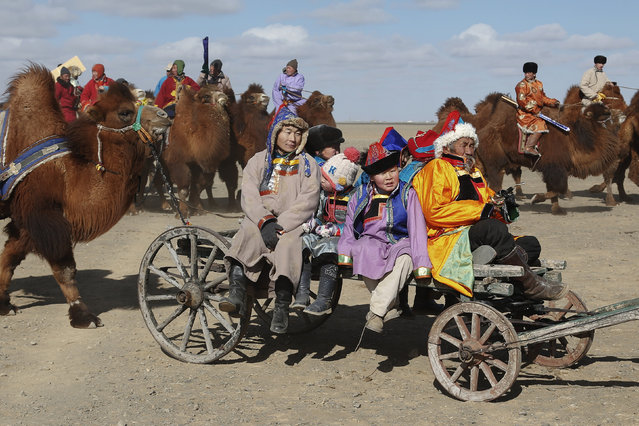
People sit on a cart with a camel tied to it during “Temeenii bayar”, the Camel Festival, in Dalanzadgad, Umnugobi aimag, Mongolia, March 6, 2016. (Photo by B. Rentsendorj/Reuters)

People sit on a cart with a camel tied to it during “Temeenii bayar”, the Camel Festival, in Dalanzadgad, Umnugobi aimag, Mongolia, March 6, 2016. On the steppes of the Gobi Desert, the crowd urges on Bactrian camels laden down with all that's needed to build and live in a traditional Mongolian tent. Guinness World Records classes the 15 km race thatÕs part of the two-day festival as the largest camel race in the world, drawing 1,108 participants. The winning camel romped home in 35 minutes and 12 seconds, according to the records website. (Photo by B. Rentsendorj/Reuters)
Details
30 Mar 2016 11:13:00
A journalist reports on a ladder outside the Great Hall of the People during the opening session of the National People's Congress (NPC) in Beijing, China March 5, 2018. (Photo by Thomas Peter/Reuters)

A journalist reports on a ladder outside the Great Hall of the People during the opening session of the National People's Congress (NPC) in Beijing, China March 5, 2018. The NPC has over 3,000 delegates and is the world's largest parliament or legislative assembly though its function is largely as a formal seal of approval for the policies fixed by the leaders of the Chinese Communist Party. The NPC runs alongside the annual plenary meetings of the Chinese People's Political Consultative Conference (CPPCC), together known as “Lianghui” or “Two Meetings”. (Photo by Thomas Peter/Reuters)
Details
07 Mar 2018 00:01:00


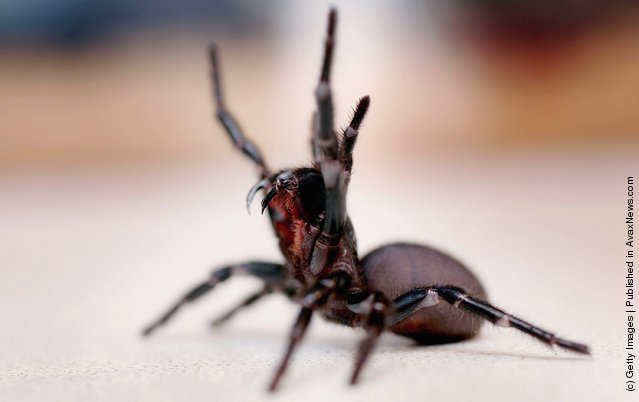
A Funnel Web spider is pictured at the Australian Reptile Park January 23, 2006 in Sydney, Australia. The Funnel Web is one of Australia's deadliest animals, with a venom that is packed with at least 40 different toxic proteins. A bite from a Funnel Web causes massive electrical over-load in the body's nervous system. Finally, fatalities occur from either heart attack or a pulmonary oedema, where the capillaries around the lungs begin to leak fluid and the patient effectively drowns. Death can come as quickly as two hours after a bite if no medical treatment is sought. Due to advances in anti-venom, there has been no death from a Funnel Web bite in Australia since 1980. Australia is home to some of the most deadly and poisonous animals on earth. (Photo by Ian Waldie/Getty Images)
Details
25 Apr 2011 07:49:00


“The Red River Hog (Potamochoerus porcus), also known as the Bush Pig (but not to be confused with P. larvatus, common name “Bushpig”), is a wild member of the pig family living in Africa, with most of its distribution in the Guinean and Congolian forests. It is rarely seen away from rainforests, and generally prefers areas near rivers or swamps.

Red River Hogs eat grass, berries, roots, insects, molluscs, small vertebrates and carrion. They are capable of causing damage to plantations. Red River Hogs typically live in herds of 6-20 members led by a dominant boar. Sows rear 3-6 piglets at a time.”

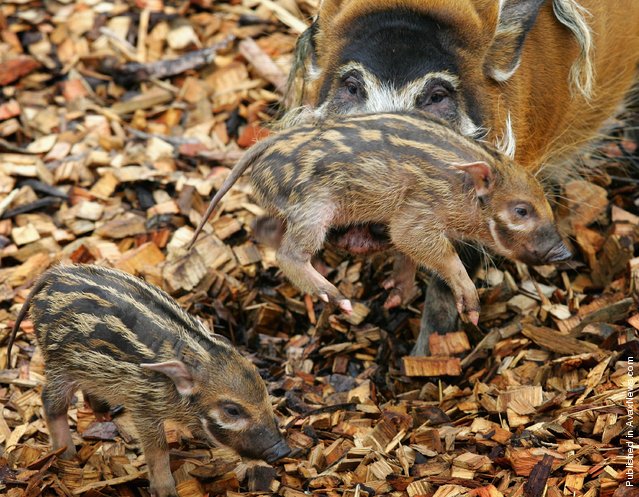
Photo: Two 17 day old red river hoglet twins forage for food next to their mother Bahiti at London Zoo on August 23, 2007 in London, England. Red River hoglets inhabit the forests and swamps of West and Central Africa. The recent additions to the London Zoo pig pen have been eagerly awaited by zoo keepers. (Photo by Chris Jackson/Getty Images)
Details
18 Mar 2011 15:15:00
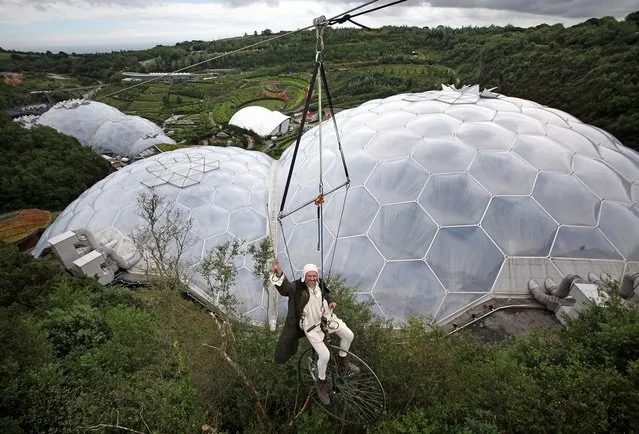
England's Longest Zip Wire Opens At The Eden Project

Marco Fiera from NoFit State Circus tries out the SkyWire, the new zip wire attraction which opens to the public this week at The Eden Project on July 17, 2012 in St Austell, England. The new 740m zip wire, currently the longest in England, allows the public a bird's eye view of the iconic Rainforest and Mediterranean Biome structures as well as the Cornish attractions outdoor gardens. The Eden Project – which opened in 2001 and has attracted over one million visitors – showcases 100,000 plants from around the world in two giant transparent domes, one of which is the world's largest greenhouse, each recreating different climate conditions. (Photo by Matt Cardy)
Details
19 Jul 2012 10:00:00
Amazing Photos by Yann Arthus-Bertrand. Part Four

Yann Arthus-Bertrand (born March 13, 1946 in Paris) is a French photographer, journalist, reporter and environmentalist.


Part One Part Two Part Three

Details
24 Sep 2012 16:52:00
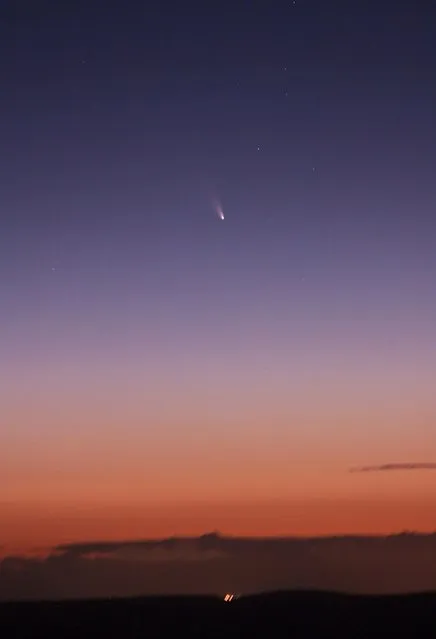
This image provided by NASA shoaws the comet PANSTARRS as seen from Mount Dale, Western Australia on March 5, 2013. According to NASA on March 10, it will make its closest approach to the sun about 28 million miles (45 million kilometers) away. As it continues its nightly trek across the sky, the comet may get lost in the sun's glare but should return and be visible to the naked eye by March 12. (Photo by AP Photo/NASA)

It’s time to start watching for Comet PANSTARRS, one of two comets to get excited about in 2013. Photo: This image provided by NASA shoaws the comet PANSTARRS as seen from Mount Dale, Western Australia on March 5, 2013. According to NASA on March 10, it will make its closest approach to the sun about 28 million miles (45 million kilometers) away. As it continues its nightly trek across the sky, the comet may get lost in the sun's glare but should return and be visible to the naked eye by March 12. (Photo by AP Photo/NASA)
Details
13 Mar 2013 08:03:00