Loading...
Done
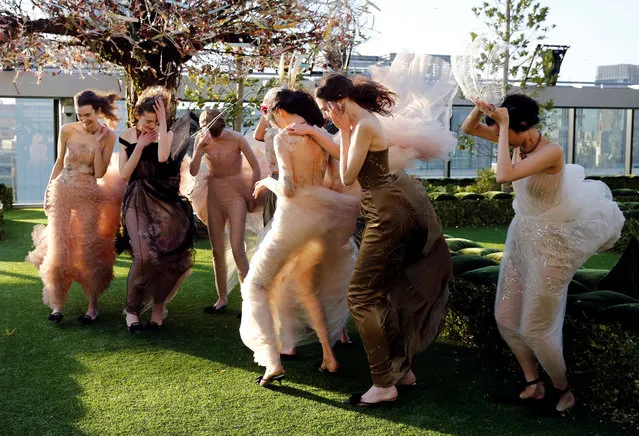
Models struggle against strong wind before the rehearsal of Christian Dior's Haute Couture Spring-Summer 2017 live show to celebrate Dior's new flagship store at the rooftop of Ginza Six mall in Tokyo, Japan, April 19, 2017. (Photo by Toru Hanai/Reuters)

Models struggle against strong wind before the rehearsal of Christian Dior's Haute Couture Spring-Summer 2017 live show to celebrate Dior's new flagship store at the rooftop of Ginza Six mall in Tokyo, Japan, April 19, 2017. (Photo by Toru Hanai/Reuters)
Details
20 Apr 2017 09:12:00
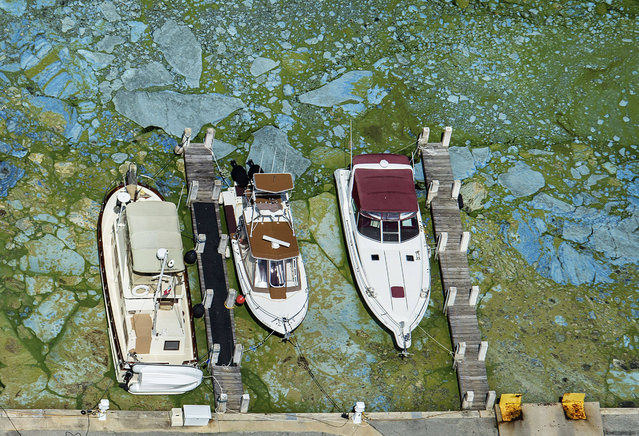
In this June 29, 2016 file photo, boats docked at Central Marine in Stuart, Fla., are surrounded by blue green algae. The 153-mile-long Indian River Lagoon has been plagued by harmful algae blooms. Water quality testing data analyzed by the AP showed the average phosphorous level – a byproduct of fertilizers and human waste that algae thrive on, rose nearly 75 percent between 2000 and 2016. (Photo by Greg Lovett/The Palm Beach Post via AP Photo)

In this June 29, 2016 file photo, boats docked at Central Marine in Stuart, Fla., are surrounded by blue green algae. The 153-mile-long Indian River Lagoon has been plagued by harmful algae blooms. Water quality testing data analyzed by the AP showed the average phosphorous level – a byproduct of fertilizers and human waste that algae thrive on, rose nearly 75 percent between 2000 and 2016. (Photo by Greg Lovett/The Palm Beach Post via AP Photo)
Details
11 May 2017 07:26:00
A devotee pulls a chariot during the Hindu festival of Thaipusam in Singapore February 9, 2017. (Photo by Edgar Su/Reuters)

A devotee pulls a chariot during the Hindu festival of Thaipusam in Singapore February 9, 2017. (Photo by Edgar Su/Reuters)
Details
11 Feb 2017 00:06:00
Nikolay Skidan, a hunter, carries the skin of a wolf in the village of Khrapkovo, Belarus February 1, 2017. (Photo by Vasily Fedosenko/Reuters)

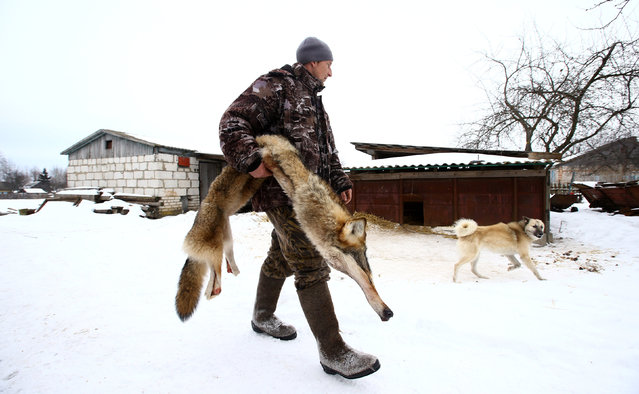
Nikolay Skidan, a hunter, carries the skin of a wolf in the village of Khrapkovo, Belarus February 1, 2017. Wolf fur grows thickest in winter, so Belarussian hunter Vladimir Krivenchik only sets his traps once snow is on the ground. He and his wife live on the edge of the Chernobyl exclusion zone – 2,600 square km of land on the Belarus-Ukraine border that was contaminated by a nuclear disaster in 1986. (Photo by Vasily Fedosenko/Reuters)
Details
16 Feb 2017 00:04:00
A vendor sells chili peppers at his stall at a market in Bangkok, Thailand March 31, 2016. (Photo by Jorge Silva/Reuters)

A vendor sells chili peppers at his stall at a market in Bangkok, Thailand March 31, 2016. (Photo by Jorge Silva/Reuters)
Details
01 Apr 2016 12:09:00
A woman talks to a man as two children play inside a wrecked car at a camp for displaced people in Port-au-Prince, Haiti, March 6, 2016. (Photo by Andres Martinez Casares/Reuters)

A woman talks to a man as two children play inside a wrecked car at a camp for displaced people in Port-au-Prince, Haiti, March 6, 2016. (Photo by Andres Martinez Casares/Reuters)
Details
18 Aug 2016 11:16:00
Resident Taina holds her brother Ysaque in the hallway outside their apartment in an occupied building in the Mangueira “favela” community on August 13, 2016 in Rio de Janeiro, Brazil. (Photo by Mario Tama/Getty Images,)

Resident Taina holds her brother Ysaque in the hallway outside their apartment in an occupied building in the Mangueira “favela” community on August 13, 2016 in Rio de Janeiro, Brazil. (Photo by Mario Tama/Getty Images)
Details
22 Aug 2016 12:18:00
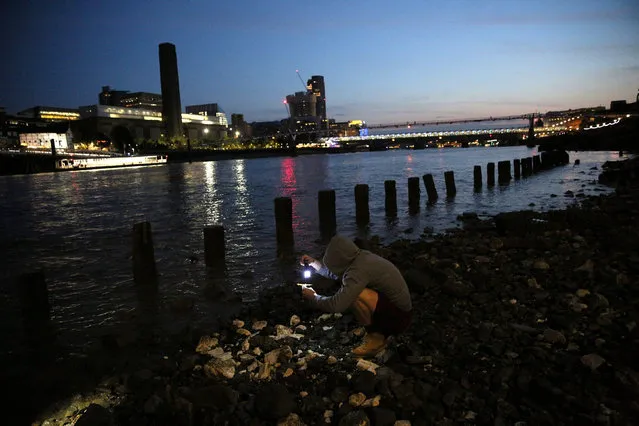
A mudlark uses a torch to look for items on the bank of the River Thames in London, Britain June 06, 2016. Mudlarking is believed to trace its origins to the 18th and 19th century, when scavengers searched the Thames' shores for items to sell. These days, history and archaeology fans are the ones hoping to find old relics such as coins, ceramics, artifacts or everyday items from across centuries. They wait for the low tide and then scour specific areas of exposed shores. "If you're in a field you could be out all day long, with the river you're restricted to about two or three hours," mudlark Nick Stevens said. While many just use the naked eye for their searches, others rely on metal detectors for which a permit from the Port of London Authority is needed. Digging also requires consent. (Photo by Neil Hall/Reuters)

A mudlark uses a torch to look for items on the bank of the River Thames in London, Britain June 06, 2016. Mudlarking is believed to trace its origins to the 18th and 19th century, when scavengers searched the Thames' shores for items to sell. These days, history and archaeology fans are the ones hoping to find old relics such as coins, ceramics, artifacts or everyday items from across centuries. their finds with the Portable Antiquities Scheme. Any item over 300 years old must be recorded. (Photo by Neil Hall/Reuters)
Details
27 Aug 2016 10:43:00