Loading...
Done
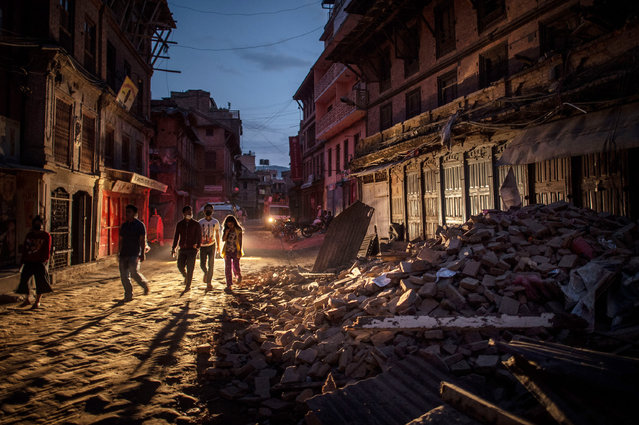
People walk past debris on May 3, 2015 in Bhaktapur, Nepal. A major 7.8 earthquake hit Kathmandu mid-day on Saturday, and was followed by multiple aftershocks that triggered avalanches on Mt. Everest that buried mountain climbers in their base camps. (Photo by David Ramos/Getty Images)

People walk past debris on May 3, 2015 in Bhaktapur, Nepal. A major 7.8 earthquake hit Kathmandu mid-day on Saturday, and was followed by multiple aftershocks that triggered avalanches on Mt. Everest that buried mountain climbers in their base camps. (Photo by David Ramos/Getty Images)
Details
09 May 2015 11:38:00
People in Kathmandu joke that the face mask has now become part of the national dress – an indispensable accessory in an effort to protect themselves from the dust. Nepal has the worst air quality in the world, according to the Environmental Performance Index. (Photo by Pete Pattisson/The Guardian)

People in Kathmandu joke that the face mask has now become part of the national dress – an indispensable accessory in an effort to protect themselves from the dust. Nepal has the worst air quality in the world, according to the Environmental Performance Index. (Photo by Pete Pattisson/The Guardian)
Details
22 Jun 2018 00:05:00
A woman struggles to drink homemade alcohol poured from the mouth of an idol of “Swet Bhairab” during the annual Indra Jatra festival to worship Indra, Kumari and other deities and to mark the end of monsoon season in Kathmandu, Nepal on September 15, 2019. (Photo by Monika Deupala/Reuters)

A woman struggles to drink homemade alcohol poured from the mouth of an idol of “Swet Bhairab” during the annual Indra Jatra festival to worship Indra, Kumari and other deities and to mark the end of monsoon season in Kathmandu, Nepal on September 15, 2019. (Photo by Monika Deupala/Reuters)
Details
19 Sep 2019 00:07:00
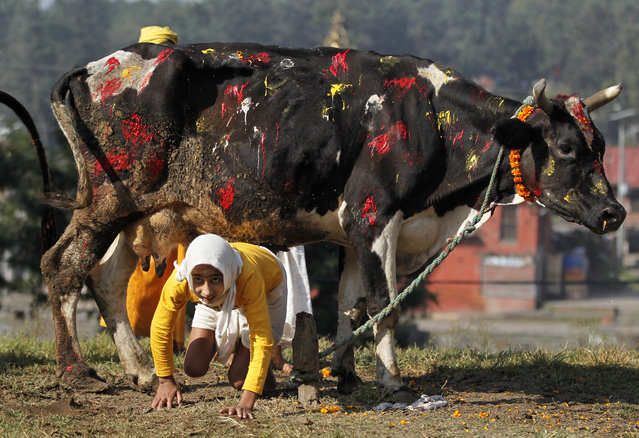
A young Hindu priest crawls under a cow as part of worship rituals during Tihar festival in Kathmandu, Nepal, Sunday, October 30, 2016. Cows are considered sacred to Hindus and are worshipped during Tihar festival, one of the most important Hindu festivals dedicated to the Goddess of wealth Laxmi. (Photo by Niranjan Shrestha/AP Photo)

A young Hindu priest crawls under a cow as part of worship rituals during Tihar festival in Kathmandu, Nepal, Sunday, October 30, 2016. Cows are considered sacred to Hindus and are worshipped during Tihar festival, one of the most important Hindu festivals dedicated to the Goddess of wealth Laxmi. (Photo by Niranjan Shrestha/AP Photo)
Details
31 Oct 2016 11:25:00
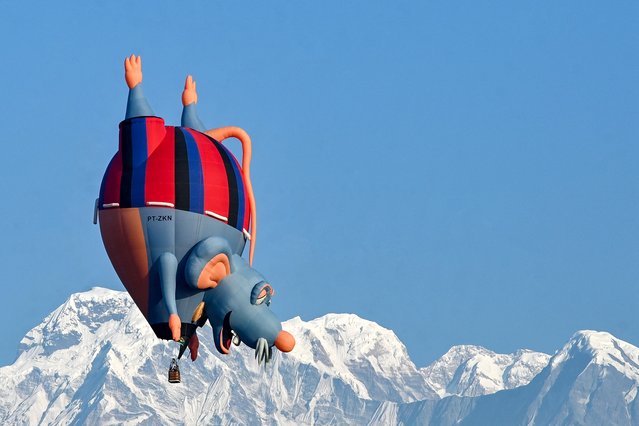
A hot air balloon rises in the sky during the International Hot-Air Balloon festival in Pokhara on December 27, 2024. With Nepal's snowy Himalayan peaks as a backdrop, the sky above Pokhara transformed into a vibrant canvas of colours for the country's first hot-air balloon festival. (Photo by Prakash Mathema/AFP Photo)

A hot air balloon rises in the sky during the International Hot-Air Balloon festival in Pokhara on December 27, 2024. With Nepal's snowy Himalayan peaks as a backdrop, the sky above Pokhara transformed into a vibrant canvas of colours for the country's first hot-air balloon festival. (Photo by Prakash Mathema/AFP Photo)
Details
15 Jul 2025 02:46:00
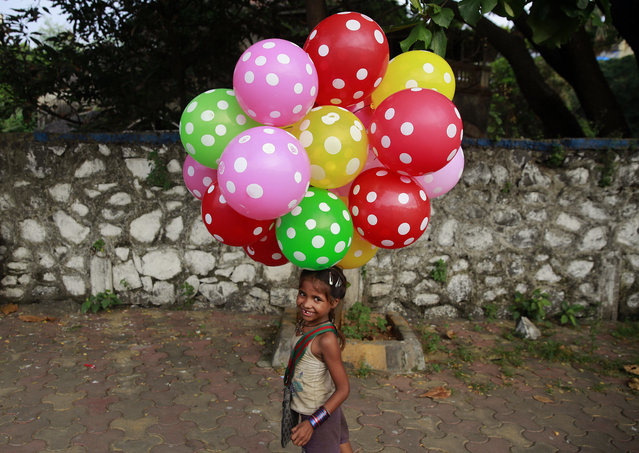
Lali carries balloons to sell on a beach in Mumbai, India, Sunday, October 11, 2015. The United Nations General Assembly marks October 11 as the International Day of the Girl Child, to recognize girls’ rights and the unique challenges girls face around the world. (Photo by Rafiq Maqbool/AP Photo)

Lali carries balloons to sell on a beach in Mumbai, India, Sunday, October 11, 2015. The United Nations General Assembly marks October 11 as the International Day of the Girl Child, to recognize girls’ rights and the unique challenges girls face around the world. (Photo by Rafiq Maqbool/AP Photo)
Details
30 Oct 2015 08:05:00
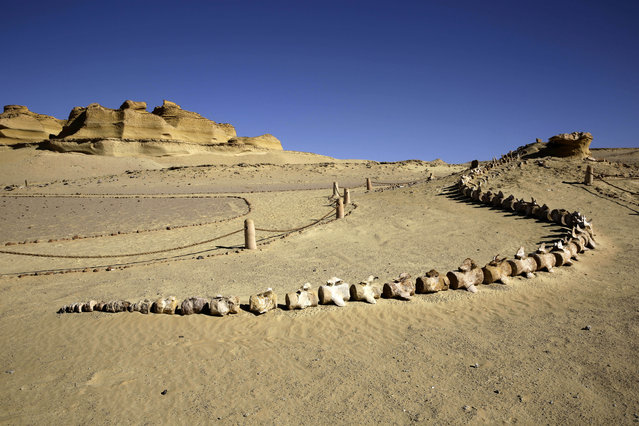
Fossilized whale bones are on display  outside the Wati El Hitan Fossils and Climate Change Museum, a UNESCO natural World Heritage site, on the opening day, in the Fayoum oasis, Egypt, Thursday, January 14, 2016. Egypt has cut the ribbon on the Middle East's first fossil museum housing the world's largest intact skeleton of a "walking whale" in an attempt to attract much-needed tourists driven off by recent militant attacks. The construction of the much-hyped Fossils and Climate Change Museum was covered a 2 billion euros (2. 17 billion dollars) grant from Italy, according to Italian Ambassador Maurizio Massari. (Photo by Thomas Hartwell/AP Photo)

Fossilized whale bones are on display outside the Wati El Hitan Fossils and Climate Change Museum, a UNESCO natural World Heritage site, on the opening day, in the Fayoum oasis, Egypt, Thursday, January 14, 2016. Egypt has cut the ribbon on the Middle East's first fossil museum housing the world's largest intact skeleton of a "walking whale" in an attempt to attract much-needed tourists driven off by recent militant attacks. The construction of the much-hyped Fossils and Climate Change Museum was covered a 2 billion euros (2. 17 billion dollars) grant from Italy, according to Italian Ambassador Maurizio Massari. Its centerpiece is an intact, 37-million-year-old and 20-meter-long skeleton of a legged form of whale that testifies to how modern-day whales evolved from land mammals. The sand-colored, dome-shaped museum is barely discernible in the breathtaking desert landscape that stretches all around. (Photo by Thomas Hartwell/AP Photo)
Details
16 Jan 2016 08:06:00
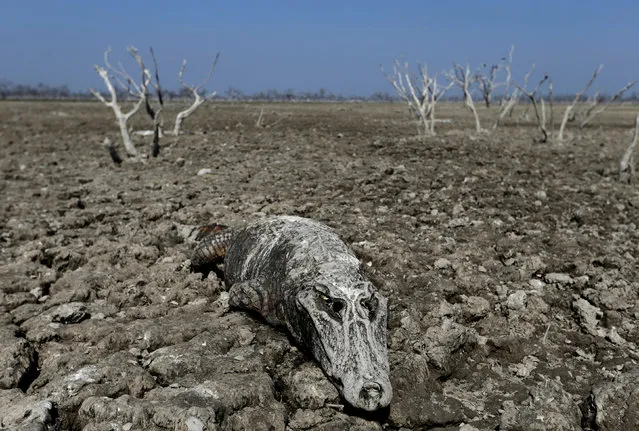
The carcass of a yacare caiman lies in the dried-up river bed of the Pilcomayo river in Boqueron, Paraguay, August 14, 2016. In Paraguay, alongside the Pilcomayo River, black vultures flew over a shrinking pond where a group of crocodilian reptiles known as yacare caimans sought refuge. Water from the river, which divides Paraguay and Argentina in the area of the Gran Chaco, was scarce. This is not an uncommon sight in the region of General Diaz, about 700 kilometres (435 miles) northwest of the country's capital Asuncion, where the Pilcomayo's waters form lakes and streams that give life to capybaras, birds and caimans. “The river's situation is critical. No water is forecast to enter the basin until December, as happens every year”, said Alcides Gonzalez, a resident of the area. (Photo by Jorge Adorno/Reuters)

The carcass of a yacare caiman lies in the dried-up river bed of the Pilcomayo river in Boqueron, Paraguay, August 14, 2016. In Paraguay, alongside the Pilcomayo River, black vultures flew over a shrinking pond where a group of crocodilian reptiles known as yacare caimans sought refuge. Water from the river, which divides Paraguay and Argentina in the area of the Gran Chaco, was scarce. This is not an uncommon sight in the region of General Diaz, about 700 kilometres (435 miles) northwest of the country's capital Asuncion, where the Pilcomayo's waters form lakes and streams that give life to capybaras, birds and caimans. (Photo by Jorge Adorno/Reuters)
Details
03 Nov 2016 12:40:00