Loading...
Done
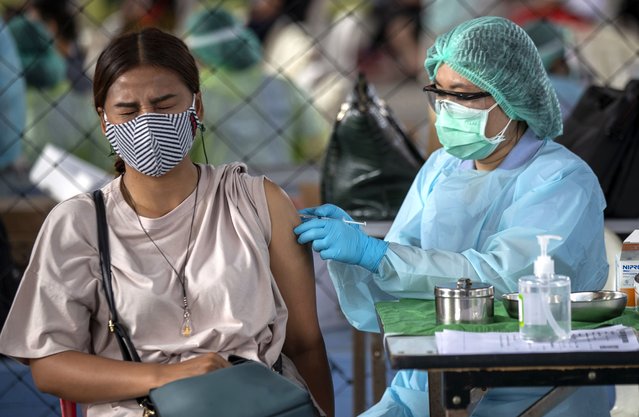
A health worker administers a dose of the Sinovac COVID-19 vaccine to a worker in a local entertainment venue area where a new cluster of COVID-19 infections were found in Bangkok, Thailand, Wednesday, April 7, 2021. Officials in Thailand’s capital have ordered a two-week closure of all entertainment venues in three districts to try to limit the spread of the coronavirus from nightspots there. (Photo by Sakchai Lalit/AP Photo)

A health worker administers a dose of the Sinovac COVID-19 vaccine to a worker in a local entertainment venue area where a new cluster of COVID-19 infections were found in Bangkok, Thailand, Wednesday, April 7, 2021. Officials in Thailand’s capital have ordered a two-week closure of all entertainment venues in three districts to try to limit the spread of the coronavirus from nightspots there. (Photo by Sakchai Lalit/AP Photo)
Details
08 Apr 2021 11:21:00
Bristol celebrates “wonderful diversity” at St Paul's carnival on Saturday, July 6, 2019. Thousands filled the streets for the city’s 51st procession highlighting the contribution of the Windrush generation. (Photo by Alex Turner/The Guardian)

Bristol celebrates “wonderful diversity” at St Paul's carnival on Saturday, July 6, 2019. Thousands filled the streets for the city’s 51st procession highlighting the contribution of the Windrush generation. (Photo by Alex Turner/The Guardian)
Details
10 Jul 2019 00:05:00
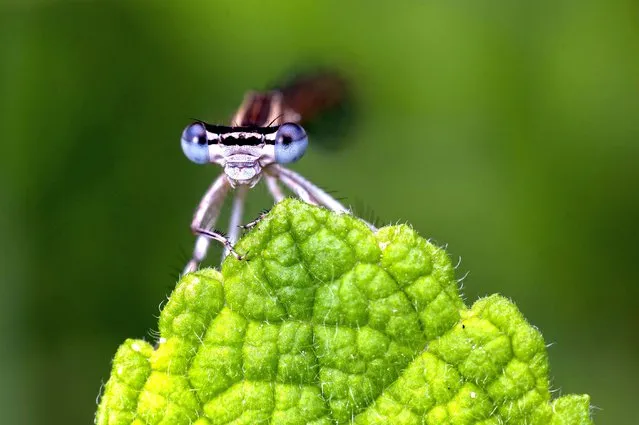
A dragonfly rests on a leaf in Hinojedo, Cantabria, northern Spain, 01 June 2023. (Photo by Pedro Puente Hoyos/EPA/EFE/Rex Features/Shutterstock)

A dragonfly rests on a leaf in Hinojedo, Cantabria, northern Spain, 01 June 2023. (Photo by Pedro Puente Hoyos/EPA/EFE/Rex Features/Shutterstock)
Details
26 Jul 2023 04:23:00
Buddhist believers wearing faces masks to help protect against the spread of the new coronavirus wait to attend a service to pray for overcoming the COVID-19 outbreak and to celebrate Buddha's birthday at the Chogyesa temple in Seoul, South Korea, Thursday, April 30, 2020. (Photo by Ahn Young-joon/AP Photo)

Buddhist believers wearing faces masks to help protect against the spread of the new coronavirus wait to attend a service to pray for overcoming the COVID-19 outbreak and to celebrate Buddha's birthday at the Chogyesa temple in Seoul, South Korea, Thursday, April 30, 2020. (Photo by Ahn Young-joon/AP Photo)
Details
14 May 2020 00:05:00
Sina prepares for the reopening of the latex fashion shop Savage Wear as the coronavirus disease (COVID-19) lockdown measures are eased in Berlin, Germany, March 9, 2021. (Photo by Hannibal Hanschke/Reuters)

Sina prepares for the reopening of the latex fashion shop Savage Wear as the coronavirus disease (COVID-19) lockdown measures are eased in Berlin, Germany, March 9, 2021. (Photo by Hannibal Hanschke/Reuters)
Details
10 Mar 2021 10:17:00
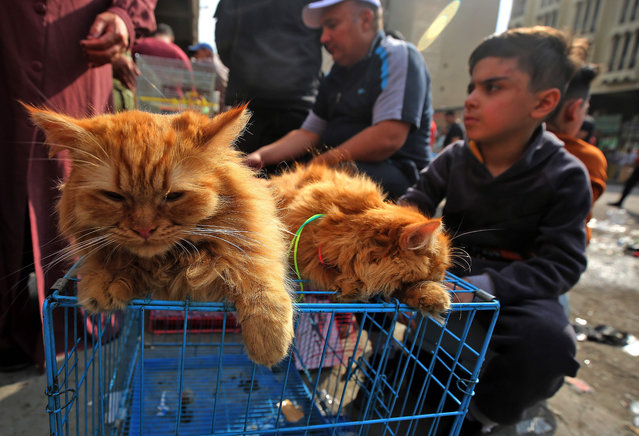
An Iraqi boy sits next to cats for sale at the Ghazl Market in central Baghdad on November 20, 2020. (Photo by Ahmad Al-Rubaye/AFP Photo)

An Iraqi boy sits next to cats for sale at the Ghazl Market in central Baghdad on November 20, 2020. (Photo by Ahmad Al-Rubaye/AFP Photo)
Details
30 Nov 2020 00:05:00
Tatyana Abramova, 33, plays with her home fox Plombir at her countryside house outside Siberian city of Novosibirsk on September 12, 2020. The official start of the Soviet experiment to better understand the domestication of animals by humans began in 1959, and was initiated by geneticists Dmitri Beliaiev and Lioudmila Trout on a farm in Akademgorodok, the scientific center of excellence in Siberia. Their primary objective was to domesticate foxes, to understand how the ancestor of wolves, another canine, evolved into a loyal and loving dog. And understand what this domestication tells us about the genetic evolution of species. (Photo by Alexander Nemenov/AFP Photo)

Tatyana Abramova, 33, plays with her home fox Plombir at her countryside house outside Siberian city of Novosibirsk on September 12, 2020. The official start of the Soviet experiment to better understand the domestication of animals by humans began in 1959, and was initiated by geneticists Dmitri Beliaiev and Lioudmila Trout on a farm in Akademgorodok, the scientific center of excellence in Siberia. Their primary objective was to domesticate foxes, to understand how the ancestor of wolves, another canine, evolved into a loyal and loving dog. And understand what this domestication tells us about the genetic evolution of species. (Photo by Alexander Nemenov/AFP Photo)
Details
25 Oct 2020 00:05:00
A student of the Sri Lankan ancient martial art “Angampora” performs during a practice session at the angam maduwa or fighting field, in Korathota, a suburb of Colombo, Sri Lanka, 07 September 2022. Sri Lanka's ancient martial art, Angampora, is thought to be thousands of years old. Anga translates to “body parts” and Angampora is a fighting art that uses body parts. Martial arts practitioners in Angampora were mostly in the king's service, and they were tasked with protecting the king and his kingdom. Angampora was practiced in secret for most centuries because the British, who colonized Sri Lanka, banned it in 1818 after seeing it as a threat. (Photo by Chamila Karunarathne/EPA/EFE)

A student of the Sri Lankan ancient martial art “Angampora” performs during a practice session at the angam maduwa or fighting field, in Korathota, a suburb of Colombo, Sri Lanka, 07 September 2022. Sri Lanka's ancient martial art, Angampora, is thought to be thousands of years old. Anga translates to “body parts” and Angampora is a fighting art that uses body parts. Martial arts practitioners in Angampora were mostly in the king's service, and they were tasked with protecting the king and his kingdom. Angampora was practiced in secret for most centuries because the British, who colonized Sri Lanka, banned it in 1818 after seeing it as a threat. (Photo by Chamila Karunarathne/EPA/EFE)
Details
14 Oct 2022 04:47:00