Loading...
Done
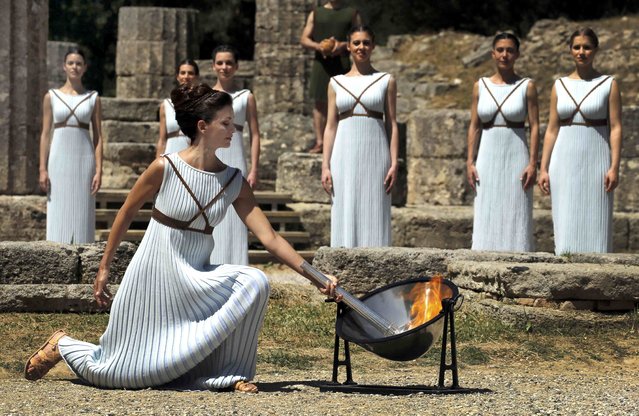
Greek actress Katerina Lehou , playing the role of High Priestess, lights a torch during the dress rehearsal for the Olympic flame lighting ceremony for the Rio 2016  Olympic Games at the site of ancient Olympia in Greece, April 20, 2016. Fire spurted from the concave mirror as a priestess, kneeling in her long, pleated dress before a ruined Greek temple, focused the blazing sun's rays on her metal torch. Come rain or shine on Thursday's official lighting ceremony, Rio de Janeiro has now secured its Olympic flame, which will burn in the main Olympic stadium throughout the Aug. 5-21 games. (Photo by Yannis Behrakis/Reuters)

Greek actress Katerina Lehou, playing the role of High Priestess, lights a torch during the dress rehearsal for the Olympic flame lighting ceremony for the Rio 2016 Olympic Games at the site of ancient Olympia in Greece, April 20, 2016. Fire spurted from the concave mirror as a priestess, kneeling in her long, pleated dress before a ruined Greek temple, focused the blazing sun's rays on her metal torch. Come rain or shine on Thursday's official lighting ceremony, Rio de Janeiro has now secured its Olympic flame, which will burn in the main Olympic stadium throughout the Aug. 5-21 games. (Photo by Yannis Behrakis/Reuters)
Details
21 Apr 2016 12:08:00
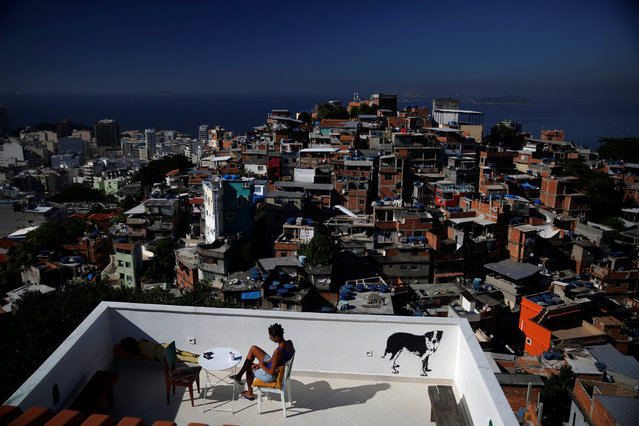
A woman sits on a terrace at Tiki hostel in Cantagalo favela, in Rio de Janeiro, Brazil, April 16, 2016. (Photo by Pilar Olivares/Reuters)

A woman sits on a terrace at Tiki hostel in Cantagalo favela, in Rio de Janeiro, Brazil, April 16, 2016. Hostels in a few of Rio's more than 1,000 slums serve not only as a cheap housing alternative for the more adventurous among the estimated 500,000 foreign tourists expected to arrive for the Olympics in August. The establishments also open up the rich culture of the city's shantytowns for travellers, giving them a glimpse into once “no-go” areas where about one-fifth of Rio's population lives. (Photo by Pilar Olivares/Reuters)
Details
04 May 2016 12:18:00
Professional bodybuilders (L-R)  Victor Martinez of the Dominican Republic, Mamdouh Elssbiay of Egypt, and Cedric McMillan and Juan Morel of U.S, pose during the Arnold Classic Brazil 2015 in Rio de Janeiro, May 30, 2015. REUTERS/Ricardo Moraes

Professional bodybuilders (L-R) Victor Martinez of the Dominican Republic, Mamdouh Elssbiay of Egypt, and Cedric McMillan and Juan Morel of U.S, pose during the Arnold Classic Brazil 2015 in Rio de Janeiro, May 30, 2015. REUTERS/Ricardo Moraes
Details
04 Jun 2015 12:55:00
In this October 14, 2013 photo, ecology professor Ricardo Freitas catches a broad-snouted caiman to examine, then release back into the water channel in the affluent Recreio dos Bandeirantes suburb of Rio de Janeiro, Brazil. (Photo by Felipe Dana/AP Photo)

In this October 14, 2013 photo, ecology professor Ricardo Freitas catches a broad-snouted caiman to examine, then release back into the water channel in the affluent Recreio dos Bandeirantes suburb of Rio de Janeiro, Brazil. Caimans are like tanks, a very old species with a remarkable capacity for renovation that allows them to survive under extreme conditions where others couldn't, said Freitas, who runs the Instituto Jacare, or the Caiman Institute, which aims to protect the reptiles. (Photo by Felipe Dana/AP Photo)
Details
18 Oct 2013 09:05:00
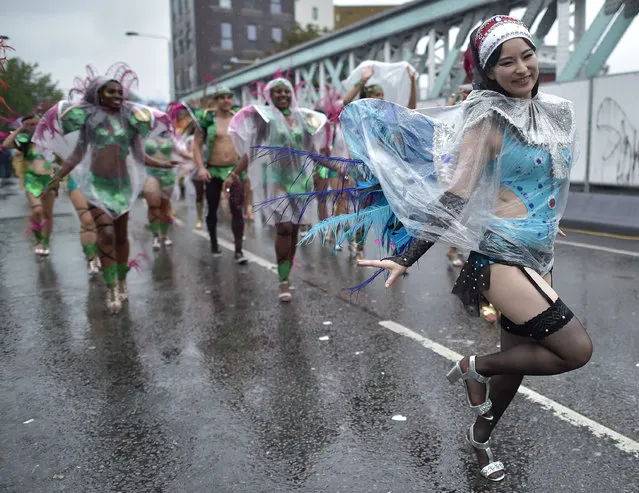
Performers in costume perform in the rain during the parade on the second day of the Notting Hill Carnival in west London on August 31, 2015. Nearly one million people are expected by the organizers Sunday and Monday in the streets of west London's Notting Hill to celebrate Caribbean culture at a carnival considered the largest street demonstration in Europe.  (Photo by Leon Neal/AFP Photo)

Performers in costume perform in the rain during the parade on the second day of the Notting Hill Carnival in west London on August 31, 2015. Nearly one million people are expected by the organizers Sunday and Monday in the streets of west London's Notting Hill to celebrate Caribbean culture at a carnival considered the largest street demonstration in Europe. The Notting Hill Carnival started in the 1960s, when the area had a large population of immigrants recently arrived from the Caribbean and was notorious for its slums – a far cry from today when it is one of London's most expensive places to live. (Photo by Leon Neal/AFP Photo)
Details
01 Sep 2015 15:17:00
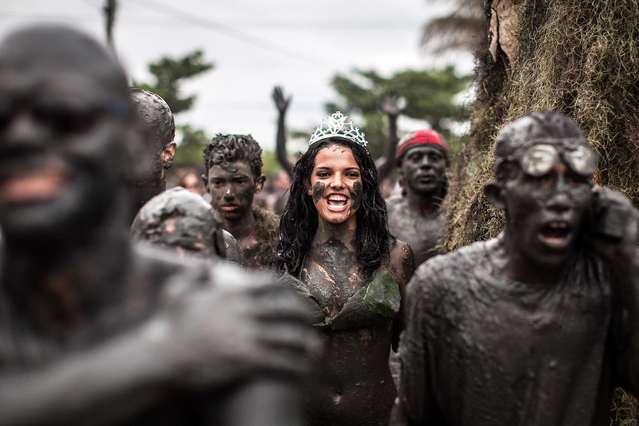
Revelers participate in the traditional Bloco da Lama (Mud block) carnival in Parati, Rio de Janeiro State, Brazil, on February 9, 2013. The event, which was begun by two men in a playful manner in 1986, has now become a traditional carnival in which participants disguised as primitives with rags, lianas or skulls and bones, dive in the mud. (Photo by Victor Moriyama/AFP Photo)

Revelers participate in the traditional Bloco da Lama (Mud block) carnival in Parati, Rio de Janeiro State, Brazil, on February 9, 2013. The event, which was begun by two men in a playful manner in 1986, has now become a traditional carnival in which participants disguised as primitives with rags, lianas or skulls and bones, dive in the mud. (Photo by Victor Moriyama/AFP Photo)
Details
12 Feb 2013 14:10:00
Revellers take part in the Notting Hill Carnival in London, Britain on August 27, 2018. (Photo by Henry Nicholls/Reuters)

Revellers take part in the Notting Hill Carnival in London, Britain on August 27, 2018. The carnival has been held every year since 1966 and one of the largest festival celebrations of its kind in Europe. (Photo by Henry Nicholls/Reuters)
Details
29 Aug 2018 00:05:00
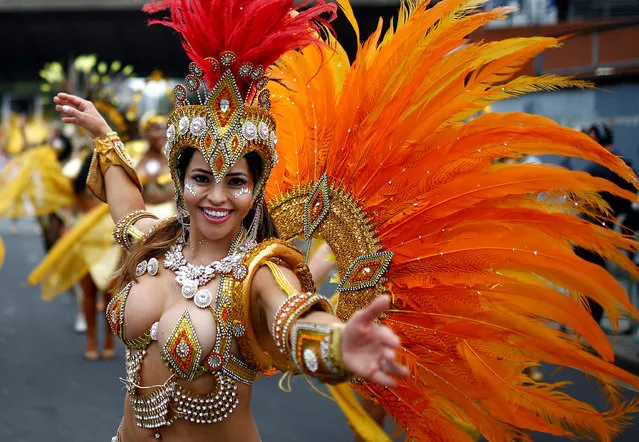
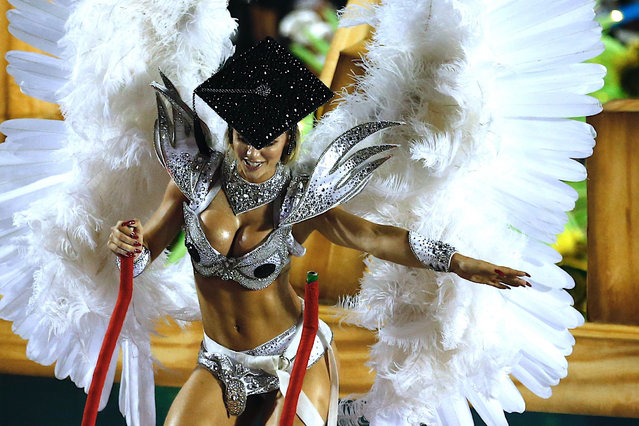
A member of the samba school of the Grupo Especial Academicos do Grande Rio parade during the Carnival celebration at the Marques de Sapucai sambadrome in Rio de Janeiro, Brazil, early 04 March 2019. The samba schools of the Rio de Janeiro Special Groups began their parades on 03 March at the sambadrome, considered the main attraction of the carnival in Brazil. (Photo by Marcelo Chello/EPA/EFE)

A member of the samba school of the Grupo Especial Academicos do Grande Rio parade during the Carnival celebration at the Marques de Sapucai sambadrome in Rio de Janeiro, Brazil, early 04 March 2019. The samba schools of the Rio de Janeiro Special Groups began their parades on 03 March at the sambadrome, considered the main attraction of the carnival in Brazil. (Photo by Marcelo Chello/EPA/EFE)
Details
09 Mar 2019 00:05:00