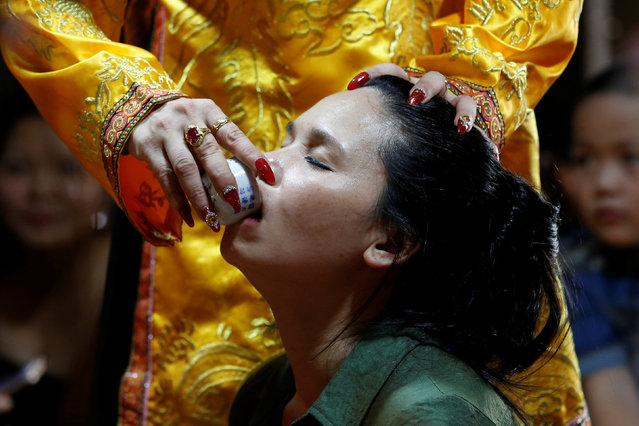
Pham Thi Thanh drinks a glass of water used as a treatment during a medium ritual at a Hau Dong ceremony at Phu Day temple in Nam Dinh province, Vietnam, May 7, 2017. Dating to the 16th century, Hau Dong centres on a belief in the Mother Goddesses of three realms – forest, water and heaven. It draws from elements of Taoism, Buddhism and other religions. (Photo by Reuters/Kham)
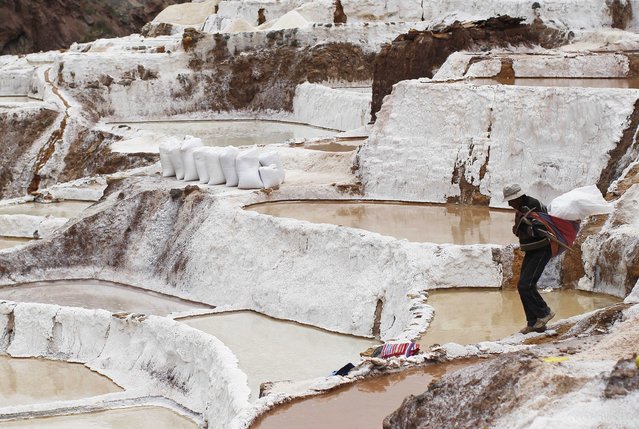
A worker carries a bag of salt after collecting it from a pond at the Maras mines in Cuzco December 3, 2014. Salt has been obtained in Maras since pre-Incan times by evaporating highly salty local subterranean stream water. The water is intricately channelled through constructions, flowing gradually down onto several hundred ancient terraced ponds. From each pond, a local member of the mine cooperative can produce 150 to 200 kilos per month which can be sold in the markets at $0.34 per kilogram, according to miners. (Photo by Enrique Castro-Mendivil/Reuters)
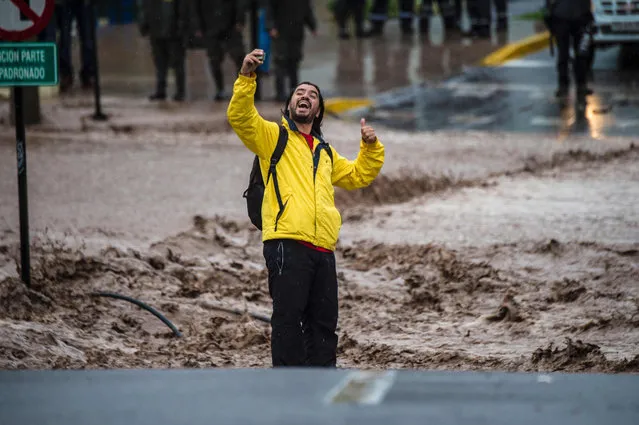
A man takes a selfie next to a flooded street due to the overflowing of the Mapocho river during heavy rains in Santiago on April 17, 2016. Four million people in Santiago were without tap water Sunday after unusually heavy rain pounding central Chile triggered landslides that fouled the city's water supply and forced the closure of the world's biggest copper mine, officials said. (Photo by Martin Bernetti/AFP Photo)
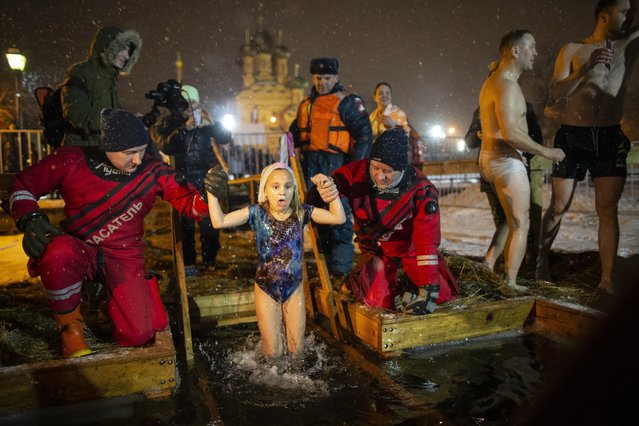
Russian Emergency Situations employees help a girl to bath in the icy water on Epiphany at the Church of the Holy Trinity in Ostankino near TV Tower in Moscow, Russia, Friday, January 18, 2019. Across Russia, the devout and the daring are observing the Orthodox Christian feast day of Epiphany by immersing themselves in frigid water through holes cut through the ice of lakes and rivers. Epiphany celebrates the revelation of Jesus Christ as the incarnation of God through his baptism in the River Jordan. (Photo by Alexander Zemlianichenko/AP Photo)