Loading...
Done
Miners pulling up lazy tourists to the rim of Kawah Ijen (Ijen Volcano), East Java, Indonesia on September 21, 2017. They will earn as much as they would bring down a load of sulfur. Nomadic Explorer, Cultural Lifestyle Photographer Claudio Sieber captured striking images of miners working at Ijen volcanic range in East Java, Indonesia. The sulphur miners risk their lives daily as they climb the active volcano carrying heavy loads, which they sell to sugar refineries. Shortly after midnight curious tourists are flocking in hundreds through the gate of Ijen's foothills to be right on time, driven by the images others took before them. Kawah Ijen is the one of the world's largest acidic volcanic crater lake; famous for its turquoise color as well as the unreal atmosphere it offers during darkness. A dusty path zigzags 3 kilometers up to the crater rim. This doesn't mean anything challenging; in particular, special sights have to be deserved anyway. The irritating smell of sulfur announces the near of the crater's existence. Arriving on the crater's rim the reward for the torture becomes visible. Blue fire darts its tongues through the fumes of sulfur dioxide. Somehow, the spectacle isn't as romantic as expected, since it is also the rough working space of approx. 150 sulfur miners who start their shift at 1 am. Lately, harvesting the abundance of devil's gold received international attention. This did obviously not really improve a miner's lifestyle; neither did it contribute to a better wage. (Photo by Claudio Sieber/Barcroft Images)

Miners pulling up lazy tourists to the rim of Kawah Ijen (Ijen Volcano), East Java, Indonesia on September 21, 2017. They will earn as much as they would bring down a load of sulfur. Nomadic Explorer, Cultural Lifestyle Photographer Claudio Sieber captured striking images of miners working at Ijen volcanic range in East Java, Indonesia. The sulphur miners risk their lives daily as they climb the active volcano carrying heavy loads, which they sell to sugar refineries. (Photo by Claudio Sieber/Barcroft Images)
Details
02 Oct 2017 08:31:00
Folk dancers from Chile participate in a folk dance festival in Bitola, North Macedonia on July 26, 2023. (Photo by Ognen Teofilovski/Reuters)

Folk dancers from Chile participate in a folk dance festival in Bitola, North Macedonia on July 26, 2023. (Photo by Ognen Teofilovski/Reuters)
Details
26 Oct 2024 02:52:00
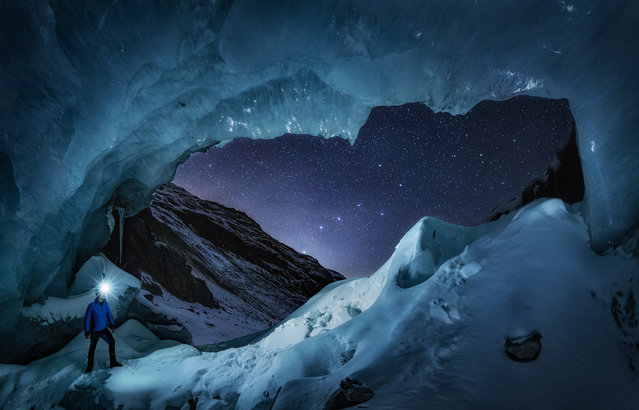
“Mr Big Dipper”, Nicholas Roemmelt (Denmark). A stargazer observes the constellation of the Big Dipper perfectly aligned with the window of the entrance to a large glacier cave in Engadin, Switzerland. This is a panorama of two pictures, and each is a stack of another two pictures: one for the stars and another one for the foreground, but with no composing or time blending. (Photo by Nicholas Roemmelt/National Maritime Museum/The Guardian)

“Mr Big Dipper”, Nicholas Roemmelt (Denmark). A stargazer observes the constellation of the Big Dipper perfectly aligned with the window of the entrance to a large glacier cave in Engadin, Switzerland. This is a panorama of two pictures, and each is a stack of another two pictures: one for the stars and another one for the foreground, but with no composing or time blending. (Photo by Nicholas Roemmelt/National Maritime Museum/The Guardian)
Details
27 Jul 2017 06:50:00
The rabbit population of San Juan Island, brought in to feed lighthouse keepers, got so big that in the 1930s foxes were introduced to kill them. Although they are red foxes, their coats can be orange, silver, black or multi-coloured. Picture date: September 2023. (Photo by Jun Zuo/Solent News)

The rabbit population of San Juan Island, brought in to feed lighthouse keepers, got so big that in the 1930s foxes were introduced to kill them. Although they are red foxes, their coats can be orange, silver, black or multi-coloured. Picture date: September 2023. (Photo by Jun Zuo/Solent News)
Details
08 Oct 2023 04:03:00
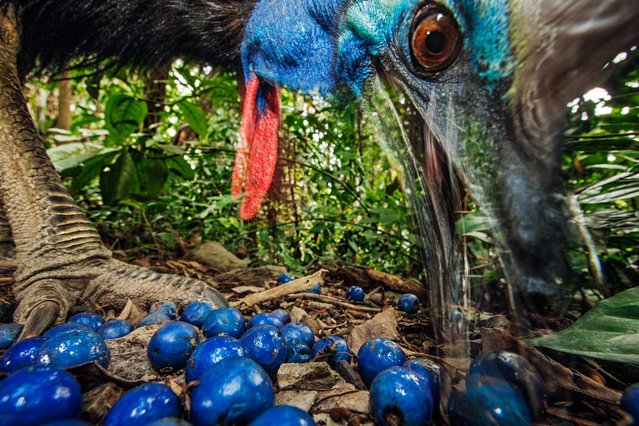
“Cassowaries are large, flightless birds related to emus and (more distantly) to ostriches, rheas, and kiwis”, writes Olivia Judson in the September issue of National Geographic magazine. (Photo by Christian Ziegler/National Geographic)

“Cassowaries are large, flightless birds related to emus and (more distantly) to ostriches, rheas, and kiwis”, writes Olivia Judson in the September issue of National Geographic magazine. How large? People-size: Adult males stand well over five foot five and top 110 pounds. Females are even taller, and can weigh more than 160 pounds. Dangerous when roused, they’re shy and peaceable when left alone. But even birds this big and tough are prey to habitat loss. The dense New Guinea and Australia rain forests where they live have dwindled. Today cassowaries might number 1,500 to 2,000. And because they help shape those same forests – by moving seeds from one place to another – “if they vanish”, Judson writes, “the structure of the forest would gradually change” too. (Photo by Christian Ziegler/National Geographic)
Details
06 Jan 2014 12:21:00
A woman with a sign that reads in Portuguese “Being woman without Temer”, stands next to a police barricade during a protest against the gang rape of a 16-year-old girl in Sao Paulo, Brazil, Wednesday, June 1, 2016. In response to the assault, Brazil's interim President Michel Temer said that the country will set up a specialized group to fight violence against women. (Photo by Andre Penner/AP Photo)

A woman with a sign that reads in Portuguese “Being woman without Temer”, stands next to a police barricade during a protest against the gang rape of a 16-year-old girl in Sao Paulo, Brazil, Wednesday, June 1, 2016. In response to the assault, Brazil's interim President Michel Temer said that the country will set up a specialized group to fight violence against women. (Photo by Andre Penner/AP Photo)
Details
03 Jun 2016 13:05:00
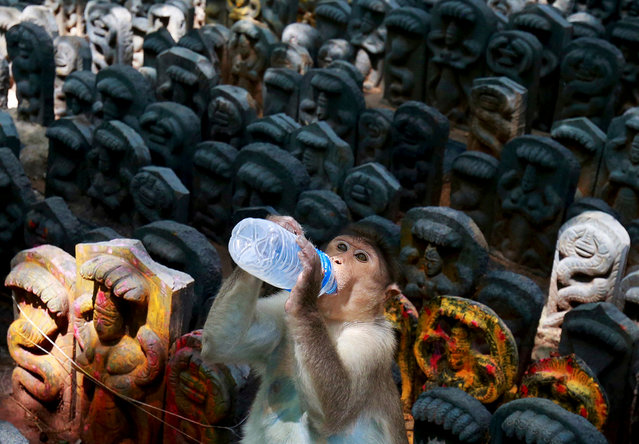
A bonnet macaque sits on consecrated idols of snakes as it drinks milk offered by a devotee during the Hindu festival of Nag Panchami, which is celebrated by worshipping snakes to honour the serpent god, inside a temple on the outskirts of Bengaluru, India, July 27, 2017. (Photo by Abhishek N. Chinnappa/Reuters)

A bonnet macaque sits on consecrated idols of snakes as it drinks milk offered by a devotee during the Hindu festival of Nag Panchami, which is celebrated by worshipping snakes to honour the serpent god, inside a temple on the outskirts of Bengaluru, India, July 27, 2017. (Photo by Abhishek N. Chinnappa/Reuters)
Details
28 Jul 2017 10:02:00
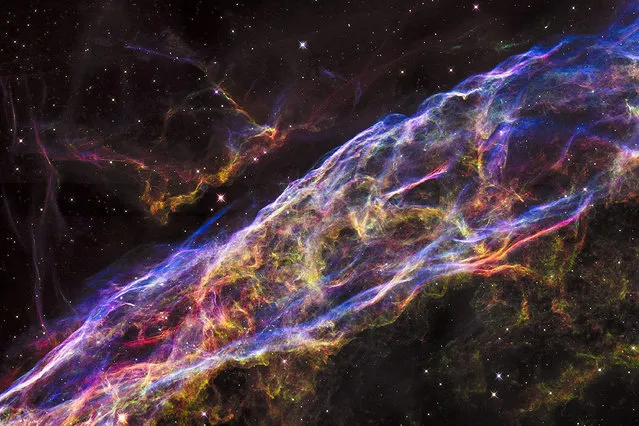
A small section of the expanding remains of the Veil Nebula, a massive star that exploded about 8,000 years ago. The entire nebula is 110 light-years across, covering six full moons on the sky as seen from Earth, and resides about 2,100 light-years away in the constellation Cygnus, the Swan. (Photo by Reuters/NASA/ESA/Hubble)

A small section of the expanding remains of the Veil Nebula, a massive star that exploded about 8,000 years ago. The entire nebula is 110 light-years across, covering six full moons on the sky as seen from Earth, and resides about 2,100 light-years away in the constellation Cygnus, the Swan. (Photo by Reuters/NASA/ESA/Hubble)
Details
29 Feb 2016 11:30:00