Loading...
Done
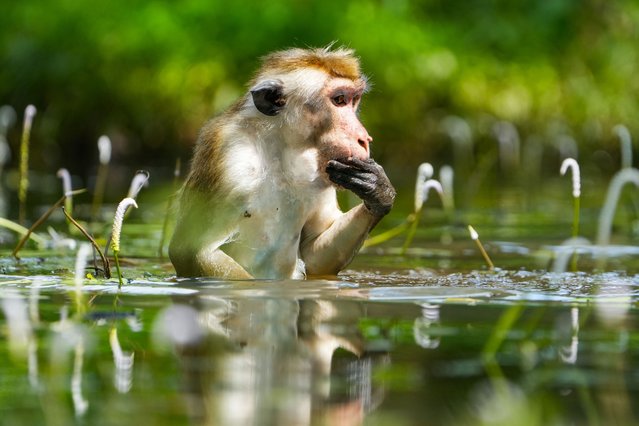
A toque macaque is eating flowers in the water at the pilgrimage site in Polonnaruwa, Sri Lanka, on January 13, 2024. The toque macaque (Macaca sinica), a reddish-brown-colored Old World monkey, is endemic to Sri Lanka, where it is known as the rilewa or rilawa. It is named for the whorl of hair at the crown of its head, which resembles a brimless toque cap. (Photo by Thilina Kaluthotage/NurPhoto/Rex Features/Shutterstock)

A toque macaque is eating flowers in the water at the pilgrimage site in Polonnaruwa, Sri Lanka, on January 13, 2024. The toque macaque (Macaca sinica), a reddish-brown-colored Old World monkey, is endemic to Sri Lanka, where it is known as the rilewa or rilawa. It is named for the whorl of hair at the crown of its head, which resembles a brimless toque cap. (Photo by Thilina Kaluthotage/NurPhoto/Rex Features/Shutterstock)
Details
10 Feb 2024 09:30:00
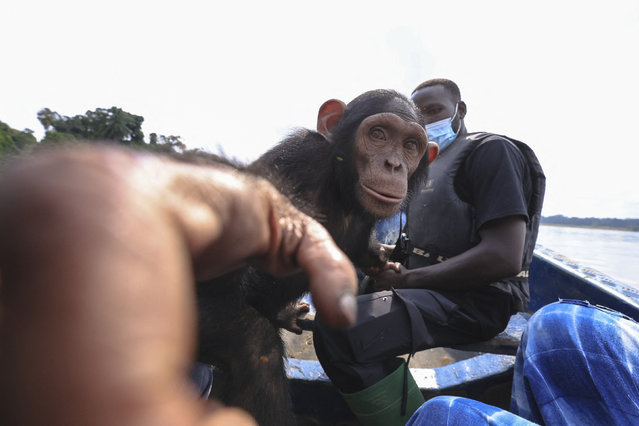
A young chimpanzee reacts on a pirogue with Rohmay Ndoulek, from the Papaye International association, during an outing in the Douala-Edea Natural Park in Marienberg on December 15, 2024. In the heart of Douala-Edea Natural Park, dedicated Cameroonian caretakers tend to and rehabilitate chimpanzees, victims of poaching and deforestation, at Papaye International, a sanctuary dubbed a “monkey paradise”. Founded in 2001, the association funded by 30 million friends and the Brigitte Bardot Foundation regularly receives eco-volunteers from all over the world. (Photo by Daniel Beloumou Olomo/AFP Photo)

A young chimpanzee reacts on a pirogue with Rohmay Ndoulek, from the Papaye International association, during an outing in the Douala-Edea Natural Park in Marienberg on December 15, 2024. In the heart of Douala-Edea Natural Park, dedicated Cameroonian caretakers tend to and rehabilitate chimpanzees, victims of poaching and deforestation, at Papaye International, a sanctuary dubbed a “monkey paradise”. Founded in 2001, the association funded by 30 million friends and the Brigitte Bardot Foundation regularly receives eco-volunteers from all over the world. (Photo by Daniel Beloumou Olomo/AFP Photo)
Details
12 Jan 2025 04:28:00
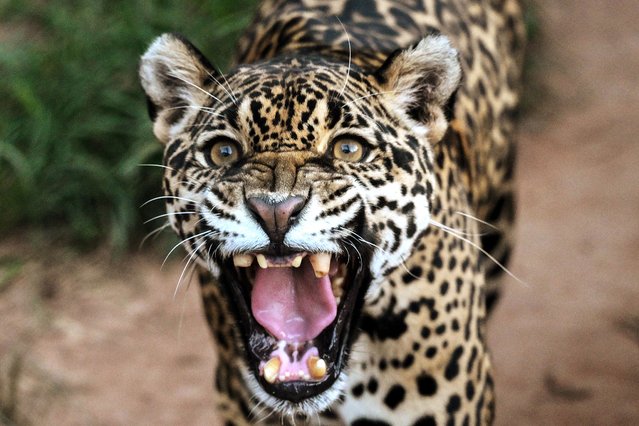
A jaguar (Panthera onca) growls at the Mata Ciliar association, an organization for the conservation of biodiversity, in Jundiai, Sao Paulo state, Brazil on May 29, 2025. Twenty-five pumas and ten jaguars are currently recovering at the Brazilian Center for the Conservation of Neotropical Felines at Mata Ciliar, a site as large as 40 football fields where monkeys, wild dogs, maned wolves, ocelots, and other regional animals are also rehabilitated. (Photo by Nelson Almeida/AFP Photo)

A jaguar (Panthera onca) growls at the Mata Ciliar association, an organization for the conservation of biodiversity, in Jundiai, Sao Paulo state, Brazil on May 29, 2025. Twenty-five pumas and ten jaguars are currently recovering at the Brazilian Center for the Conservation of Neotropical Felines at Mata Ciliar, a site as large as 40 football fields where monkeys, wild dogs, maned wolves, ocelots, and other regional animals are also rehabilitated. (Photo by Nelson Almeida/AFP Photo)
Details
22 Jun 2025 02:21:00
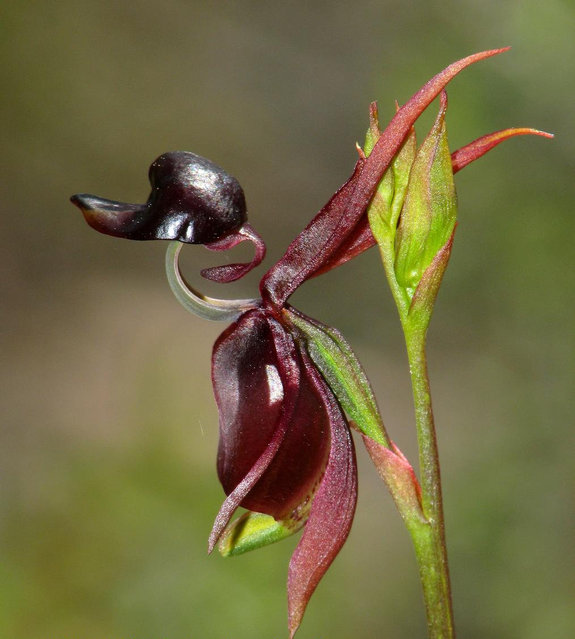
The Flying Duck Orchid

Caleana major, the Flying Duck Orchid is a small orchid found in eastern and southern Australia. This terrestrial plant features a remarkable flower, resembling a duck in flight. The flower is an attractant to insects, such as male sawflies which pollinate the flower in a process known as pseudocopulation. In 1986 this orchid was featured on an Australian postage stamp.


See Also: Monkey Orchid
Details
22 Apr 2013 10:56:00
This Thursday, January 22, 2015 photo made with a long exposure shows the glow from a Noctiluca scintillans algal bloom along the seashore in Hong Kong. The luminescence, also called Sea Sparkle, is triggered by farm pollution that can be devastating to marine life and local fisheries, according to University of Georgia oceanographer Samantha Joye. (Photo by Kin Cheung/AP Photo)

This Thursday, January 22, 2015 photo made with a long exposure shows the glow from a Noctiluca scintillans algal bloom along the seashore in Hong Kong. The luminescence, also called Sea Sparkle, is triggered by farm pollution that can be devastating to marine life and local fisheries, according to University of Georgia oceanographer Samantha Joye. Noctiluca itself does not produce neurotoxins like other similar organisms do. But its role as both prey and predator tends can eventually magnify the accumulation of toxins in the food chain, according to R. Eugene Turner at Louisiana State University. (Photo by Kin Cheung/AP Photo)
Details
23 Jan 2015 13:12:00
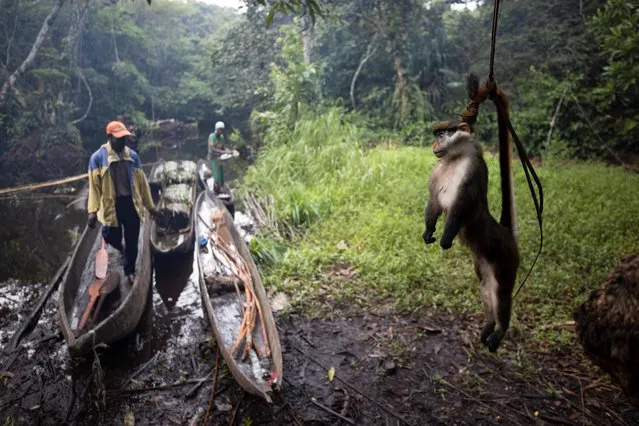
A dead red-tailed monkey hangs by its tail above the ground, in order to keep it away from ants, in the forest near the city of Mbandaka, Democratic Republic of the Congo, April 5, 2019. Bushmeat hunters are emptying Central Africa's forests at a high rate, researchers say. A growing appetite for wild meat in cities has ramped up the scale of hunting. Research shows around 6 million tonnes of bushmeat are sourced annually from the Congo Basin, whose forest spans across six countries and is second in size only to the Amazon. (Photo by Thomas Nicolon/Reuters)

A dead red-tailed monkey hangs by its tail above the ground, in order to keep it away from ants, in the forest near the city of Mbandaka, Democratic Republic of the Congo, April 5, 2019. Bushmeat hunters are emptying Central Africa's forests at a high rate, researchers say. A growing appetite for wild meat in cities has ramped up the scale of hunting. Research shows around 6 million tonnes of bushmeat are sourced annually from the Congo Basin, whose forest spans across six countries and is second in size only to the Amazon. (Photo by Thomas Nicolon/Reuters)
Details
14 Oct 2019 00:03:00
A woman poses for a photograph with light sculptures depicting animals that make up the twelve animals of the zodiac during a photocall to promote the Magical Lantern Festival at Chiswick House Gardens in west London on January 29, 2016. (Photo by Justin Tallis/AFP Photo)

A woman poses for a photograph with light sculptures depicting animals that make up the twelve animals of the zodiac during a photocall to promote the Magical Lantern Festival at Chiswick House Gardens in west London on January 29, 2016. The festival, to celebrate Chinese New Year 2016 – the Year of the Monkey, uses more than 50 hand-sculpted lanterns and is set to run from Febuary 3 to March 6, 2016. (Photo by Justin Tallis/AFP Photo)
Details
30 Jan 2016 13:35:00
“Two-Handed Saw, 2014”. “Most of the neighbors have switched to power tools to run their households, the buzz of chain saws and weed-whackers overpowering the quieter sounds of country life, but my aunts hold on to the two-handed saw that's decades old, the sickle and scythe that need to be sharpened and polished after each use, the old axe that's becoming heavier each year. Each of these objects is familiar, holding memories of their brother, who succumbed to cancer a few years ago, of days before my grandfather lost his vision in the 50's, of busier days and longer futures”, Sablin told. (Photo by Nadia Sablin)

In northwest Russia, in a small village called Alekhovshchina, Nadia Sablin's aunts spend the warmer months together in the family home and live as the family has always lived, chopping wood to heat the house and making their own clothes. Sablin's book of photographs, “Aunties: The Seven Summers of Alevtina and Ludmila”, is published by Duke University Press. Here: “Two-Handed Saw, 2014”. (Photo by Nadia Sablin)
Details
25 Feb 2016 12:12:00