Loading...
Done
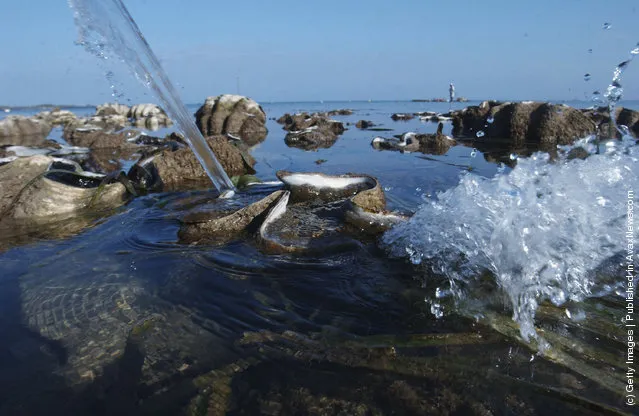
Tridacna Gigas, or Giant Clams

“The giant clam, Tridacna gigas (known as pā’ua in Cook Islands Māori), is the largest living bivalve mollusc. T. gigas is one of the most endangered clam species. It was mentioned as early as 1825 in scientific reports. One of a number of large clam species native to the shallow coral reefs of the South Pacific and Indian oceans, they can weigh more than 200 kilograms (440 lb) measure as much as 120 cm (47 in) across, and have an average lifespan in the wild of 100 years or more”. – Wikipedia

Photo: Tridacna Gigas, or Giant Clams spew water as a traditional fisherman passes by a small sanctuary on January 23, 2004 near Bolinao in the Northern Philippines. The clams, prime builders for coral reefs and providing shelter for spawning fish and other marine life, are exposed by low tides in the sanctuary. Overfishing and pollution throughout the country are not only threatening food security, but are also starting to choke one of the few working clam sanctuaries in the world. (Photo by David Greedy/Getty Images)
Details
01 Oct 2011 13:10:00
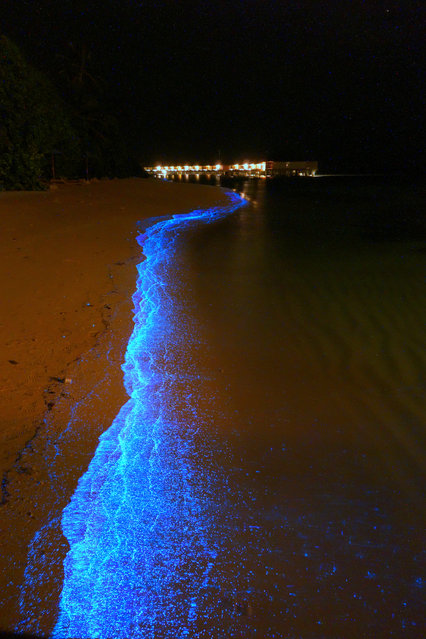
Bioluminescent phytoplankton washes up on Maldives beach. (Photo by Will Ho)

While vacationing on the Maldives Islands, Taiwanese amateur photographer Will Ho stumbled onto an incredible stretch of beach covered in millions of bioluminescent phytoplankton. These tiny organisms glow similarly to fireflies and tend to emit light when stressed, such as when waves crash or when they are otherwise agitated. While the phenomenon and its chemical mechanisms have been known for some time, biologists have only recently began to understand the reasons behind it. Photo: Bioluminescent phytoplankton washes up on Maldives beach. (Photo by Will Ho)
Details
07 Feb 2014 10:03:00
In this October 6, 2018, photo, a craftsman makes daggers or “Jambiyya” in Yemeni Arabic, made out of remains of missiles, at his workshop, in Hajjah, Yemen. (Photo by Hammadi Issa/AP Photo)

In this October 6, 2018, photo, a craftsman makes daggers or “Jambiyya” in Yemeni Arabic, made out of remains of missiles, at his workshop, in Hajjah, Yemen. Missiles raining on Yemen from the jets of the Saudi-led coalition fighting Houthi rebels are killing thousands of civilians and militiamen alike, but amid crashing economy, some Yemenis see the bright side of it: they make daggers out of the fragments of the missiles for ordinary men traditionally wear for prestige and a show of courage. (Photo by Hammadi Issa/AP Photo)
Details
10 Oct 2018 00:01:00
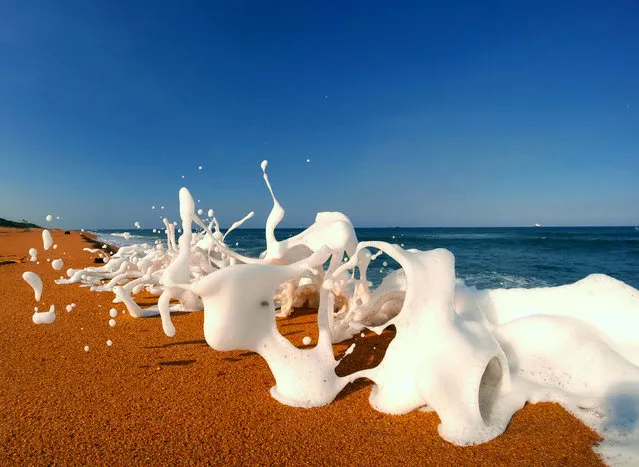
Foam party: Marck captured this moment in time from the shore on July, 30, 2015, in Durban, South Africa. (Photo by Marck Botha/Barcroft Media)

Beautiful seascapes capture the “raw power” of waves rising and crashing in the Indian Ocean. The stunning photos were taken off the coast of Durban in South Africa, and show formations from above and below the surface. Surfer and photographer Marck Botha took the images between April and July, and has always had a passion for the ocean. Here: Marck captured this moment in time from the shore on July, 30, 2015, in Durban, South Africa. (Photo by Marck Botha/Barcroft Media)
Details
30 Jan 2016 13:46:00
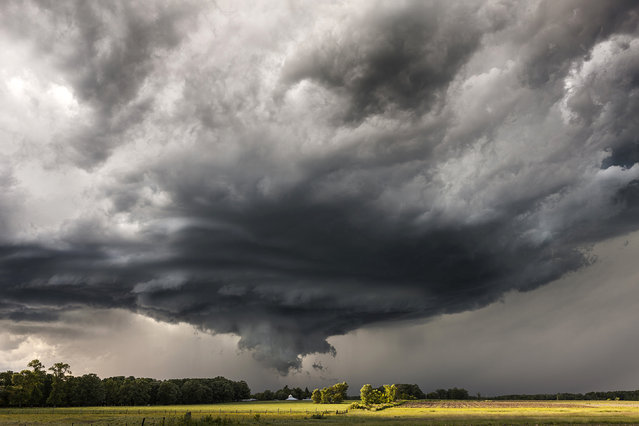
Supercell in Minnesota, near Browerville, Minnesota in 2014. (Photo by Camille Seaman/Caters News)

These stunning images show the phwoar-some power of some of Americas most extreme weather. Camille Seaman’s wondrous work features huge super cells, crashing lightning and gale-force winds. The roaming photographer has chased storms across the US from Iowa to Wyoming and from Minnesota to Texas. Her favorite places to chase are Kansas, Nebraska and South Dakota – notorious hotspots for spectacular storms. Here: Supercell in Minnesota, near Browerville, Minnesota in 2014. (Photo by Camille Seaman/Caters News)
Details
26 Jan 2015 12:10:00
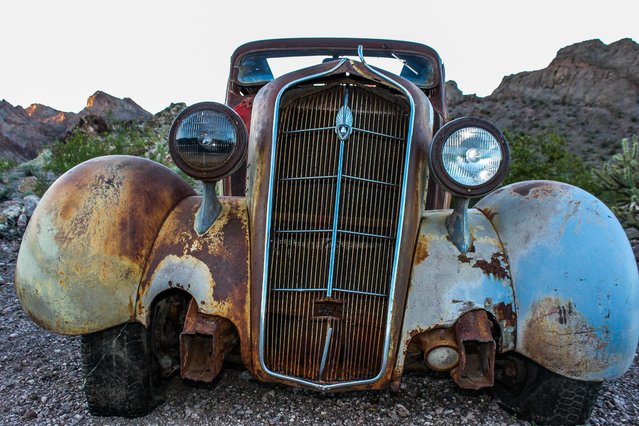
Images of an American ghost town that was home to gold mines and features a plane which crashed during the filming of 3000 Miles to Graceland starring Kevin Costner and Kurt Russell reveal the remnants of the once thriving location. An assortment of rusted vehicles which include a canary yellow bus, caravans and cars have all been left behind in the desert. Other pictures of Nelson, Nevada show its desolate surroundings with only a couple of houses and museums scattered around the area. In one shot, a derelict petrol pump stands still after making its final sale years ago. The stunning photographs were taken by an American photographer known as Abandoned Southeast on a visit to Nelson, Nevada. The area was called Eldorado by the Spaniards who made the original discoveries of gold in the town. The notorious Techatticup gold and silver mine which was associated with crime and murders ran in the area from 1861 to 1942. It was the richest mine in Southern Nevada. (Photo by Abandoned Southeast/Mediadrumworld.com)

Images of an American ghost town that was home to gold mines and features a plane which crashed during the filming of 3000 Miles to Graceland starring Kevin Costner and Kurt Russell reveal the remnants of the once thriving location. An assortment of rusted vehicles which include a canary yellow bus, caravans and cars have all been left behind in the desert. (Photo by Abandoned Southeast/Mediadrumworld.com)
Details
25 Dec 2016 09:25:00
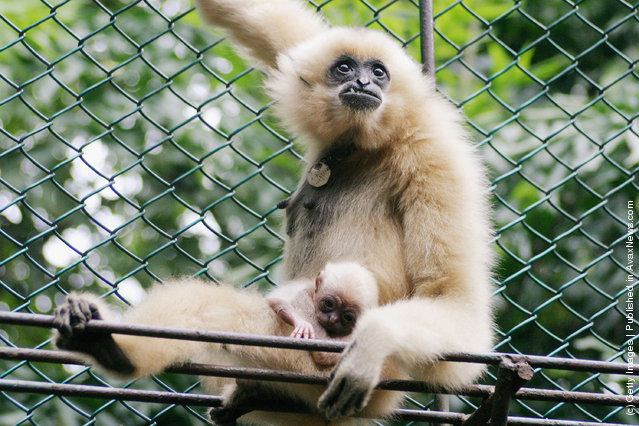
Newborn White-Cheeked Gibbon Nomascus

“Nomascus is the second most speciose genus of gibbons (family Hylobatidae). Originally this genus was a subgenus of Hylobates, and all individuals were considered one species, Hylobates concolor. Species within Nomascus are characterized by 52 chromosomes. Some species are all black, some light with a distinct black tuft of crown fur, and some by distinct, light-colored cheek patches. Nomascus is found from southern China (Yunnan) to southern Vietnam, and also on Hainan Island. One of the genus' species, Nomascus nasutus, has been deemed “the most critically endangered ape species in the world”. All of the species in this genus are endangered or critically endangered”. – Wikipedia

Photo: A newborn White-Cheeked Gibbon clings to its mother in the Nanning Zoo on April 12, 2004 in Nanning, Guangxi province, China. The White-Cheeked Gibbon's natural habitat is Southern China as well as Vietnam and Laos. They are classified as highly endangered and are on the brink of extinction due to poaching and reduction of natural rainforests. (Photo by Getty Images)
Details
12 Aug 2011 11:51:00
Cuddle Party

“A cuddle party or cuddle puddle is an event designed with the intention of allowing people to experience non-sexual group physical intimacy through cuddling. Cuddle parties are described by organizers as “workshop/social-events” that gives adults an opportunity to “give and receive welcomed affectionate touch in a no-expectation, friendly setting, according to your needs, desires, interests, and boundaries”. Cuddle parties are described as non-sexual events but kissing may occur at some parties”. – Wikipedia

Photo: People cuddle during an a “Cuddle Party” October 16, 2004 in New York City. Started by Reid Mihalko and Marcia Baczynski, cuddle parties are events for adults to get together and explore affectionate touch and communication without it becoming sexualized. At the parties, strangers spend time introducing themselves and setting boundaries before lying down to cuddle. (Photo by Spencer Platt/Getty Images)
Details
12 Sep 2011 10:07:00