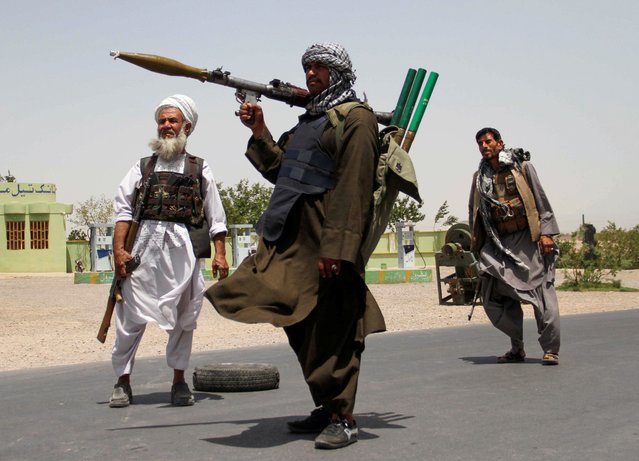
Former Mujahideen hold weapons to support Afghan forces in their fight against Taliban, on the outskirts of Herat province, Afghanistan on July 10, 2021. (Photo by Jalil Ahmad/Reuters)
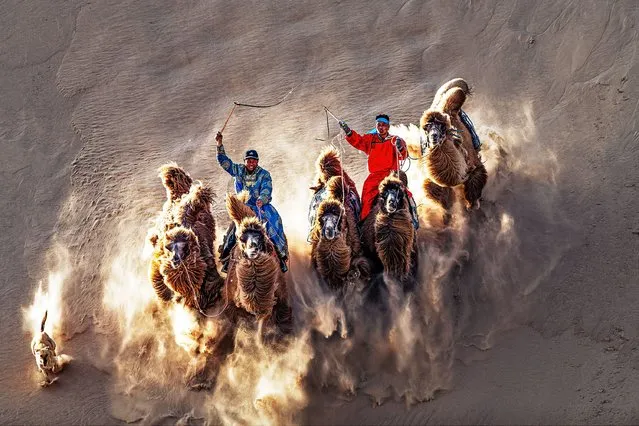
Camels kick up clouds of sand as they race down a steep dune. The camels can reach speeds of up to 40 kilometres per hour as they descend the ten-metre tall dunes on April 20, 2022. The photos were taken by photographer Qian Guo in Naiman Banner, near the city of Tongliao in the Inner Mongolia region of northeastern China. The 58 year old said: “These are local Mongolian farmers, and two of them are a father and a son. They have more than ten camels which they farm and train”. (Photo by Qian Guo/Solent News & Photo Agency)
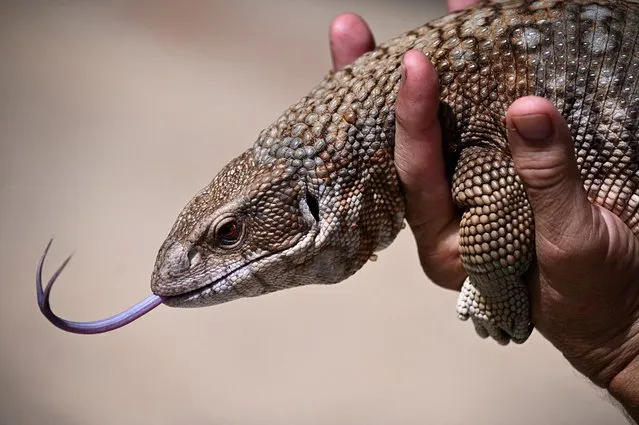
A man holds a Savannah monitor in the petting zoo “La Casita del Avestruz” (The ostrich's little house), in Caracas, Venezuela on January 28, 2024. (Photo by Gaby Oraa/Reuters)
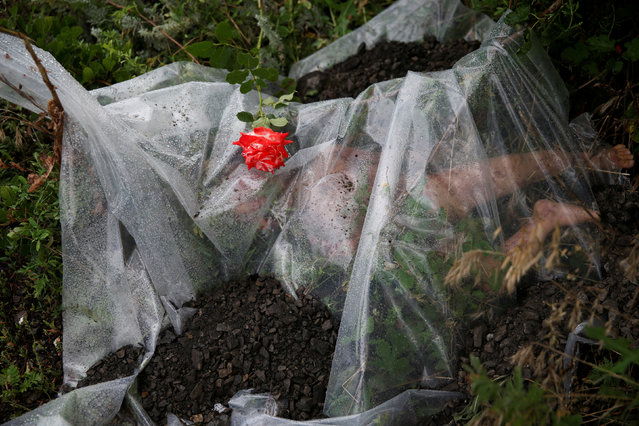
A rose lies on a plastic sheet covering a victim of a Malaysian Airlines Boeing 777 plane which was downed on Thursday near the village of Rozsypne, in the Donetsk region July 18, 2014. International prosecutors investigating the downing of flight MH17 over eastern Ukraine in 2014 say the missile that hit the plane was fired from territory controlled by Russian-backed rebels. They said the missile launcher was brought into Ukraine from Russia. All 298 people on board the Boeing 777 died when it broke apart in midair flying from Amsterdam to Kuala Lumpur. The JIT investigation's findings are meant to prepare the ground for a criminal trial. (Photo by Maxim Zmeyev/Reuters)
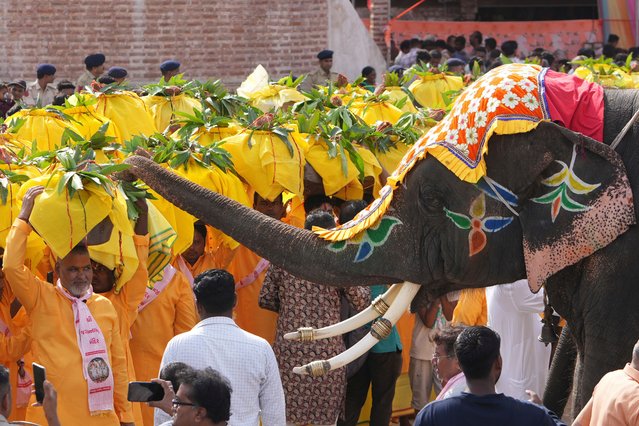
An elephant tries to eat leaves during a religious procession called Jal Yatra, ahead of the annual Rath Yatra, or chariot procession of Hindu god Lord Jagannath, in Ahmedabad, India, Wednesday, June 11, 2025. (Photo by Ajit Solanki/AP Photo)
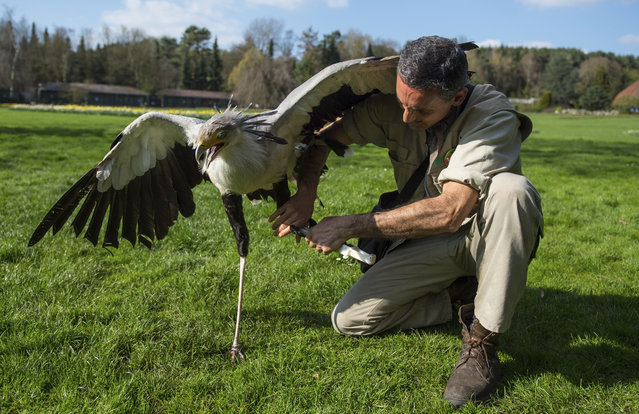
In this April 4, 2017 photo keeper German Alonso straps a leg prothesis to on the left leg of secretarybird Soeckchen (Sagittarius seprentarius) at the bird park in Walsrode, northern Germany. The prothesis was made in a 3D-printer after his left leg was amputated. (Photo by Philipp Schulze/DPA via AP Photo)
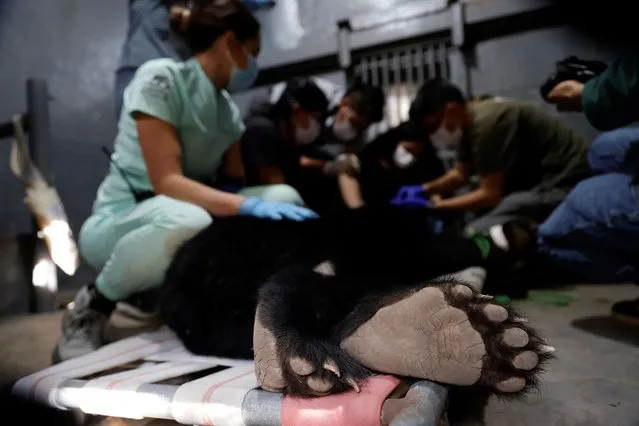
Veterinarians and biologists from the Quito Zoo and the Andean Condor Foundation fit a tracking collar that juvenile Andean bear Tupak will wear for the next four years, prior to his reintroduction into the wild, after the bear's life was deemed in danger due to proximity to humans, in Quito, Ecuador on March 31, 2024. (Photo by Karen Toro/Reuters)