Loading...
Done
Camels kick up clouds of sand as they race down a steep dune. The camels can reach speeds of up to 40 kilometres per hour as they descend the ten-metre tall dunes on April 20, 2022. The photos were taken by photographer Qian Guo in Naiman Banner, near the city of Tongliao in the Inner Mongolia region of northeastern China. The 58 year old said: “These are local Mongolian farmers, and two of them are a father and a son. They have more than ten camels which they farm and train”. (Photo by Qian Guo/Solent News & Photo Agency)

Camels kick up clouds of sand as they race down a steep dune. The camels can reach speeds of up to 40 kilometres per hour as they descend the ten-metre tall dunes on April 20, 2022. The photos were taken by photographer Qian Guo in Naiman Banner, near the city of Tongliao in the Inner Mongolia region of northeastern China. The 58 year old said: “These are local Mongolian farmers, and two of them are a father and a son. They have more than ten camels which they farm and train”. (Photo by Qian Guo/Solent News & Photo Agency)
Details
25 Apr 2022 04:34:00
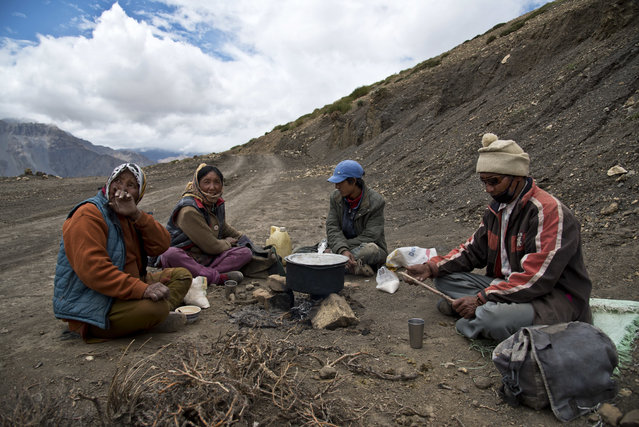
In this August 17, 2016, photo, from left to right, Chhering Chodom, 60, Tashi Yangzom, 50, Lobsang Chhering, 27, and Dorje Tandup, 58, drink milk tea on the side of the road. For centuries, the sleepy valley nestled in the Indian Himalayas remained a hidden Buddhist enclave forbidden to outsiders. Enduring the harsh year-round conditions of the high mountain desert, the people of Spiti Valley lived by a simple communal code – share the Earth's bounty, be hospitable to neighbors, and eschew greed and temptation at all turns. That's all starting to change, for better or worse. Since India began allowing its own citizens as well as outsiders to visit the valley in the early 1990s, tourism and trade have boomed. And the marks of modernization, such as solar panels, asphalt roads and concrete buildings, have begun to appear around some of the villages that dot the remote landscape at altitudes above 4,000 meters (13,000 feet). (Photo by Thomas Cytrynowicz/AP Photo)

In this August 17, 2016, photo, from left to right, Chhering Chodom, 60, Tashi Yangzom, 50, Lobsang Chhering, 27, and Dorje Tandup, 58, drink milk tea on the side of the road. For centuries, the sleepy valley nestled in the Indian Himalayas remained a hidden Buddhist enclave forbidden to outsiders. Enduring the harsh year-round conditions of the high mountain desert, the people of Spiti Valley lived by a simple communal code – share the Earth's bounty, be hospitable to neighbors, and eschew greed and temptation at all turns. That's all starting to change, for better or worse. (Photo by Thomas Cytrynowicz/AP Photo)
Details
15 Sep 2016 09:22:00
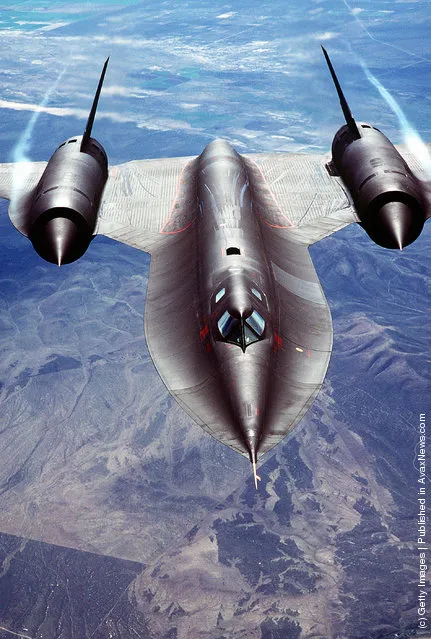
A U.S. Air Force SR-71A, also known as the Blackbird, is put through it's paces during a test flight

“The Lockheed SR-71 “Blackbird” was an advanced, long-range, Mach 3+ strategic reconnaissance aircraft. It was developed as a black project from the Lockheed A-12 reconnaissance aircraft in the 1960s by the Lockheed Skunk Works. Clarence “Kelly” Johnson was responsible for many of the design's innovative concepts. During reconnaissance missions the SR-71 operated at high speeds and altitudes to allow it to outrace threats. If a surface-to-air missile launch was detected, the standard evasive action was simply to accelerate and outrun the missile”. – Wikipedia

Photo: A U.S. Air Force SR-71A, also known as the “Blackbird”, is put through it's paces during a test flight over Beale Air Force Base in California. The aircraft is a strategic reconnaissance plane by Lockheed and is the world's fastest and highest flying operational aircraft. (Photo by Getty Images)
Details
07 Sep 2011 12:17:00
Brian Tomlinsons ink artwork. (Photo by Brian Tomlinsons/Caters News Agency)

These ink-redible, explosive masterpieces are like say-what-you see inkblots tests only in water. The vibrant colors burst from Brian Tomlinsons works, appearing as though they may be coloured ash clouds from an erupting volcano, rather than simply everyday substances. By doing so, Brian challenges viewers to identify what images can be imagined when mixing one fluid with another. In order to shoot the series, entitled Liquid Ink Art, Brain, 40, drops different coloured inks into a fish tank full of water before capturing high-speed shots with a flash. Here: Brian Tomlinsons ink artwork. (Photo by Brian Tomlinsons/Caters News Agency)
Details
15 Jun 2017 08:32:00
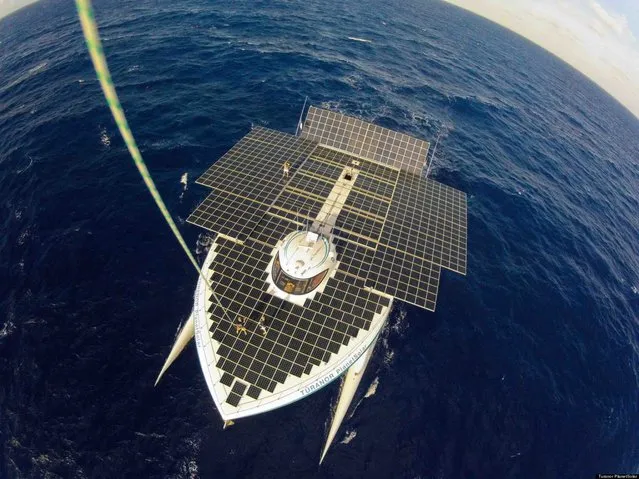
Turanor PlanetSolar

MS Tûranor PlanetSolar, known under the project name PlanetSolar, is the largest solar-powered boat in the world The vessel was designed by LOMOcean Design, built by Knierim Yachtbau in Kiel, Germany, and launched on 31 March 2010. In May 2012, it became the first ever solar electric vehicle to circumnavigate the globe. The 31-meter boat is covered in over 500 square meters of solar panels rated 93 kW, which in turn connect to one of the two electric motors in each hull. There are 8.5 tons of lithium-ion batteries in the ship's two hulls. The boat's shape allows it to reach speeds of up to 14 knots. The hull was model tested in wind tunnels and was tank tested to determine its hydrodynamics and aerodynamics. The boat has been designed to be used as a luxury yacht after the record attempt is finished.
Details
30 Oct 2013 09:06:00


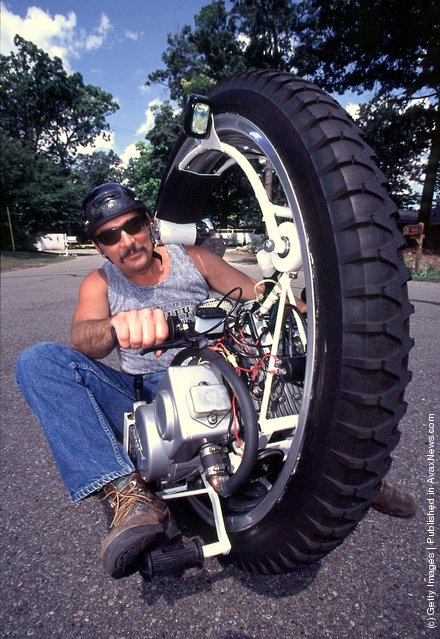
“A monowheel is a one-wheeled single-track vehicle similar to a unicycle. However, instead of sitting above the wheel, the rider sits either within it or next to it. The wheel is a ring, usually driven by smaller wheels pressing against its inner rim. Most are single-passenger vehicles, though multi-passenger models have been built.

Pedal-powered monowheels were built in the late 19th century; most built in the 20th century have been motorized. Some modern builders refer to these vehicles as monocycles, though that term is also sometimes used to describe motorized unicycles. Today, monowheels are generally built and used for fun and entertainment purposes, though from the 1860s through to the 1930s, they were proposed for use as serious transportation”. – Wikipedia

Photo: Cycle inventor Kerry McLean poses for the photographer 2000 in Walled Lake, Michigan. The “Monocycle” is equipped with a 40-horsepower engine, 4ft tire and is expected to reach speeds upwards of 100 mph. (Photo by Bill Pugliano/Liaison)
Details
02 Jul 2011 12:24:00
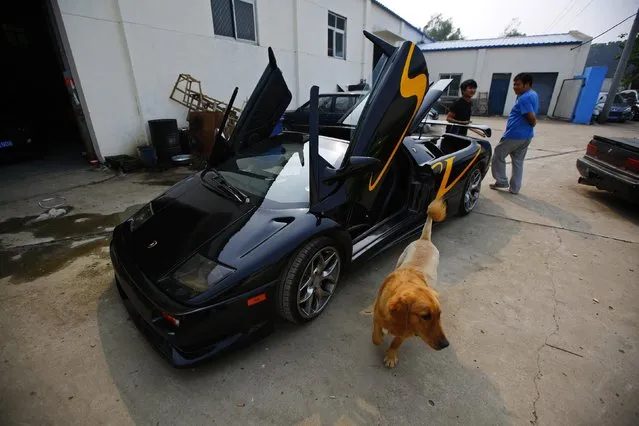
A dog walks past a handmade replica of Lamborghini Diablo outside a garage rented by Wang Yu and Li Lintao on the outskirts of Beijing, August 21, 2014. (Photo by Petar Kujundzic/Reuters)

A dog walks past a handmade replica of Lamborghini Diablo outside a garage rented by Wang Yu and Li Lintao on the outskirts of Beijing, August 21, 2014. Chinese race car enthusiasts Wang Yu and Li Lintao, both in their 30s, have finished designing and making two replicas of the Lamborghini Diablo, which can reach the top speed of 310km/h, and are currently working on a replica of the T-Rex motorcycle. They spent approximately 5 million yuan (around USD 811,899) to buy parts and hire workers, and about 6 years to assemble them with the knowledge they gained from studying mechanology for nearly a decade abroad. Wang and Li went popular after showing their first handmade replica of Lamborghini Diablo at the Beijing International Automobile Exhibition in 2012, and sold their second Lamborghini replica to Alibaba as a collection. (Photo by Petar Kujundzic/Reuters)
Details
26 Aug 2014 09:50:00
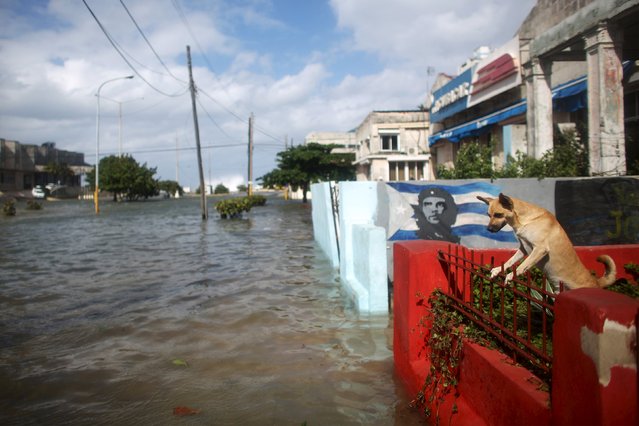
A four-year-old dog Nika stands next to an image of Cuba's revolutionary hero Ernesto “Che” Guevara in front of a flooded street in Havana, January 23, 2016. Havana's seafront Malecon continued to be slammed by massive waves that flooded parts of the seaside city on Saturday. As a result, Havana was confronting flooding as a cold front passes through the Caribbean island.  (Photo by Alexandre Meneghini/Reuters)

A four-year-old dog Nika stands next to an image of Cuba's revolutionary hero Ernesto “Che” Guevara in front of a flooded street in Havana, January 23, 2016. Havana's seafront Malecon continued to be slammed by massive waves that flooded parts of the seaside city on Saturday. As a result, Havana was confronting flooding as a cold front passes through the Caribbean island. The giant waves began washing up onto shore during sunrise. The waves have been accompanied by winds passing through at a speed between 35 and 50 km (21 to 31 miles) per hour. (Photo by Alexandre Meneghini/Reuters)
Details
24 Jan 2016 15:03:00