Loading...
Done
Tree leaves displaying their autumn colours at the Royal Horticultural Society Garden Wisley

Members of the public admire trees displaying their autumn colours at the Royal Horticultural Society Garden Wisley on October 26, 2011 in Wisley, England. Many deciduous trees have now changed colour as they begin to shed their leaves for Autumn. An extended period of leaf colour change has come about this year due to a warm, dry Spring prompting an early growth spurt and a premature colour change. (Photo by Oli Scarff/Getty Images)
Details
28 Oct 2011 12:41:00
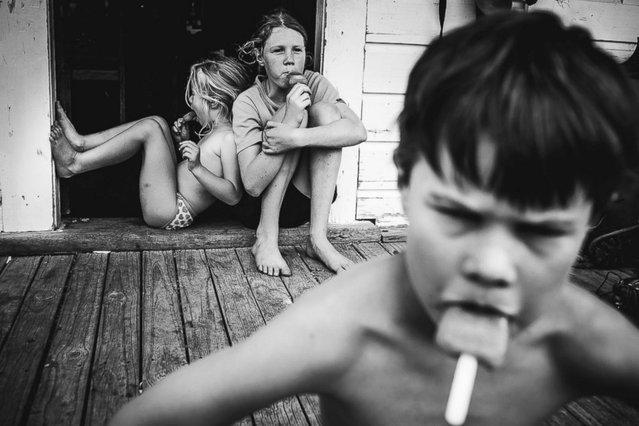
New Zealand photographer Niki Boon captured her children, who are growing up with limited electronics, in the photo series “Childhood in the Raw Photos”. Niki Boon began taking photos as a hobby while she was working as a physiotherapist in Scotland. However, the New Zealand native found her interest in the art waning while she travelled, and it wasn’t until she had returned home and started raising a family that her passion was rekindled. “Childhood in the Raw”, an ongoing photo series of her four children’s technology-free life on her 10-acre property in New Zealand, is the perennial fruit of this passion. (Photo by Niki Boon)

New Zealand photographer Niki Boon captured her children, who are growing up with limited electronics, in the photo series “Childhood in the Raw Photos”. Niki Boon began taking photos as a hobby while she was working as a physiotherapist in Scotland. However, the New Zealand native found her interest in the art waning while she travelled, and it wasn’t until she had returned home and started raising a family that her passion was rekindled. “Childhood in the Raw”, an ongoing photo series of her four children’s technology-free life on her 10-acre property in New Zealand, is the perennial fruit of this passion. (Photo by Niki Boon)
Details
20 Apr 2016 12:01:00
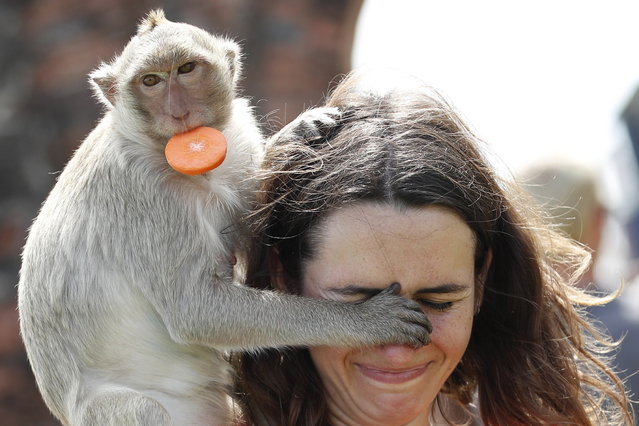
A monkey is being fed by a foreign tourist during the annual Monkey Banquet at Phra Prang Sam Yod ancient temple in Lopburi, some 180km from Bangkok, central Thailand, 24 November 2024. The annual gala has been organized since 1989 by Lopburi's entrepreneur Yongyuth Kitwatananusont, offering all-you-can-eat fruits, vegetables, and desserts for monkeys to honor the long-tailed macaques to attract tourists to visit the town to promote tourism. According to the Wildlife Department, more than 2,000 urban monkeys were captured in 2024 by authorities to control the monkey population after the growing complaints of residents that the macaques maraud food, frequently confront residents, causing accidents as well as their properties, assets, and the ancient city to be overrun and damaged by the monkeys. (Photo by Rungroj Yongrit/EPA)

A monkey is being fed by a foreign tourist during the annual Monkey Banquet at Phra Prang Sam Yod ancient temple in Lopburi, some 180km from Bangkok, central Thailand, 24 November 2024. The annual gala has been organized since 1989 by Lopburi's entrepreneur Yongyuth Kitwatananusont, offering all-you-can-eat fruits, vegetables, and desserts for monkeys to honor the long-tailed macaques to attract tourists to visit the town to promote tourism. (Photo by Rungroj Yongrit/EPA)
Details
08 Dec 2024 04:22:00
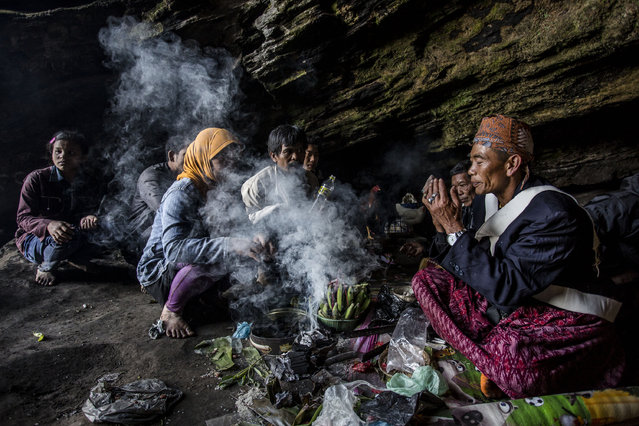
A Tenggerese shaman praying for worshippers at Widodaren cave during the Tenggerese Hindu Yadnya Kasada festival on July 31, 2015 in Probolinggo, East Java, Indonesia. The festival is the main festival of the Tenggerese people and lasts about a month. On the fourteenth day, the Tenggerese make the journey to Mount Bromo to make offerings of rice, fruits, vegetables, flowers and livestock to the mountain gods by throwing them into the volcano's caldera. (Photo by Ulet Ifansasti/Getty Images)

A Tenggerese shaman praying for worshippers at Widodaren cave during the Tenggerese Hindu Yadnya Kasada festival on July 31, 2015 in Probolinggo, East Java, Indonesia. The festival is the main festival of the Tenggerese people and lasts about a month. On the fourteenth day, the Tenggerese make the journey to Mount Bromo to make offerings of rice, fruits, vegetables, flowers and livestock to the mountain gods by throwing them into the volcano's caldera. The origin of the festival lies in the 15th century when a princess named Roro Anteng started the principality of Tengger with her husband Joko Seger, and the childless couple asked the mountain Gods for help in bearing children. The legend says the Gods granted them 24 children but on the provision that the 25th must be tossed into the volcano in sacrifice. The 25th child, Kesuma, was finally sacrificed in this way after initial refusal, and the tradition of throwing sacrifices into the caldera to appease the mountain Gods continues today. (Photo by Ulet Ifansasti/Getty Images)

Details
01 Aug 2015 12:07:00
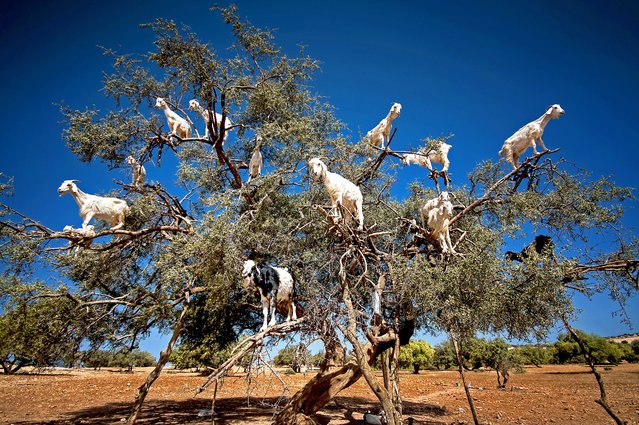
These goats threw caution to the wind and scaled this Argan tree right to the very top, even balancing on the most unsturdy of branches. It looks like a bit of a baa-lancing act, but the goats hooves are perfectly adapted to climbing the trees, where they graze on the Argan fruit. Amateur photographer Burak Senbak, 51, took these photos whilst travelling through Morocco in July 2016. Burak is originally from Turkey and works as a mechanical engineer, but has pursued his passion for photography for 10 years. Intrigued by the sight of goats in a tree, Burak couldnt resist the opportunity to take some photos, and said the goats proved a perfect subject. (Photo by Burak Senbak/Caters News)

These goats threw caution to the wind and scaled this Argan tree right to the very top, even balancing on the most unsturdy of branches. It looks like a bit of a baa-lancing act, but the goats hooves are perfectly adapted to climbing the trees, where they graze on the Argan fruit. Amateur photographer Burak Senbak, 51, took these photos whilst travelling through Morocco in July 2016. Burak is originally from Turkey and works as a mechanical engineer, but has pursued his passion for photography for 10 years. Intrigued by the sight of goats in a tree, Burak couldnt resist the opportunity to take some photos, and said the goats proved a perfect subject. (Photo by Burak Senbak/Caters News)
Details
27 Aug 2017 07:00:00
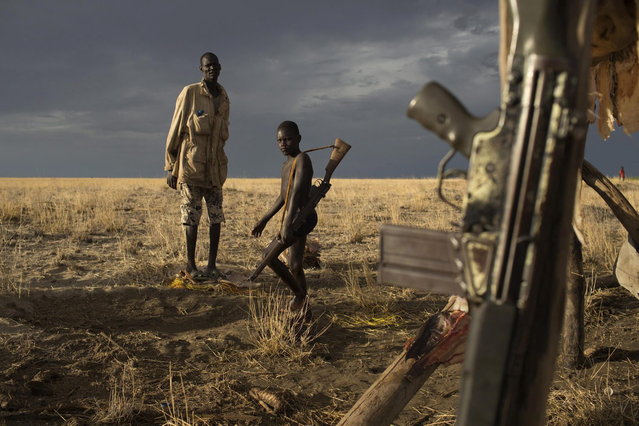
A Turkana man and a boy carrying a gun look on as a G3 battle rifle hangs from a structure used to dry fish at a fishing camp on the shores of Lake Turkana, some kilometres from Todonyang near the Kenya-Ethiopia border in northwestern Kenya October 12, 2013. (Photo by Siegfried Modola/Reuters)

A Turkana man and a boy carrying a gun look on as a G3 battle rifle hangs from a structure used to dry fish at a fishing camp on the shores of Lake Turkana, some kilometres from Todonyang near the Kenya-Ethiopia border in northwestern Kenya October 12, 2013The Turkana are traditionally nomadic pastoralists, but they have seen the pasture that they need to feed their herds suffer from recurring droughts and many have turned to fishing. However, Lake Turkana is overfished, and scarcity of food and pastureland is fuelling long-standing conflict with Ethiopian indigenous Dhaasanac, who have seen grazing grounds squeezed by large-scale government agricultural schemes in southern Ethiopia. The Dhaasanac now venture ever deeper into Kenyan territory in search of fish and grass, clashing with neighbours. Fighting between the communities has a long history, but the conflict has become ever more fatal as automatic weapons from other regional conflicts seep into the area. While the Turkana region is short of basics like grass and ground-water, it contains other resources including oil reserves and massive, newly discovered underground aquifers. (Photo by Siegfried Modola/Reuters)
Details
05 Dec 2013 12:08:00
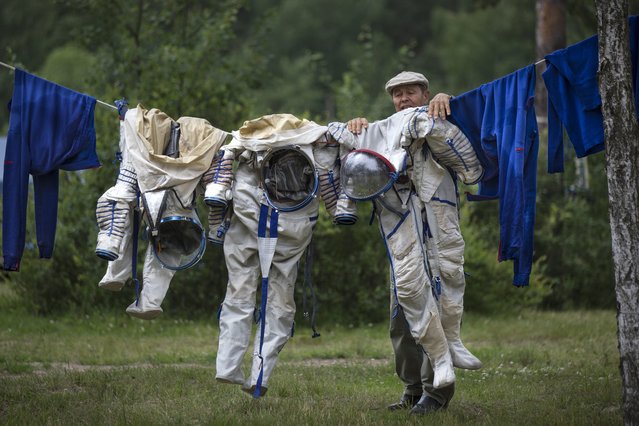
An employe of Russian Space Training Center hangs out to dry space suits of Russian cosmonaut Anatoly Ivanishin, NASA's U.S. flight engineer Kathleen Rubins, and Japanese space agency's flight engineer Takuya Onishi, right, after their undergoing  training near in Noginsk, 60 km (38 miles) east of Moscow, Russia, Wednesday, July 2, 2014. (Photo by Alexander Zemlianichenko/AP Photo)

An employe of Russian Space Training Center hangs out to dry space suits of Russian cosmonaut Anatoly Ivanishin, NASA's U.S. flight engineer Kathleen Rubins, and Japanese space agency's flight engineer Takuya Onishi, right, after their undergoing training near in Noginsk, 60 km (38 miles) east of Moscow, Russia, Wednesday, July 2, 2014. The training was intended to simulate the capsule landing on water. Russian cosmonaut Anatoly Ivanishin, Japanese space agency's flight engineer Takuya Onishi, and NASA's U.S. flight engineer Kathleen Rubins are being trained for a future mission to the International Space Station. (Photo by Alexander Zemlianichenko/AP Photo)
Details
05 Jul 2014 11:47:00
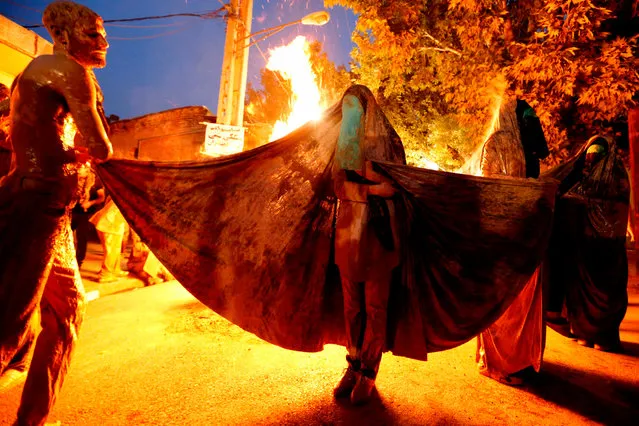
Iranian Shiite Muslim women gather around a bonfire after rubbing mud on their body during the “Kharrah Mali” (Mud Rubbing) ritual to mark the Ashura religious ceremony in the city of Khorramabad, some 470 kms southwest of Tehran, early in the morning on October 1, 2017. “Khrreh Mali” or “Mud Rubbing” is a ritual that is held in the city of Khorramabad every year to commemorate the seventh century slaying of Prophet Mohammed' s grandson Imam Hussein, in which Iranian men roll over in mud and dry themselves by gathering around the bonfires before flagellating themselves. (Photo by Atta Kenare/AFP Photo)

Iranian Shiite Muslim women gather around a bonfire after rubbing mud on their body during the “Kharrah Mali” (Mud Rubbing) ritual to mark the Ashura religious ceremony in the city of Khorramabad, some 470 kms southwest of Tehran, early in the morning on October 1, 2017. “Khrreh Mali” or “Mud Rubbing” is a ritual that is held in the city of Khorramabad every year to commemorate the seventh century slaying of Prophet Mohammed' s grandson Imam Hussein, in which Iranian men roll over in mud and dry themselves by gathering around the bonfires before flagellating themselves. (Photo by Atta Kenare/AFP Photo)
Details
02 Oct 2017 08:38:00