Loading...
Done
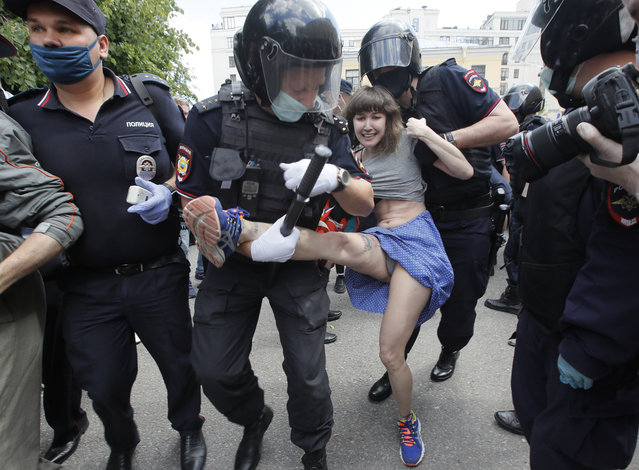
Police detain a woman protesting against the court verdict for Yuliy Boyarshinov, and Viktor Filinkov, members of a left-wing group Set (Network) at the Western regional military court in St.Petersburg, Russia, Monday, June 22, 2020. (Photo by Dmitri Lovetsky/AP Photo)

Police detain a woman protesting against the court verdict for Yuliy Boyarshinov, and Viktor Filinkov, members of a left-wing group Set (Network) at the Western regional military court in St.Petersburg, Russia, Monday, June 22, 2020. A Russian military court convicted two members of a left-wing youth group of terrorism Monday and sentenced them to prison terms of five and a half and seven years, in a case that human rights groups called fabricated and based on coerced testimony. (Photo by Dmitri Lovetsky/AP Photo)
Details
24 Jun 2020 00:03:00
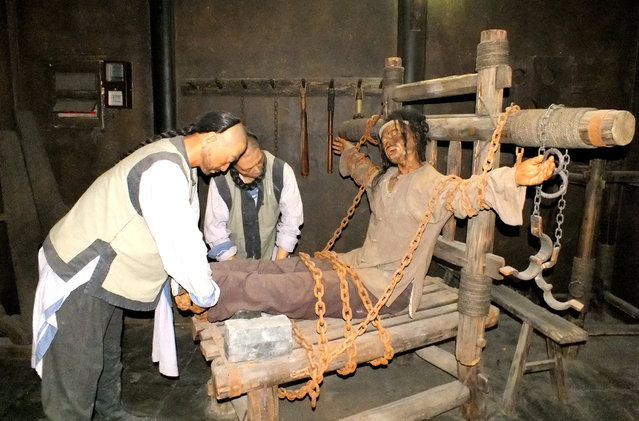
Wax figures with torture instrument named “torture-rack” are seen on October 25, 2014 in Huai'an, Jiangsu province of China. The exhibition, which opened last year at an educational center in the eastern city of Huai'an, includes reenactments of prisoners being hung over a fire, flayed and being tortured on what is known as a “Tiger Bench” – pictured above – a Qing dynasty (1644-1912) device that contorted victims' legs and arms in high pressure positions that could break bones or tear apart joints. (Photo by ChinaFotoPress)

Organizers of an exhibition of ancient instruments of torture in Huai'an, Jiangsu province, have suggested that children, heart disease patients and people with high blood pressure stay away because of the vivid depictions of shocking cruelty. The exhibition has more than 200 instruments of torture on display in the 50,000-square-meter exhibition halls of a restored ancient building. Wax figures, along with sound and light techniques, are incorporated for scary effect. The local government said the exhibition is for tourists and historians to research ancient torture practices. (Photo by ChinaFotoPress)
Details
29 Oct 2014 12:22:00
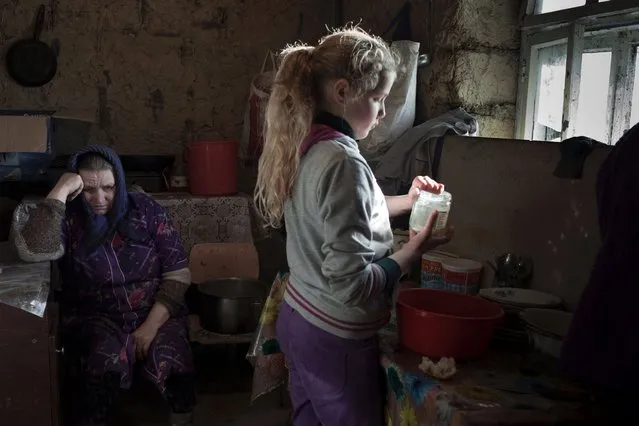
According to the U.S. government, Moldova, one of the poorest countries in Europe, depends on about $1.6 billion annually sent back from the roughly one million Moldovans who left for work in in Europe, Russia, and other former Soviet Bloc countries. Photographer Myriam Meloni went to Moldova to document what she refers to as “social orphans” – children whose parents have emigrated to another country in search of a job and a better future for their families. Here: Lulia is seen washing dishes in her grandmother's house, where she lives. (Photo by Myriam Meloni)

According to the U.S. government, Moldova, one of the poorest countries in Europe, depends on about $1.6 billion annually sent back from the roughly one million Moldovans who left for work in in Europe, Russia, and other former Soviet Bloc countries. Photographer Myriam Meloni went to Moldova to document what she refers to as “social orphans” – children whose parents have emigrated to another country in search of a job and a better future for their families. Here: Lulia is seen washing dishes in her grandmother's house, where she lives. (Photo by Myriam Meloni)
Details
12 Mar 2016 14:57:00
In this file photo taken on Sunday, August 2, 2020, Sviatlana Tsikhanouskaya, candidate for the presidential elections greets people waving old Belarus flags during a meeting to show her support, in Brest, 326 km (203,7 miles) southwest of Minsk, Belarus. Belarus’ authoritarian President Alexander  Lukashenko faces a perfect storm as he seeks a sixth term in the election held Sunday, Aug. 9, 2020 after 26 years in office. Mounting public discontent over the worsening economy and his government’s bungled handling of the coronavirus pandemic has fueled the largest opposition rallies since the Soviet collapse. (Photo by Sergei Grits/AP Photo)

In this file photo taken on Sunday, August 2, 2020, Sviatlana Tsikhanouskaya, candidate for the presidential elections greets people waving old Belarus flags during a meeting to show her support, in Brest, 326 km (203,7 miles) southwest of Minsk, Belarus. Belarus’ authoritarian President Alexander Lukashenko faces a perfect storm as he seeks a sixth term in the election held Sunday, Aug. 9, 2020 after 26 years in office. Mounting public discontent over the worsening economy and his government’s bungled handling of the coronavirus pandemic has fueled the largest opposition rallies since the Soviet collapse. (Photo by Sergei Grits/AP Photo)
Details
10 Aug 2020 00:01:00

Combine harvesters work on a wheat field of the Solgonskoye farming company near the village of Talniki, southwest from Siberian city of Krasnoyarsk, Russia, August 27, 2015. (Photo by Ilya Naymushin/Reuters)

Combine harvesters work on a wheat field of the Solgonskoye farming company near the village of Talniki, southwest from Siberian city of Krasnoyarsk, Russia, August 27, 2015. Russia, one of the world's top wheat exporters, will harvest its third-largest grain crop in post-Soviet history this year, leading Russian consultancy SovEcon said on August 27 after upgrading its forecast. (Photo by Ilya Naymushin/Reuters)
Details
29 Aug 2015 10:47:00
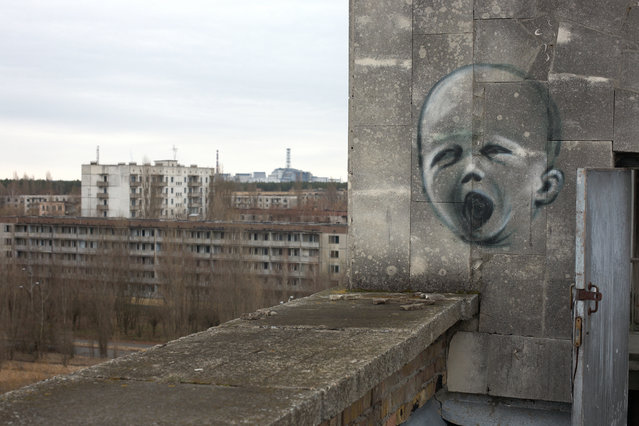
Graffiti of a crying baby on a wall, Chernobyl Power Plant, Chernobyl, Ukraine. (Photo by Hans Neleman/Getty Images)

The Chernobyl disaster was a catastrophic nuclear accident that occurred on 26 April 1986 at the Chernobyl Nuclear Power Plant in Ukraine, which was under the direct jurisdiction of the central authorities of the Soviet Union. The Chernobyl disaster is the worst nuclear power plant accident in history in terms of cost and resulting deaths, and is one of only two classified as a level 7 event (the maximum classification) on the International Nuclear Event Scale (the other being the Fukushima Daiichi nuclear disaster in 2011). Photo: Graffiti of a crying baby on a wall, Chernobyl Power Plant, Chernobyl, Ukraine. (Photo by Hans Neleman/Getty Images)
Details
27 Apr 2014 08:12:00
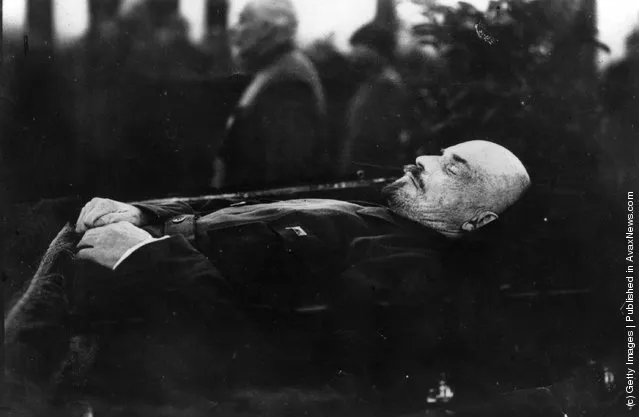
1924:  Vladimir Ilyich Lenin lying in state in the Kremlin

Photo: Vladimir Ilyich Lenin (1870 – 1924) lying in state in the Kremlin. (Photo by Hulton Archive/Getty Images). 1924

Important! For the same article in Russian language click here.

Something quite intriguing is happening within Russian-speaking internet during the last few – should you type a fully academic inquiry (at least, according to Russian academic requirements) in national search engines for "Lenin's mausoleum" – the first thing you get (even in top 10 searches) is website pages talking about black magic and occult. Website authors view this construction differently, but unconditionally agree on one thing: the mausoleum of the "leader of the world proletariat” – the essence of a magical artifact, a sort of “energy vampire”. It was built with a certain purpose: to drain the energy out of miserable Soviet citizens on one hand; and to poison the anthroposphere of one-sixth part of the earth with its vibes (the exact territory that was occupied by the former Soviet Union), depriving the Russian people of will to resist on the other hand. Complete nonsense? No doubt. Nevertheless, an intriguing one. Well, probably because some oddities do exist in mausoleum's history. These oddities are the thing we are going to discuss this time. First, let me refresh you memory on the subject.
Details
16 Oct 2011 11:27:00
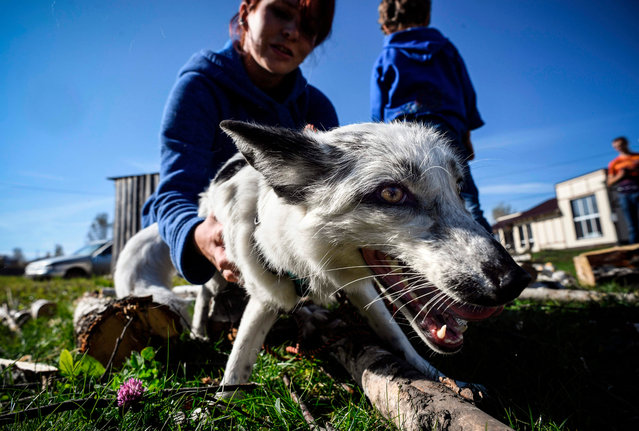
Tatyana Abramova, 33, plays with her home fox Plombir at her countryside house outside Siberian city of Novosibirsk on September 12, 2020. The official start of the Soviet experiment to better understand the domestication of animals by humans began in 1959, and was initiated by geneticists Dmitri Beliaiev and Lioudmila Trout on a farm in Akademgorodok, the scientific center of excellence in Siberia. Their primary objective was to domesticate foxes, to understand how the ancestor of wolves, another canine, evolved into a loyal and loving dog. And understand what this domestication tells us about the genetic evolution of species. (Photo by Alexander Nemenov/AFP Photo)

Tatyana Abramova, 33, plays with her home fox Plombir at her countryside house outside Siberian city of Novosibirsk on September 12, 2020. The official start of the Soviet experiment to better understand the domestication of animals by humans began in 1959, and was initiated by geneticists Dmitri Beliaiev and Lioudmila Trout on a farm in Akademgorodok, the scientific center of excellence in Siberia. Their primary objective was to domesticate foxes, to understand how the ancestor of wolves, another canine, evolved into a loyal and loving dog. And understand what this domestication tells us about the genetic evolution of species. (Photo by Alexander Nemenov/AFP Photo)
Details
25 Oct 2020 00:05:00