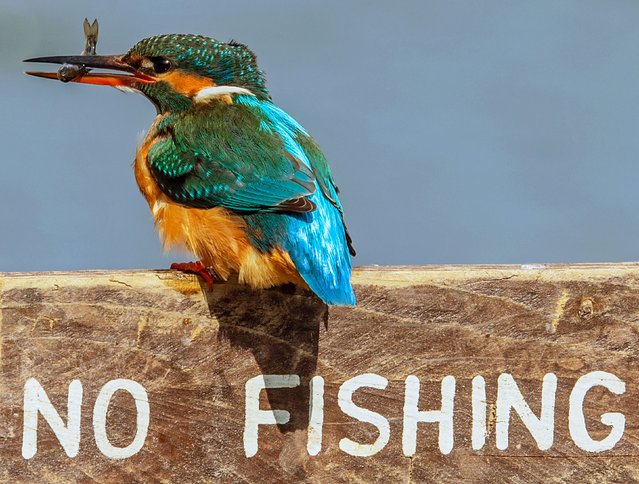
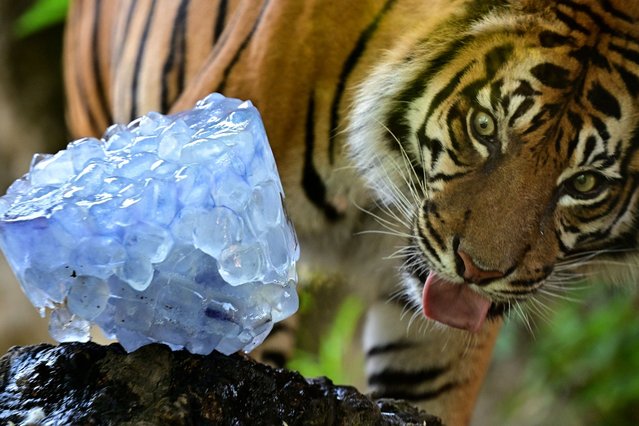
A kingfisher ignores the “no fishing” sign after catching food at Teddesley Park in Staffordshire, England, on Saturday, April 5, 2025. (Photo by Stuart Brock/Anadolu/Getty Images)
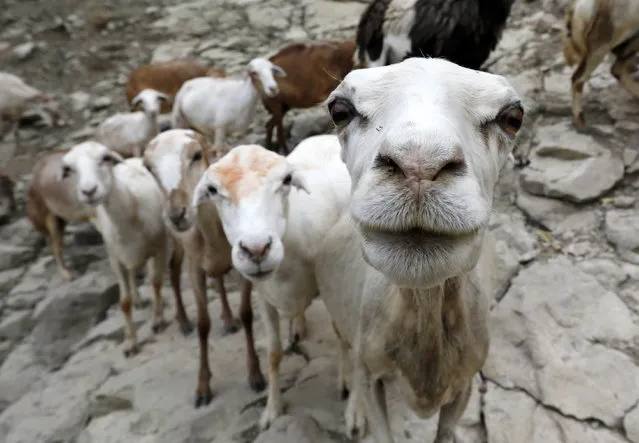
A flock of sheep and goats is led by shepherds to pastures at a mountain village on the outskirts of Sana'a, Yemen, 27 July 2023. At least eight million sheep and goats from about 470,000 pastoralist and agro pastoralist households across Yemen will be treated and vaccinated over the two years 2023 and 2024, in an effort to reduce livestock losses, improve production efficiency, and household income generation amid an acute food insecurity, the UN Food and Agriculture Organization (FAO) has reported. (Photo by Yahya Arhab/EPA)
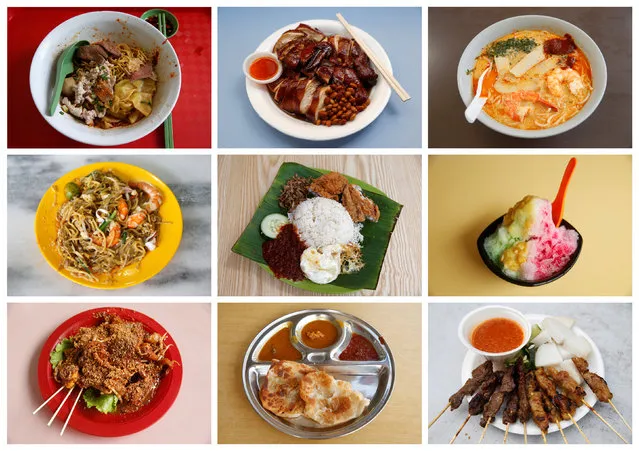
A combination photo shows various popular street foods under $6 from various hawker food stalls and eateries in Singapore, taken between July 28 to 31, 2016. Top row (L to R) bak chor mee, soya sauce chicken; Middle row (L to R) laksa, hokkien mee, nasi lemak, ice kachang; Bottom row (L to R) rojak, roti prata and satay. (Photo by Edgar Su/Reuters)
“One Third” – a project on food waste by an Austrian photography Klaus Pichler. According to a UN study one third of the world's food goes to waste – the largest part thereof in the industrialized nations of the global north. Equally, 925 million people around the world are threatened by starvation. The series “One Third” describes the connection between individual wastage of food and globalized food production.
Photo: Pineapple. Place of production: Guayaquil, Ecuador. Cultivation method: Outdoor plantation • Time of harvest: All- season. Transporting distance: 10.666 km (linear distance) • Means of transportation: Aircraft, truck. Carbon footprint (total) per kg: 11,94 kg • Water requirement (total) per kg: 360 l. Price: 2,10 € / kg. (Photo by Klaus Picher)
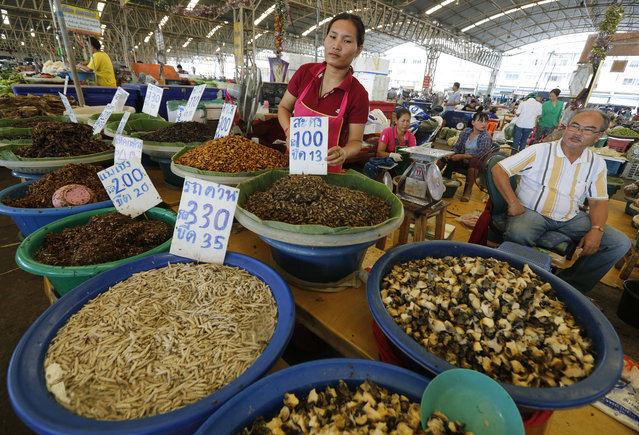
Thai vendors stand next to edible insects for sale at Talad Thai market in Pathum Thani province on the outskirts of Bangkok, Thailand, 15 July 2013. Insects have long been on the menu in Thailand, but academics and the United Nation's Food and Agriculture Organization (FAO) officials are hoping they will become a more common global source of protein and nutrients to meet the need for growing world food requirements in the future. (Photo by Narong Sangnak/EPA)
A visitor takes a selfie with “The Breach” by Leandro Erlich, during a photo call for Kew Gardens' forthcoming “Food Forever” exhibition, examining the fragile future of food and the impact of our day-to-day eating habits on the planet, at the Royal Botanic Gardens, in Kew, Richmond, Surrey on Thursday, June 16, 2022. (Photo by Dominic Lipinski/PA Images via Getty Images)
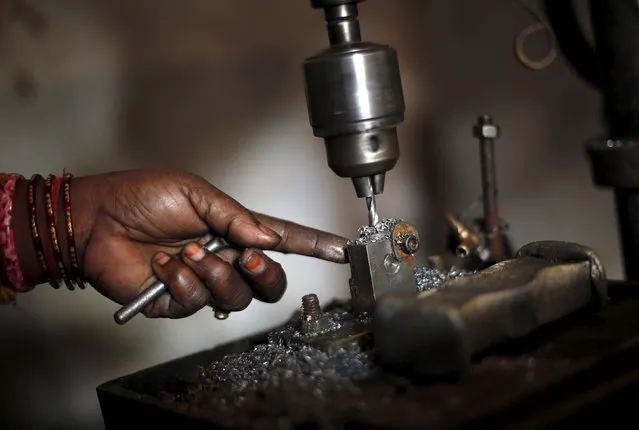
A worker makes auto parts on a machine inside a workshop in Faridabad, India, December 24, 2015. Car makers such as Maruti Suzuki India and Hyundai Motor see huge growth in India, set to become the world's third-largest auto market by 2020 as millions buy their first new car. Price tags can be as low as $3,000 for a new Tata Motors Nano mini-car. India is also becoming a low-cost export hub for global car makers such as General Motors and Ford Motor. As the sector expands, some of the work is sub-contracted out to small factories operating on paper-thin margins, where poor contract workers often have little or no access to safety equipment or health benefits. (Photo by Adnan Abidi/Reuters)