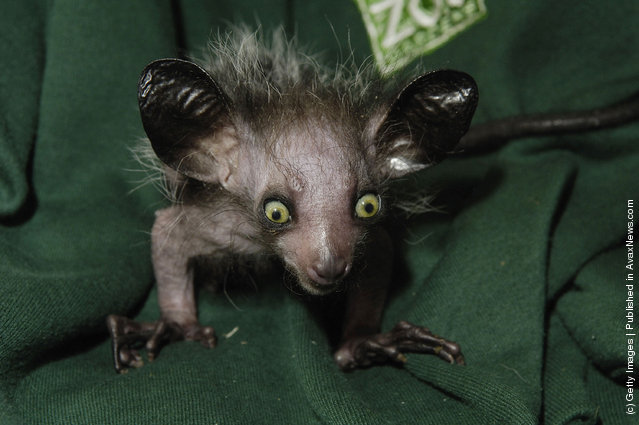
“The aye-aye (Daubentonia madagascariensis) is a lemur, a strepsirrhine primate native to Madagascar that combines rodent-like teeth and a special thin middle finger to fill the same ecological niche as a woodpecker. It is the world's largest nocturnal primate, and is characterized by its unusual method of finding food; it taps on trees to find grubs, then gnaws holes in the wood and inserts its narrow middle finger to pull the grubs out. The only other animal species known to find food in this way is the striped possum. From an ecological point of view the aye-aye fills the niche of a woodpecker as it is capable of penetrating wood to extract the invertebrates within”. – Wikipedia
Photo: In this handout image from Bristol Zoo is seen the first captive bred aye-aye in the UK named “Kintana” (meaning star in Malagasy) April 15, 2005 at Bristol Zoo Gardens, England. The zoo announced today only the second baby aye-aye to be hand-reared in the world (the first was in Jersey Zoo) and has now made his first public appearance since his birth on 11 February 2005. (Photo by Rob Cousins/Bristol Zoo via Getty Images)
A gallery assistant holds a rare 14th century time-telling device device in Bonhams auction house on December 9, 2011 in London, England. The instrument, which dates from 1396 and was discovered in a shed in Queensland, Australia, is due to be auctioned on December 13, 2011 and is expected to fetch 200,000 GBP. (Photo by Oli Scarff/Getty Images)
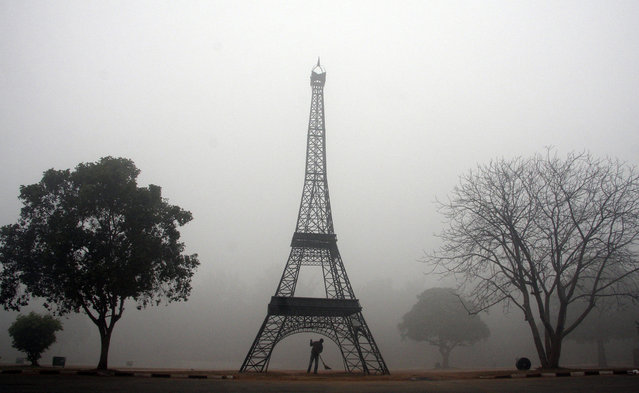
India: A sweeper cleans the side of a road near a replica of the Eiffel Tower amid heavy fog in the early morning in the northern Indian city of Chandigarh January 18, 2010. (Photo by Ajay Verma/Reuters)
A woman photographs “Super Space Titan Kitty” by Colin Christian at the “Hello! Exploring the Supercute World of Hello Kitty” museum exhibit in honor of Hello Kitty's 40th anniversary, at the Japanese American National Museum in Los Angeles, California October 10, 2014. (Photo by Lucy Nicholson/Reuters)
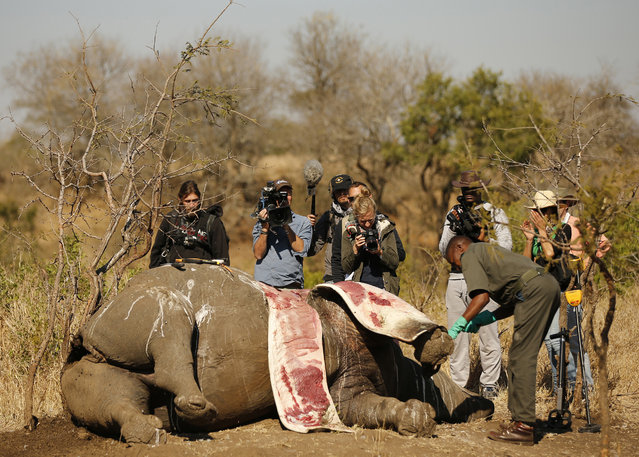
Members of the media film as a ranger performs a post mortem on the carcass of a rhino after it was killed for its horn by poachers at the Kruger national park in Mpumalanga province August 27, 2014. Rhino poachers in South Africa now risk giving themselves away when they shoot thanks to a high-tech, gunfire-detection system being piloted in the country's flagship Kruger National Park. The stakes are high, for rhinos are being slain in escalating numbers for their prized horns, alarming both conservationists and the government since wildlife in South Africa is an important tourist draw. (Photo by Siphiwe Sibeko/Reuters)
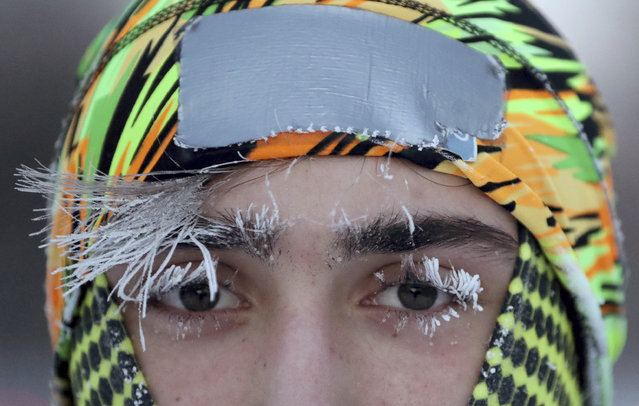
Frost covers part of the face of University of Minnesota student Daniel Dylla during a morning jog along Mississippi River Parkway Tuesday, January 29, 2019, in Minneapolis. Extreme cold and record-breaking temperatures are crawling into parts of the Midwest after a powerful snowstorm pounded the region, and forecasters warn that the frigid weather could be life-threatening. (Photo by David Joles/Star Tribune via AP Photo)
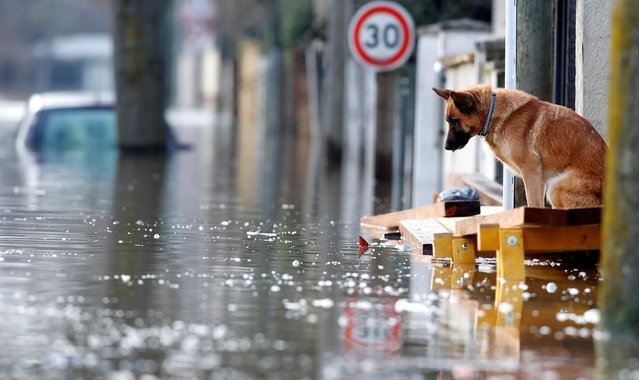
A dog is seen at the entrance of a house in the flooded residential area of Villeneuve-Saint-Georges, near Paris, France January 26, 2018. The Paris region has been deeply affected by the floods that hit the country over the past week, but in Paris, it was business as usual. (Photo by Christian Hartmann/Reuters)