Loading...
Done
Tattooing Pigs By Wim Delvoye

Wim Delvoye is a notorious tattoo artist, who became famous when he started tattooing live pigs. He first began in 1997 and after animal rights activists found out about what he was doing, he had to move to China to continue his business. There is nothing special about the tattoos that Wim Delvoye creates, they look mediocre at best, and the only reason why he’s famous is his acts of animal cruelty. Nevertheless, Wim states that the pigs feel just fine and are well fed and taken care off. Full anesthesia is used to ensure that the pig doesn’t feel pain during the course of the whole procedure. During this time three tattoo artists work on the tattoo simultaneously to complete it as quickly as possible. Skins of those pigs are then sold for as much as £50k a piece.
Details
02 Apr 2015 09:06:00
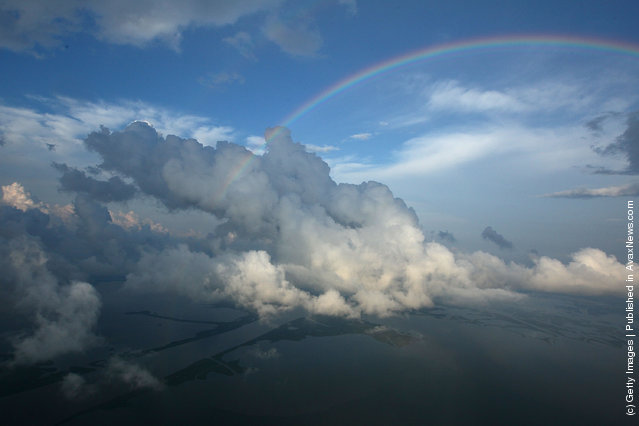
A rainbow appears over the Louisiana gulf May 26, 2010 in the Gulf of Mexico near Brush Island, Louisiana

A rainbow appears over the Louisiana gulf May 26, 2010 in the Gulf of Mexico near Brush Island, Louisiana. (Photo by Win McNamee/Getty Images)
Details
24 Oct 2011 14:43:00
In this June 12, 2017 photo, a woman stands in front of a mural on the slope in Central district, Hong Kong. (Photo by Kin Cheung/AP Photo)

In this June 12, 2017 photo, a woman stands in front of a mural on the slope in Central district, Hong Kong. Once known as Victoria after the British queen, Hong Kong island's waterfront formed the core of the British settlement after Hong Kong island was handed over as a colony in 1842. Today as Hong Kong approaches the 20th anniversary of its return to China, it remains a bustling commercial and financial center as well as the location of the main government offices. However, along the streets that angle sharply upward toward the mountains above, a more relaxed pace of life endures. (AP Photo/Kin Cheung)
Details
28 Jun 2017 08:18:00
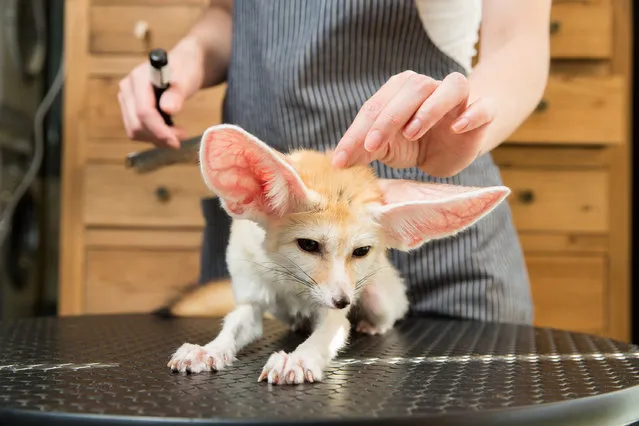
A fennec fox (Vulpes zerda) is groomed in a pet store in central Beijing. Native to the Sahara in North Africa, the species became a popular pet after being depicted as a character in Disney’s 2016 animated movie Zootopia. Individuals can cost between $2,000–$3,000. (Photo by Sean Gallagher/The Guardian)

A dramatic rise in owning exotic pets in China is fuelling global demand for threatened species. The growing trade in alligators, snakes, monkeys, crocodiles and spiders is directly linked to species loss in some of the world’s most threatened ecosystems. Here: A fennec fox (Vulpes zerda) is groomed in a pet store in central Beijing. Native to the Sahara in North Africa, the species became a popular pet after being depicted as a character in Disney’s 2016 animated movie Zootopia. Individuals can cost between $2,000–$3,000. (Photo by Sean Gallagher/The Guardian)
Details
23 Sep 2017 08:04:00
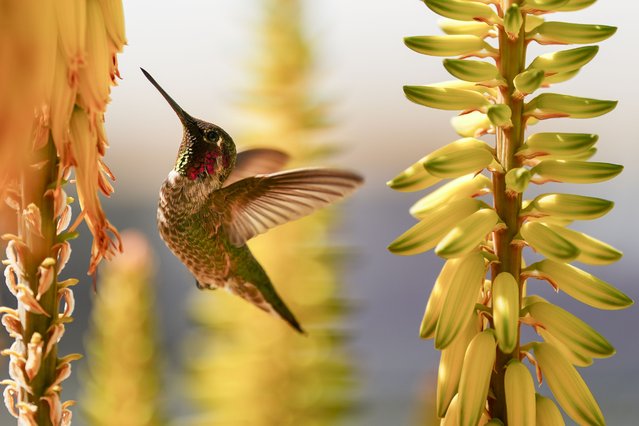
A hummingbird drinks from a flower in a garden on the outfield lawn before a spring training baseball game between the Kansas City Royals and the Athletics, Monday, February 24, 2025, in Surprise, Ariz. (Photo by Lindsey Wasson/AP Photo)

A hummingbird drinks from a flower in a garden on the outfield lawn before a spring training baseball game between the Kansas City Royals and the Athletics, Monday, February 24, 2025, in Surprise, Ariz. (Photo by Lindsey Wasson/AP Photo)
Details
09 Mar 2025 04:05:00
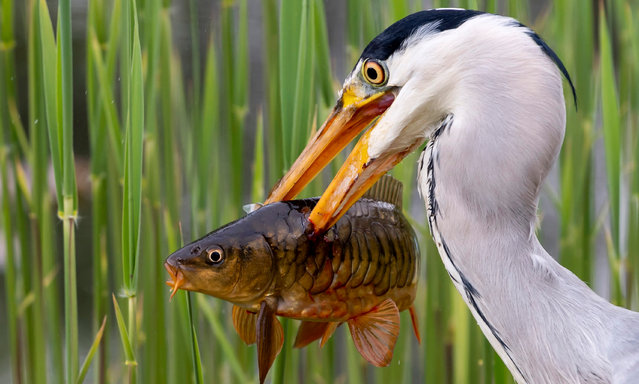
A gray heron (Ardea cinerea) that fished a common carp (Cyprinus carpio) in Geneva, Switzerland, 21 April 2019. (Photo by Martial Trezzini/EPA/EFE/Rex Features/Shutterstock)

A gray heron (Ardea cinerea) that fished a common carp (Cyprinus carpio) in Geneva, Switzerland, 21 April 2019. (Photo by Martial Trezzini/EPA/EFE/Rex Features/Shutterstock)
Details
06 Sep 2020 00:01:00
In a photo taken on November 4, 2020 visitors wearing traditional Korean hanbok dress walk beneath yellow ginko leaves in a courtyard at Gyeongbokgung palace in Seoul. (Photo by Ed Jones/AFP Photo)

In a photo taken on November 4, 2020 visitors wearing traditional Korean hanbok dress walk beneath yellow ginko leaves in a courtyard at Gyeongbokgung palace in Seoul. (Photo by Ed Jones/AFP Photo)
Details
20 Nov 2020 00:05:00
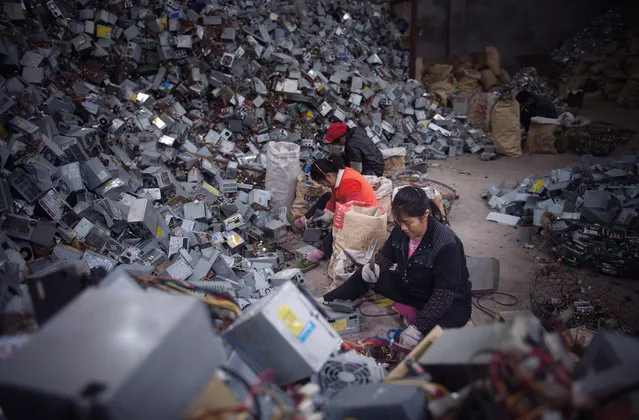
“The sustainable development goals cannot be met unless waste management is addressed as a priority”, says UK waste management charity Waste Aid. “E-waste is one of the fastest growing categories of the 7-10bn tonnes of waste produced globally every year”, adds director Mike Webster. “In our view, decent waste management is a basic right and we want governments around the world take this issue much more seriously – in 2012 only 0.2% of international aid went on improving solid waste management – it’s just not enough”. (Photo by Kai Loeffelbein/laif Agentur)

Sustainable development goal target 12.5 is to reduce waste. But with a planet increasingly dependent on technology, is that even possible? As of today, over 30m tonnes of electronic waste has been thrown out so far this year, according to the World Counts. Most e-waste is sent to landfills in Asia and Africa where it is recycled by hand, exposing the people who do it to environmental hazards. Kai Loeffelbein’s photographs of e-waste recycling in Guiyu, southern China show what happens to discarded computers. (Photo by Kai Loeffelbein/laif Agentur)
Details
19 Oct 2016 12:14:00