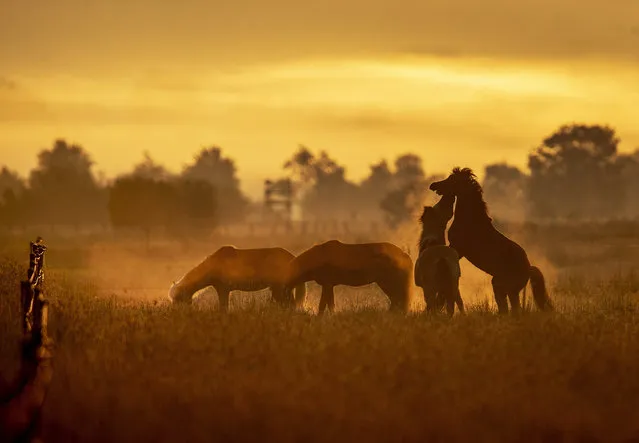
Pilot Robert Johnson, with the Trojan Phlyers Flight Demonstration Team, flies a North American T-28 Trojan above Gary, Indiana, on Thursday, August 8, 2024 ahead of the Chicago Air and Water Show. (Photo by Tess Crowley/Chicago Tribune/Tribune News Service via Getty Images)
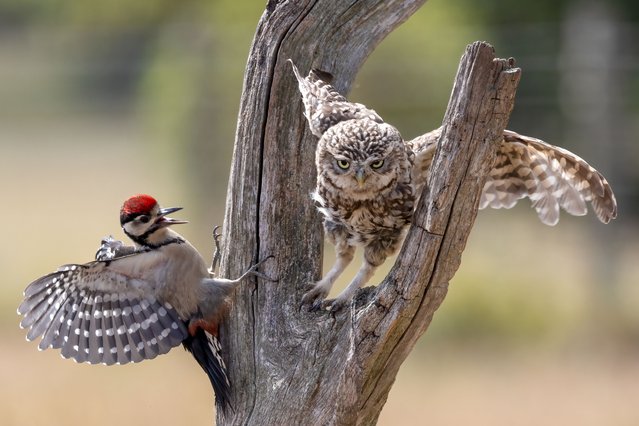
A woodpecker and an owl bicker on a tree branch near Bromsgrove in the West Midlands, UK in the second decade of July 2025. The photographer says the juvenile woodpecker, with a red crown, poked the owl in the eye before flying off. (Photo by Julie Yates/Solent News & Photo Agency)
In more “raccoons are getting more like us” news, a drunk raccoon was found in a liquor store in Virginia, US in the first decade of December 2025. The animal had got into the shop via some loose ceiling tiles, knocked bottles of spirits off the shelves, lapped up the contents and passed out in the toilets. Once it had sobered up, it was released back into the wild – no doubt with a crashing hangover. (Photo by AP Photo)
A woman reacts as she attends Fet Gede, the traditional Haitian Day of the Dead celebration at the Port-au-Prince cemetery, in Haiti, on November 1, 2025. Fet Gede is the annual celebration when practitioners of vodou parade and believe to be possessed by the spirits of the dead. (Photo by Clarens Siffroy/AFP Photo)
Protestors from the Extinction Rebellion march on day six of protests stopping traffic in the city district of Melbourne, Australia on October 12, 2019. (Photo by ydney Low/ZUMA Wire/Rex Features/Shutterstock)
In this July 17, 2015 photo, Michael Chilton squeezes into a corner of his car to make a quick repair to some body panels after he ran into a wall during dirt track racing in the late model division at the Ponderosa Speedway in Junction City, Ky. He banged up the car in the qualifying round and had a few minutes to fix it before the final race. (Photo by David Stephenson/AP Photo)
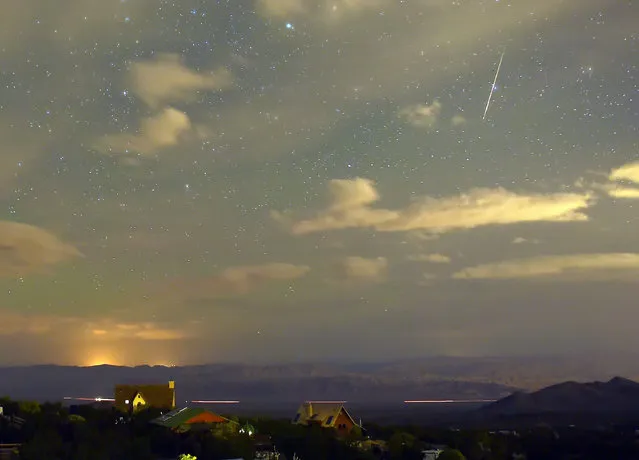
A Perseid meteor streaks across the sky over the community of Cold Creek on August 12, 2015 in the Spring Mountains National Recreation Area, Nevada. The annual display, known as the Perseid shower because the meteors appear to radiate from the constellation Perseus in the northeastern sky, is a result of Earth's orbit passing through debris from the comet Swift-Tuttle. (Photo by Ethan Miller/Getty Images)