Loading...
Done
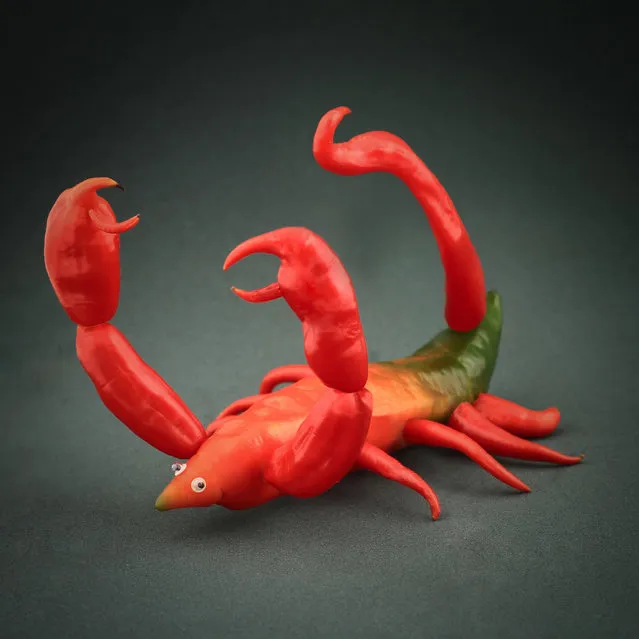
“Red Pepperpion. (Photo by Vanessa Dualib)

“Red Pepperpion. Red Pepperpions are secretive, nocturnal arachilli which can be spotted in kitchens of arid climates all around the world.

Red Pepperpions are equipped with a delicious (and depending on the quantity...deadly!) stinger at the end of its tail. If you happen to get bitten (or if you bite him!) it will produce a burning sensation on your taste nerves.

However, there is no need to worry, since the fact is that his potent stinger is usually only used when hunting or whenever the Pepperpion feels like he might become part of someones meal...

At daylight or when encountering a larger foe, such as a Saucier Chef, they retreat into burrows inside the fridge or hide beneath the oven”. (Photo and comment by Vanessa Dualib)


Details
08 Feb 2013 09:24:00
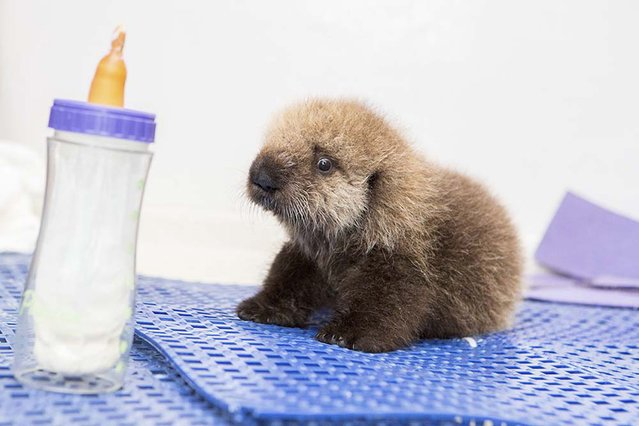
A five-week-old orphaned Southern Sea Otter pup rests on a rubber mat after arriving at the Shedd Aquarium's Abbott Oceanarium in Chicago, Illinois October 28, 2014 in this handout photo provided to Reuters on November 5, 2014. The stranded pup was found on September 30 on Coastways Beach in California and was rescued the next day to be brought back to health at the Monterey Bay Aquarium. (Photo by Brenna Hernandez/Reuters/Shedd Aquarium)

A five-week-old orphaned Southern Sea Otter pup rests on a rubber mat after arriving at the Shedd Aquarium's Abbott Oceanarium in Chicago, Illinois October 28, 2014 in this handout photo provided to Reuters on November 5, 2014. The stranded pup was found on September 30 on Coastways Beach in California and was rescued the next day to be brought back to health at the Monterey Bay Aquarium. Southern sea otters were listed as “threatened” under the U.S. Endangered Species Act in 1977. (Photo by Brenna Hernandez/Reuters/Shedd Aquarium)
Details
08 Nov 2014 13:15:00
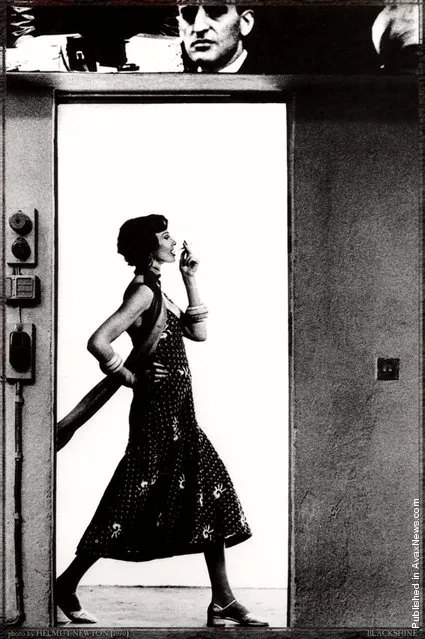
Photographers: Helmut Newton

“Newton was born in Berlin, the son of Klara “Claire” (Marquis) and Max Neustädter, a button factory owner. His family was Jewish. Newton attended the Heinrich-von-Treitschke-Realgymnasium and the American School in Berlin. Interested in photography from the age of 12 when he purchased his first camera, he worked for the German photographer Yva (Elsie Neulander Simon) from 1936. The increasingly oppressive restrictions placed on Jews by the Nuremberg laws meant that his father lost control of the factory in which he manufactured buttons and buckles; he was briefly interned in a concentration camp on “Kristallnacht”, November 9, 1938, which finally compelled the family to leave Germany. Newton's parents fled to South America. He was issued with a passport just after turning 18, and left Germany on December 5, 1938. At Trieste he boarded the “Conte Rosso” (along with about 200 others escaping the Nazis) intending to journey to China. After arriving in Singapore he found he was able to remain there, first and briefly as a photographer for the Straits Times and then as a portrait photographer”. – Wikipedia

Photo: Sigourney Weaver by Helmut Newton, 1995.
Details
08 Apr 2012 13:49:00
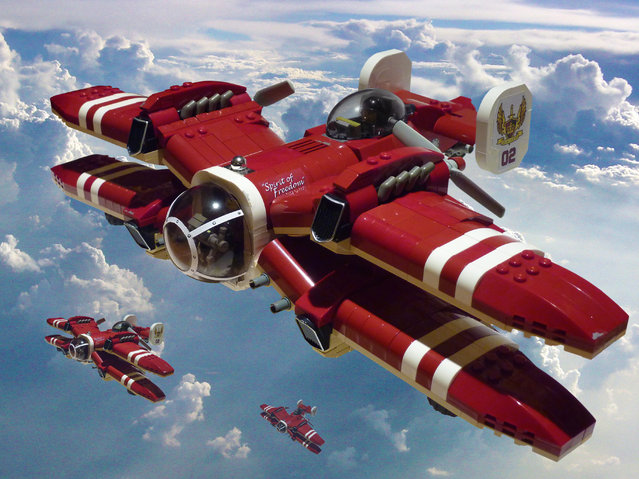
“The V-30 Warhawk was designed by Blackshaw Avionics as a long-range fighter and was primarily used by the Arcadian Air Force for escort duties. . (Jon Hall)

“The V-30 Warhawk was designed by Blackshaw Avionics as a long-range fighter and was primarily used by the Arcadian Air Force for escort duties. The plane pictured is the “Spirit of Freedom” and was one of the four planes that escorted the Arcadian Royal Airship during and after the Great War. The three other fighters were the “Spirit of Hope”, the “Spirit of Justice” and the “Spirit of Destiny”. All pilots were hand-picked by the Head of Airborne Forces and included some of the very finest pilots in the Kingdom. The crew consisted of one pilot and one gunner although both cabins were fitted so that if either crew member was killed the other could take over their duties. Each Warhawk was fitted with four Haverlock “Banshee” engines and four 24mm machine guns”. (Photo and comment by Jon Hall)


Details
11 Feb 2013 10:36:00
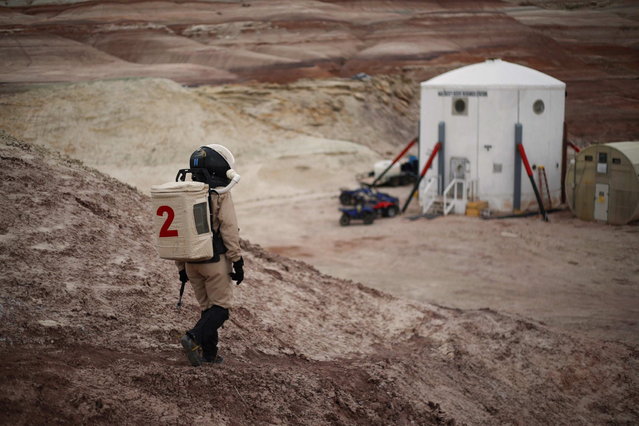
Csilla Orgel, a geologist of Crew 125 EuroMoonMars B mission, makes her way back to the Mars Desert Research Station (MDRS) in the Utah desert March 3, 2013. (Photo by Jim Urquhart/Reuters)

NASA says it could be another 20 years before humans touch down on Mars, but in a sense, the Mars Society has been exploring the red planet for more than a decade – in Utah. Photo: Csilla Orgel, a geologist of Crew 125 EuroMoonMars B mission, makes her way back to the Mars Desert Research Station (MDRS) in the Utah desert March 3, 2013. The MDRS aims to investigate the feasibility of a human exploration of Mars and uses the Utah desert's Mars-like terrain to simulate working conditions on the red planet. Scientists, students and enthusiasts work together developing field tactics and studying the terrain. All outdoor exploration is done wearing simulated spacesuits and carrying air supply packs and crews live together in a small communication base with limited amounts of electricity, food, oxygen and water. Everything needed to survive must be produced, fixed and replaced on site. (Photo by Jim Urquhart/Reuters)
Details
14 Mar 2013 12:11:00
Bisit Badlands, New Mexico. (Photo by Wayne Pinkston/Caters News)

These are the stunning pictures of the night sky brilliantly capturing the lights and colors of the Milky Way glistening over desert landscapes. Taken in various locations across Australia and the United States from the Grand Canyon to the Coral Sea, the pictures perfectly show the bright lights of the starry skies. Here: Bisit Badlands, New Mexico. (Photo by Wayne Pinkston/Caters News)
Details
26 Sep 2015 08:05:00
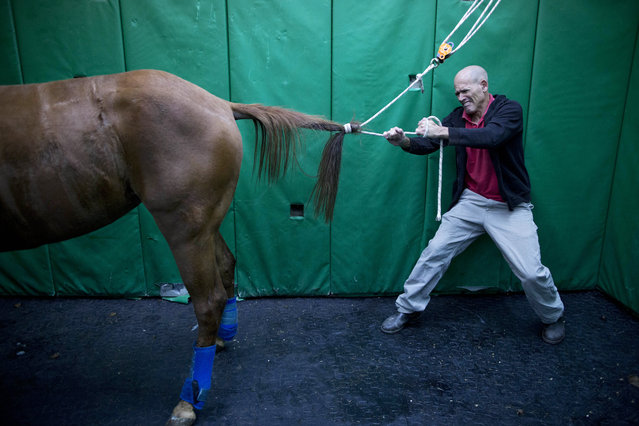
In this Wednesday, December 2, 2015 photo, Dr. Gal Kelmer, head of the department of large animals, unties a horse after its operation at the University's Koret School of Veterinary Medicine in Rishon Lezion, Israel. “Horses have an instinctive response of flight from danger”, Kelmer said. “The minute they wake up they start trying to stand and run, even if they don't have control of their limbs. So then they fall”. (Photo by Oded Balilty/AP Photo)

In this Wednesday, December 2, 2015 photo, Dr. Gal Kelmer, head of the department of large animals, unties a horse after its operation at the University's Koret School of Veterinary Medicine in Rishon Lezion, Israel. “Horses have an instinctive response of flight from danger”, Kelmer said. “The minute they wake up they start trying to stand and run, even if they don't have control of their limbs. So then they fall”. (Photo by Oded Balilty/AP Photo)
Details
15 Dec 2015 08:04:00
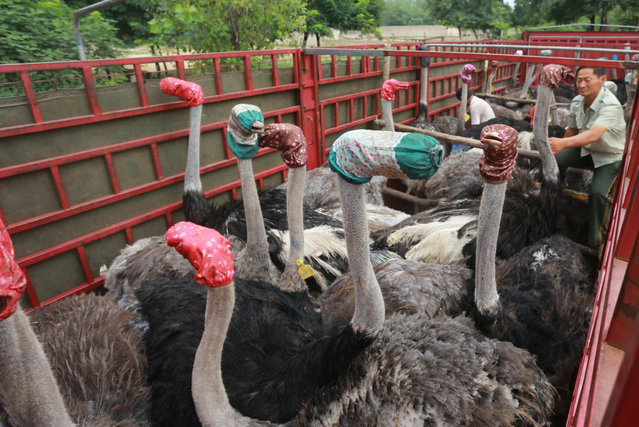
Ostriches wear masks as they are transported by a truck for relocation in Zhengzhou, Henan Province, China, August 8, 2016. (Photo by Reuters/Stringer)

Ostriches wear masks as they are transported by a truck for relocation in Zhengzhou, Henan Province, China, August 8, 2016. (Photo by Reuters/Stringer)
Details
16 Aug 2016 09:35:00