Loading...
Done
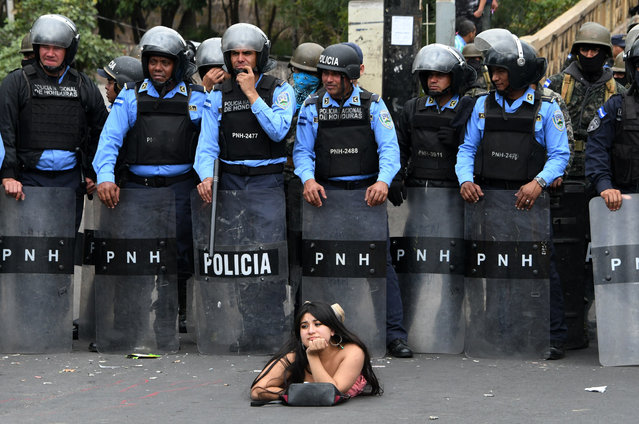
A supporter of the presidential candidate for the Honduran Opposition Alliance Against the Dictatorship for the past election, Salvador Nasralla, lies on the street in front of police officers during a demonstration against the contested re-election of President Juan Orlando Hernandez, in Tegucigalpa, Honduras on January 21, 2018. The opposition called for a “national strike” on Saturday to focus on blocking the country's main roads ahead of the start of the president's new term in office on January 27. Dozens of people have been killed and hundreds jailed since Hernandez was declared the winner of the November 26 run-off election – but only after a three week stretch of often-interrupted ballot counting that stoked tensions and sparked accusations of fraud in the Central American country. (Photo by Orlando Sierra/AFP Photo)

A supporter of the presidential candidate for the Honduran Opposition Alliance Against the Dictatorship for the past election, Salvador Nasralla, lies on the street in front of police officers during a demonstration against the contested re-election of President Juan Orlando Hernandez, in Tegucigalpa, Honduras on January 21, 2018. (Photo by Orlando Sierra/AFP Photo)
Details
23 Jan 2018 08:32:00
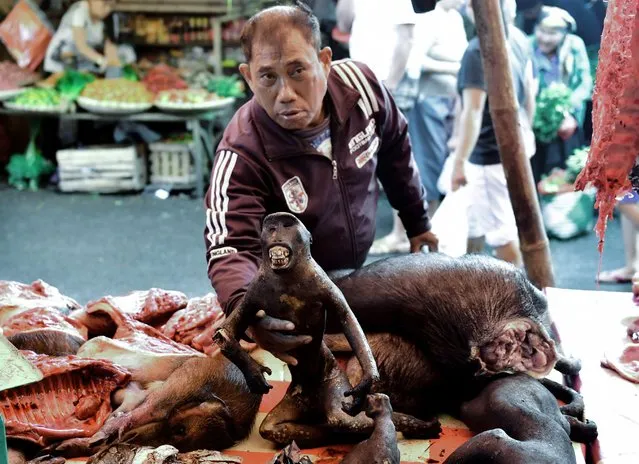
This picture taken on February 18, 2017 shows a customer holding a crested black macaque in Tomohon market in northern Sulawesi, Indonesia. (Photo by Bay Ismoyo/AFP Photo)

This picture taken on February 18, 2017 shows a customer holding a crested black macaque in Tomohon market in northern Sulawesi, Indonesia. Authorities and activists are stepping up efforts to persuade villagers on Sulawesi island to stop consuming the critically endangered crested black macaques, one of many exotic creatures that form part of the local indigenous community' s diet. The macaque' s meat is prized by the ethnic Minahasan people, a largely Christian group in the world' s most populous Muslim- majority country, who have no reservation about eating exotic animals, unlike Indonesia' s Islamic communities. (Photo by Bay Ismoyo/AFP Photo)
Details
04 Apr 2017 10:01:00
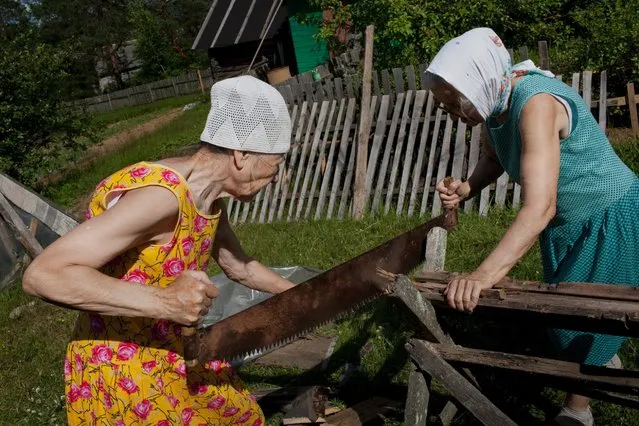
“Two-Handed Saw, 2014”. “Most of the neighbors have switched to power tools to run their households, the buzz of chain saws and weed-whackers overpowering the quieter sounds of country life, but my aunts hold on to the two-handed saw that's decades old, the sickle and scythe that need to be sharpened and polished after each use, the old axe that's becoming heavier each year. Each of these objects is familiar, holding memories of their brother, who succumbed to cancer a few years ago, of days before my grandfather lost his vision in the 50's, of busier days and longer futures”, Sablin told. (Photo by Nadia Sablin)

In northwest Russia, in a small village called Alekhovshchina, Nadia Sablin's aunts spend the warmer months together in the family home and live as the family has always lived, chopping wood to heat the house and making their own clothes. Sablin's book of photographs, “Aunties: The Seven Summers of Alevtina and Ludmila”, is published by Duke University Press. Here: “Two-Handed Saw, 2014”. (Photo by Nadia Sablin)
Details
25 Feb 2016 12:12:00
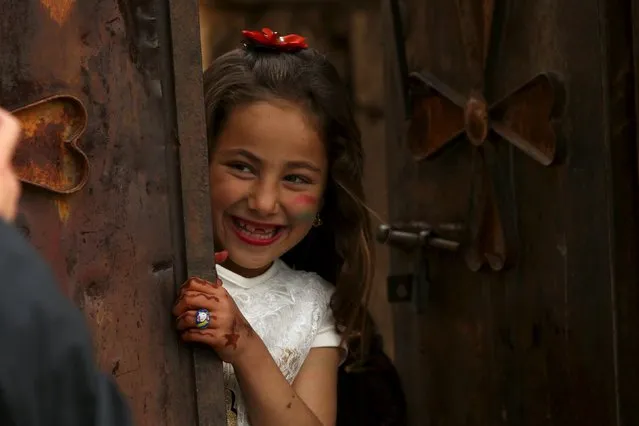
A Kurdish girl celebrates Newroz Day, a festival marking spring and the new year, in Akra, Iraq March 20, 2016. (Photo by Ari Jalal/Reuters)

A Kurdish girl celebrates Newroz Day, a festival marking spring and the new year, in Akra, Iraq March 20, 2016. Nowruz is the name of the Iranian New Year also referred to as Persian New Year which is celebrated worldwide by Iranian peoples, along with some other ethno-linguistic groups. Nowruz is the day of the vernal equinox, and marks the beginning of spring in the Northern Hemisphere. It usually occurs on March 21 or the previous/following day, depending on where it is observed. Although having Persian and religious Zoroastrian origins, Nowruz has been celebrated by people from diverse ethno-linguistic communities for thousands of years. (Photo by Ari Jalal/Reuters)
Details
21 Mar 2016 12:47:00
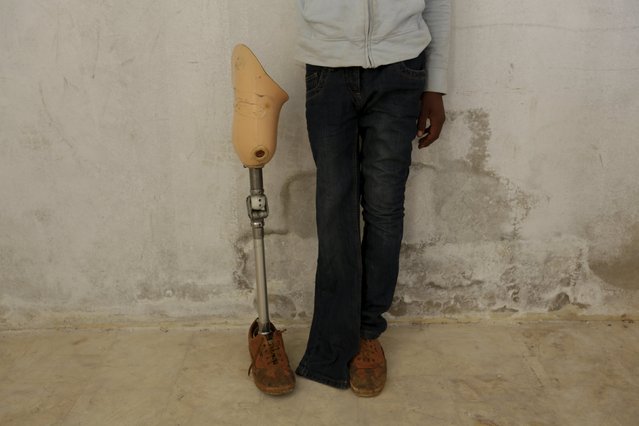
A young man with an amputated leg poses for a photograph standing by his broken artificial limb in the rebel-controlled area of Maaret al-Numan town in Idlib province, Syria March 20, 2016. (Photo by Khalil Ashawi/Reuters)

A young man with an amputated leg poses for a photograph standing by his broken artificial limb in the rebel-controlled area of Maaret al-Numan town in Idlib province, Syria March 20, 2016. Two university students forced to interrupt their studies have learnt to make and fit hundreds of new limbs in the past four years in opposition-held areas of Syria. A mobile clinic operating from a truck has gone some way to improve access to treatment. While most patients are between 15 and 45, the clinic also helps children and the elderly with replacement limbs. (Photo by Khalil Ashawi/Reuters)
Details
16 Apr 2016 12:03:00
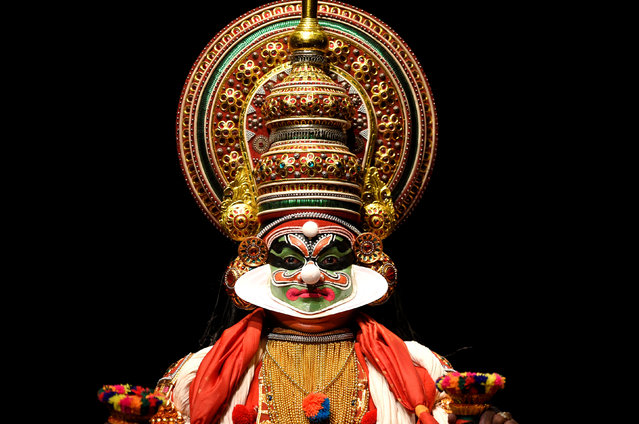
A member of the Indian company Margi Kathakali theatre performs during “Kijote Kathakali”, a Kathakali recital based on the Spanish classic “Don Quixote”, at the Niemeyer Center in Aviles, northern Spain, July 29, 2016. The performance and text captured the essence of the novel while sticking to the format of Kathakali. Kathakali is one of the major forms of classical Indian dance. It is another “story play” genre of art, but one distinguished by its elaborately colorful make-up, costumes and face masks wearing actor-dancers, who have traditionally been all males. (Photo by Eloy Alonso/Reuters)

A member of the Indian company Margi Kathakali theatre performs during “Kijote Kathakali”, a Kathakali recital based on the Spanish classic “Don Quixote”, at the Niemeyer Center in Aviles, northern Spain, July 29, 2016. The performance and text captured the essence of the novel while sticking to the format of Kathakali. Kathakali is one of the major forms of classical Indian dance. (Photo by Eloy Alonso/Reuters)
Details
31 Jul 2016 11:02:00
Brtukan. “Being a girl of colour in a society where the majority of the people are white, I have had to get used to all the different ways people approach me. From being asked what kind of rap music you listen to and how you wash your hair, to getting told, “you don’t sound black”, “you’re pretty for a black girl” or “you’re not that black so it’s OK”, as if being black is such a bad thing”. (Photo by Lisa Minogue/The Guardian)

As part of FLAIR Melbourne – a Flinders Lane art festival – Melbourne’s Lisa Minogue presents stylised photographic portraits of Australian women of colour, their faces painted vibrantly to accentuate their individuality and encourage the viewer to study each face more closely. Minogue asked each woman the same question: “What do the words “coloured girl” mean to you?”. (Photo by Lisa Minogue/The Guardian)
Details
17 Aug 2016 11:16:00
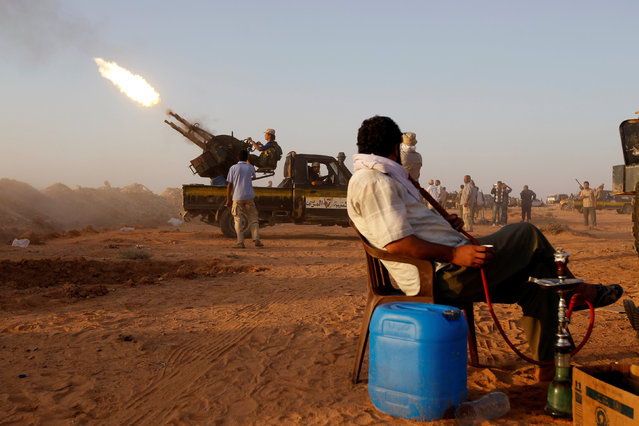
An anti-Gaddafi fighter tests an anti-aircraft gun southwest of Sirte, Libya one of Muammar Gaddafi's last remaining strongholds, September 16, 2011. (Photo by Goran Tomasevic/Reuters)

An anti-Gaddafi fighter tests an anti-aircraft gun southwest of Sirte, Libya one of Muammar Gaddafi's last remaining strongholds, September 16, 2011. A timeline of images dating from 2010 from Sirte, Libya, the home town of deposed Libyan leader Muammar Gaddafi. Libyan forces battling Islamic State in the city of Sirte say they have defeated the militant group after months of street to street fighting backed by U.S. air strikes. Islamic State took control of the city more than a year ago and set up its main base outside Syria and Iraq. (Photo by Goran Tomasevic/Reuters)
Details
06 Dec 2016 10:43:00