Loading...
Done
The Red Arrows make a flypast during the Trooping The Colour parade at Buckingham Palace, in London, Saturday, June 13, 2015. Hundreds of soldiers in ceremonial dress have marched in London in the annual Trooping the Color parade to mark the official birthday of Queen Elizabeth II. The Trooping the Color tradition originates from preparations for battle, when flags were carried or "trooped" down the rank for soldiers to see. (AP Photo/Tim Ireland)

The Red Arrows make a flypast during the Trooping The Colour parade at Buckingham Palace, in London, Saturday, June 13, 2015. Hundreds of soldiers in ceremonial dress have marched in London in the annual Trooping the Color parade to mark the official birthday of Queen Elizabeth II. The Trooping the Color tradition originates from preparations for battle, when flags were carried or "trooped" down the rank for soldiers to see. (AP Photo/Tim Ireland)

Details
17 Jun 2015 13:50:00
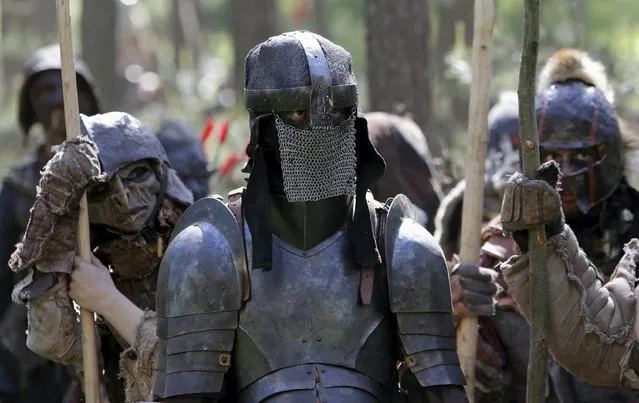
Participants re-enact the “Battle of Five Armies” from J.R.R. Tolkien's novel “The Hobbit” in a forest near the town of Doksy, Czech Republic June 6, 2015. According to event organizers, hundreds of enthusiasts dressed as characters such as elves, dwarves, goblins and orcs from the book “The Hobbit” re-enacted the clash. (Photo by David W. Cerny/Reuters)

Participants re-enact the “Battle of Five Armies” from J.R.R. Tolkien's novel “The Hobbit” in a forest near the town of Doksy, Czech Republic June 6, 2015. According to event organizers, hundreds of enthusiasts dressed as characters such as elves, dwarves, goblins and orcs from the book “The Hobbit” re-enacted the clash. (Photo by David W. Cerny/Reuters)
Details
10 Jul 2015 11:33:00
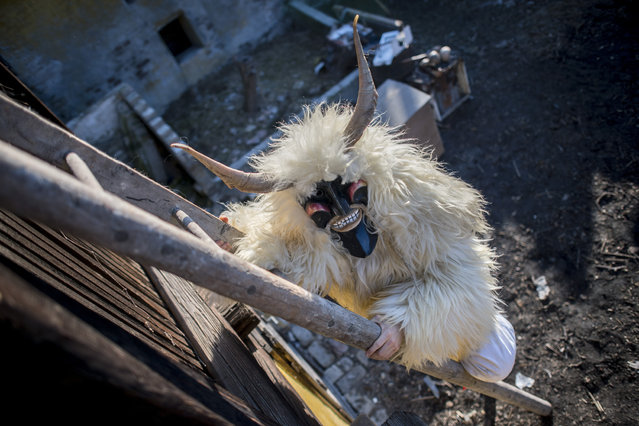
A man wears a busho mask and a costume made of sheep pelt while climbing up a ladder outside a barn in Mohacs, Hungary, 20 February 2020, on the first day of carnival. The traditional Busho carnival, which marks the end of winter, dates back to the 16th century. According to local legend, members of an ethnic South Slavic group living in Mohacs at the time dressed up in similar costumes and wore wooden masks to scare away Ottoman invaders, who mistook them for demons. (Photo by Tamas Soki/EPA/EFE)

A man wears a busho mask and a costume made of sheep pelt while climbing up a ladder outside a barn in Mohacs, Hungary, 20 February 2020, on the first day of carnival. The traditional Busho carnival, which marks the end of winter, dates back to the 16th century. According to local legend, members of an ethnic South Slavic group living in Mohacs at the time dressed up in similar costumes and wore wooden masks to scare away Ottoman invaders, who mistook them for demons. (Photo by Tamas Soki/EPA/EFE)
Details
23 Feb 2020 00:07:00
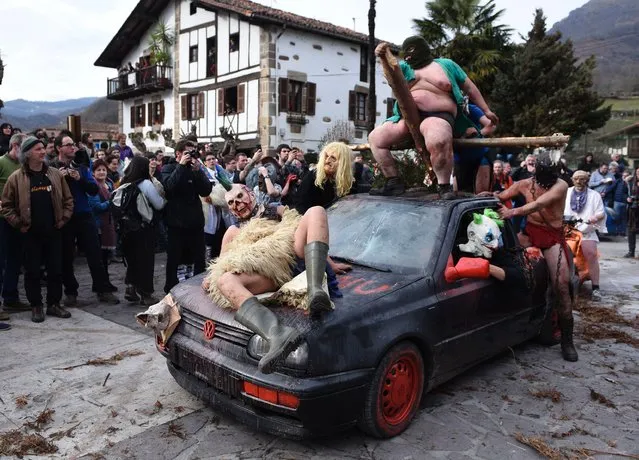
Disguised participants strike poses on a car during the ancient carnival of Ituren, in the northern Spanish Navarra province on January 30, 2017. The yearly three day festivities, revolving mainly around agriculture and principally sheep hearding, run on the last Sunday, Monday and Tuesday of January where Navarra Valley locals from two villages dress up and participate in a variety of activites as they perform a pilgrimage through each village. (Photo by Ander Gillenea/AFP Photo)

Disguised participants strike poses on a car during the ancient carnival of Ituren, in the northern Spanish Navarra province on January 30, 2017. The yearly three day festivities, revolving mainly around agriculture and principally sheep hearding, run on the last Sunday, Monday and Tuesday of January where Navarra Valley locals from two villages dress up and participate in a variety of activites as they perform a pilgrimage through each village. (Photo by Ander Gillenea/AFP Photo)
Details
31 Jan 2017 10:00:00
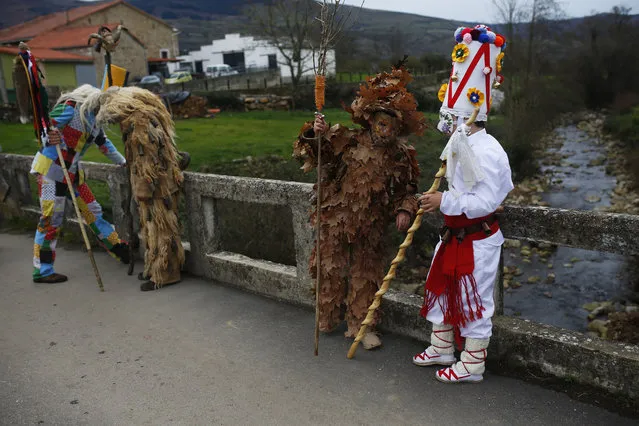
People dressed in costumes have a break while marching during the Vijanera Festival, in the small village of Silio, northern Spain, Sunday, January 3, 2016. The Vijanera masquerade, of pre-Roman origin, is the first carnival of the year in Europe symbolizing the triumph of good over evil and involving the participation of crowds of residents wearing different masks, animal skins and brightly coloured clothing with its own complex function and symbolism and becoming the living example of the survival of archaic cults to nature. (Photo by Francisco Seco/AP Photo)

People dressed in costumes have a break while marching during the Vijanera Festival, in the small village of Silio, northern Spain, Sunday, January 3, 2016. The Vijanera masquerade, of pre-Roman origin, is the first carnival of the year in Europe symbolizing the triumph of good over evil and involving the participation of crowds of residents wearing different masks, animal skins and brightly coloured clothing with its own complex function and symbolism and becoming the living example of the survival of archaic cults to nature. (Photo by Francisco Seco/AP Photo)
Details
04 Jan 2016 10:17:00
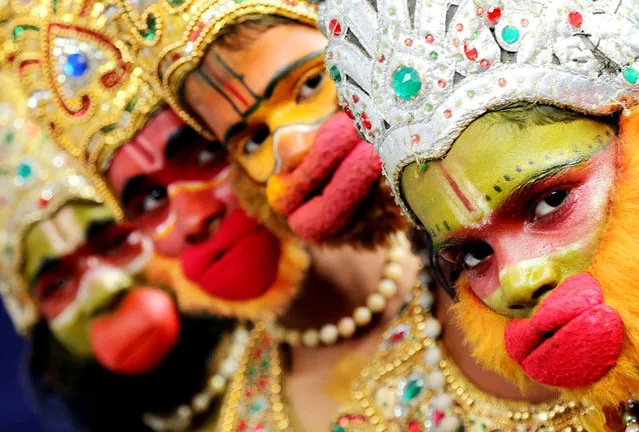
Indian School children's in a traditational attire of a characters of Indian epic Ramayan, on the eve of children's day celebration at cubbon park, in Bangalore, India, 13 November 2016. Children's day (also known as Bal Divas), in India is celebrated every year on 14th of November to increase the awareness of people towards the rights, care, and education of children. Many schools hold activities and allow students to have fun and attend their classes in coloured dresses. (Photo by Jagadeesh N.V./EPA)

Indian School children's in a traditational attire of a characters of Indian epic Ramayan, on the eve of children's day celebration at cubbon park, in Bangalore, India, 13 November 2016. Children's day (also known as Bal Divas), in India is celebrated every year on 14th of November to increase the awareness of people towards the rights, care, and education of children. Many schools hold activities and allow students to have fun and attend their classes in coloured dresses. (Photo by Jagadeesh N.V./EPA)
Details
14 Nov 2016 10:12:00
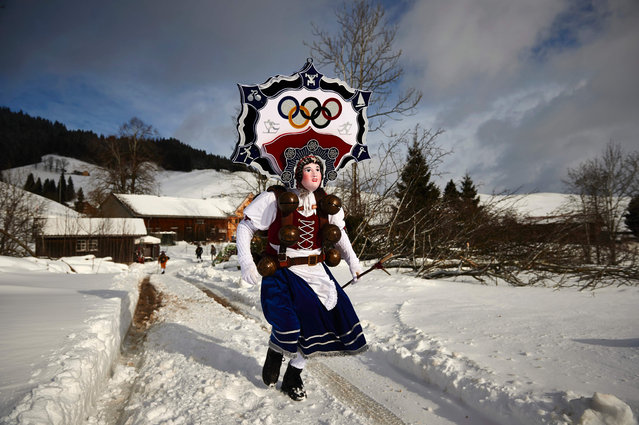
A leader “Rolli” of a yodel group “Schuppel” runs in the snow in front of a farmstead during the “Silvesterchlausen” in the early morning in Urnaesch in the Swiss canton Appenzell Ausserroden on January 13, 2017. The “Silvesterchlausen” is a tradition of the Swiss canton Appenzell, where colorfull characters organized in groups called “Schuppel”, chase out the old year and welcome the new one. They run all day long from farmstead to farmstead, gather together to sing a jodel and great the farmers. A “Schuppel” consists of some “Schelli” and two “Rolli”, sometimes with female dresses and nice scenes over the head, despite the dress all participants are males. The Silversterchlausen run twice a year, first for the new Silvester on December 31, and then again on January 13, for the old Silvester following the Julian calendar. (Photo by Michael Buholzer/AFP Photo)

A leader “Rolli” of a yodel group “Schuppel” runs in the snow in front of a farmstead during the “Silvesterchlausen” in the early morning in Urnaesch in the Swiss canton Appenzell Ausserroden on January 13, 2017. (Photo by Michael Buholzer/AFP Photo)
Details
14 Jan 2017 12:41:00
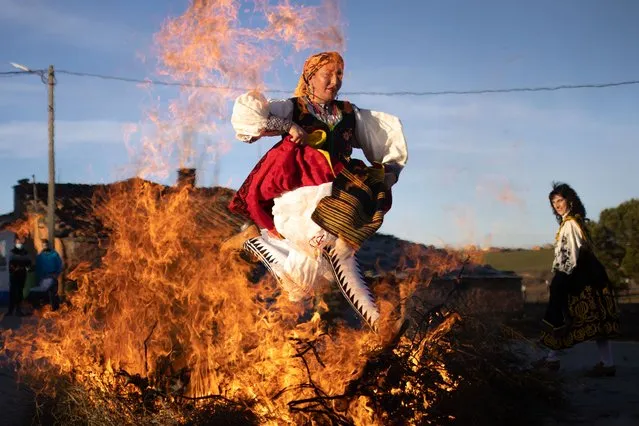
A woman dressed in traditional costumes jumps over a bonfire to commemorate the day of Santa Agueda in Andavias, Spain, on February 6, 2022. In the province of Zamora it is quite a tradition, the women take over the city and the towns to gain control in the province, the councils give them the batons as a sign of authority, they celebrate around 7 days of festivity where they dance, eat, live the festival and honor Santa Agueda. (Photo by Manuel Balles/ZUMA Press Wire/Rex Features/Shutterstock)

A woman dressed in traditional costumes jumps over a bonfire to commemorate the day of Santa Agueda in Andavias, Spain, on February 6, 2022. In the province of Zamora it is quite a tradition, the women take over the city and the towns to gain control in the province, the councils give them the batons as a sign of authority, they celebrate around 7 days of festivity where they dance, eat, live the festival and honor Santa Agueda. (Photo by Manuel Balles/ZUMA Press Wire/Rex Features/Shutterstock)
Details
07 Feb 2022 07:38:00