Loading...
Done
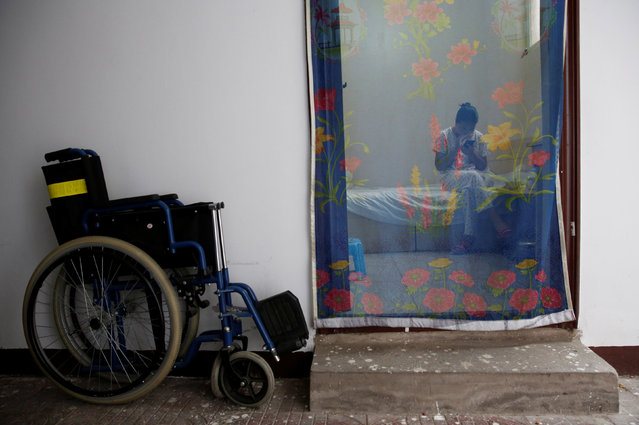
Wang uses a mobile phone as she take a rest in her room at the accommodation where patients and their family members stay while seeking medical treatments in Beijing, China, June 23, 2016. Wang, who suffers from cervical cancer, came from Inner Mongolia to seek treatment at a specialist hospital in Beijing. (Photo by Kim Kyung-Hoon/Reuters)

Wang uses a mobile phone as she take a rest in her room at the accommodation where patients and their family members stay while seeking medical treatments in Beijing, China, June 23, 2016. Wang, who suffers from cervical cancer, came from Inner Mongolia to seek treatment at a specialist hospital in Beijing. (Photo by Kim Kyung-Hoon/Reuters)
Details
30 Sep 2016 09:03:00
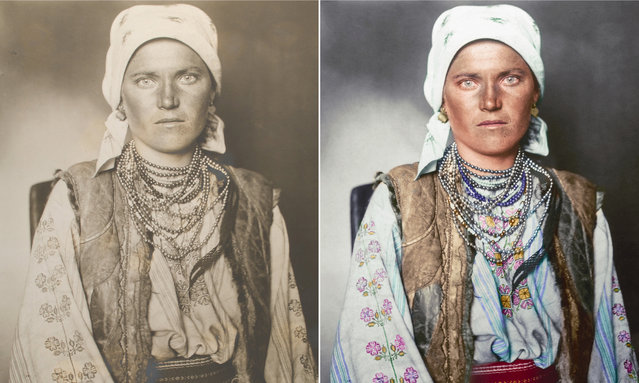
A Ruthenian woman circa 1906 from the region historically inhabiting the kingdom of the Rus, incorporating parts of modern-day Slavic speaking countries. Her outfit consists of a shirt and underskirt made from linen embroidered with traditional floral-based patterns. (Photo by Augustus Francis Sherman/New York Public Library/The Guardian)

Many of the 12 million people who entered the US through New York’s Ellis Island wore traditional dress from their homelands. Here: A Ruthenian woman circa 1906 from the region historically inhabiting the kingdom of the Rus, incorporating parts of modern-day Slavic speaking countries. Her outfit consists of a shirt and underskirt made from linen embroidered with traditional floral-based patterns. (Photo by Augustus Francis Sherman/New York Public Library/The Guardian)
Details
03 Oct 2016 09:15:00
For her series “Japanese Whispers”, Belgian photographer Zaza Bertrand headed inside the intimate world of rabuhos – Japanese love hotels. Love hotels became popular in Japan from the 1960s onwards, due to a lack of privacy in many family homes. There are now around 37,000 of these hotels in Japan, allowing short daytime “rests” or overnight stays. (Photo by Zaza Bertrand/The Guardian)

For her series “Japanese Whispers”, Belgian photographer Zaza Bertrand headed inside the intimate world of rabuhos – Japanese love hotels. Love hotels became popular in Japan from the 1960s onwards, due to a lack of privacy in many family homes. There are now around 37,000 of these hotels in Japan, allowing short daytime “rests” or overnight stays. (Photo by Zaza Bertrand/The Guardian)
Details
02 Dec 2016 11:30:00
Cristine Angelie Garcia (C), 24, rides a jeepney on her way to work at a call centre for the midnight shift in Taguig city, Metro Manila, Philippines October 3, 2016. “Maybe there is another way where people do not need to die”, she said, adding she felt safer walking the streets at night. “I'm on Duterte's side. Maybe he's just misunderstood because he grew up on the streets”. (Photo by Ezra Acayan/Reuters)

Cristine Angelie Garcia (C), 24, rides a jeepney on her way to work at a call centre for the midnight shift in Taguig city, Metro Manila, Philippines October 3, 2016. “Maybe there is another way where people do not need to die”, she said, adding she felt safer walking the streets at night. “I'm on Duterte's side. Maybe he's just misunderstood because he grew up on the streets”. (Photo by Ezra Acayan/Reuters)
Details
29 Dec 2016 07:48:00
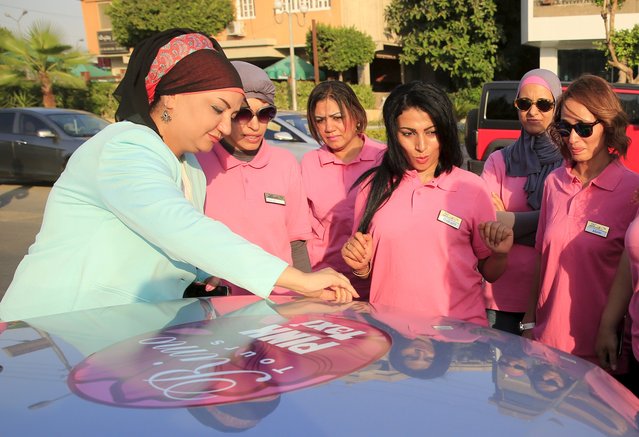
Reem Fawzy (L), the director of the Pink Taxi company, stands with her drivers in a parking lot in Cairo, Egypt, September 6, 2015. (Photo by Amr Abdallah Dalsh/Reuters)

Reem Fawzy (L), the director of the Pink Taxi company, stands with her drivers in a parking lot in Cairo, Egypt, September 6, 2015. Pink uniforms, a pink logo on the cars, and even pink nail polish – it's all part of the look of women-drivers working for Egypt's first women-only taxi service. The Pink Taxi company hires only women drivers and gives rides to only female passengers. The company was started in an effort to provide a safe taxi service for women in a country with high rates of sexual harassment, said Reem Fawzy, the director of the company. (Photo by Amr Abdallah Dalsh/Reuters)
Details
09 Sep 2015 12:28:00
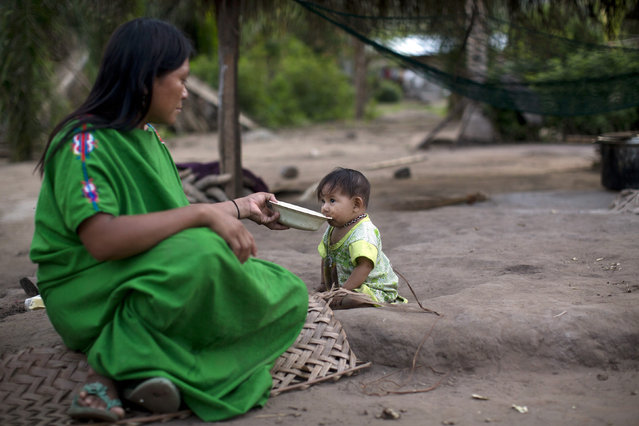
In this November 19, 2015 photo, Ester Melendez feeds banana porridge to her nine-month-old daughter Dina, in Pichiquia, an Ashaninka indigenous community in Peru's Junin region. Incursions and assaults by loggers, miners, colonists and leftist guerrillas have reduced the lands of the Ashaninka people in the Peruvian Amazon, leaving many of the 97,000 members of the group malnourished, despite efforts by the government and independent organizations to help. (Photo by Rodrigo Abd/AP Photo)

In this November 19, 2015 photo, Ester Melendez feeds banana porridge to her nine-month-old daughter Dina, in Pichiquia, an Ashaninka indigenous community in Peru's Junin region. Incursions and assaults by loggers, miners, colonists and leftist guerrillas have reduced the lands of the Ashaninka people in the Peruvian Amazon, leaving many of the 97,000 members of the group malnourished, despite efforts by the government and independent organizations to help. (Photo by Rodrigo Abd/AP Photo)
Details
10 Dec 2015 08:00:00
Nepal's Kumari, or living goddess, adjusts her ornament as she watches the Rato Machindranath chariot Festival in Lalitpur, Nepal, Friday, April 24, 2015. Nepal's living goddesses are young pre-pubescent girls considered by devotees to be incarnations of a Hindu goddess. Selected as toddlers, living goddesses usually keep their positions until they reach puberty. (Photo by Niranjan Shrestha/AP Photo)

Nepal's Kumari, or living goddess, adjusts her ornament as she watches the Rato Machindranath chariot Festival in Lalitpur, Nepal, Friday, April 24, 2015. Nepal's living goddesses are young pre-pubescent girls considered by devotees to be incarnations of a Hindu goddess. Selected as toddlers, living goddesses usually keep their positions until they reach puberty. (Photo by Niranjan Shrestha/AP Photo)
Details
25 Apr 2015 10:05:00
Afghan artists perform a re-enactment of the lynching of Farkhunda, a 27-year old woman, to protest against her killing in Kabul, April 27, 2015. (Photo by Omar Sobhani/Reuters)

Afghan artists perform a re-enactment of the lynching of Farkhunda, a 27-year old woman, to protest against her killing in Kabul, April 27, 2015. Farkhunda, who was killed by an angry mob in front of police in the Afghan capital in March for allegedly burning a copy of Islam's holy book was wrongly accused, Afghanistan's top criminal investigator said on March 22. The killing has fuelled anger about the weak rule of law and corruption that is crippling the country's instutitions. (Photo by Omar Sobhani/Reuters)
Details
28 Apr 2015 13:39:00